Skip to content

IGCSE Physics · November 2025 · Paper 33 · Difficulty 3 · Standard

Question 5

5
(a)

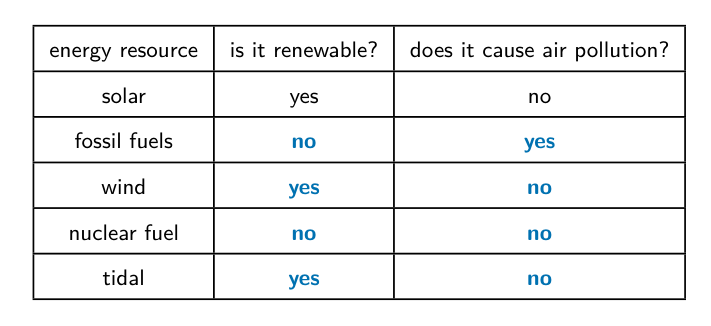
Table 5.1 shows whether some energy resources are renewable and whether they cause air pollution when being used to generate electrical power.

For each energy resource, complete Table 5.1 by writing yes or no in each space. The solar energy resource has been done for you.

Table 5.1

energy resourceis it renewable?does it cause air pollution?
solaryesno
fossil fuels
wind
nuclear fuel
tidal

[4]

(b)

A solar cell is one way of using the solar energy resource.

Solar cells use visible light from the Sun to generate electrical power.

(i)

State the property that allows visible light to travel through space from the Sun to a solar cell.

[1]

(ii)

A frequency of visible light for a solar cell is $6.0 \times 10^{14} \text{Hz}$.

The speed of visible light is $3.0 \times 10^{8} \text{m/s}$.

Calculate the wavelength of this visible light.

wavelength = m[3]

(c)

State one region of the electromagnetic spectrum which has a frequency lower than that of visible light. Describe a use of this region.

region

use of the region [2]

[Total: 10]
Show the mark scheme

These are the official mark-scheme rows. Each point that matches your answer earns a mark.

Tap the mark scheme to open it full size.

Show a worked answer

How to reach each mark, step by step. Try the question yourself first.

5(a)

  • Fossil fuels: renewable No; air pollution Yes. Supplies are limited, and burning them releases polluting gases.
  • Wind: renewable Yes; air pollution No. Wind is naturally replaced, and no fuel is burned during generation.
  • Nuclear fuel: renewable No; air pollution No. The fuel is limited, but it is not burned to generate electricity.
  • Tidal: renewable Yes; air pollution No. Tides keep occurring, and no fuel is burned during generation.
Worked answer drawing

5(b)(i)

  • Visible light can travel through a vacuum; it does not need a material medium.

5(b)(ii)

  • Use the wave equation $v = f\lambda$, so $\lambda = v/f$.
  • $\lambda = \frac{3.0\times10^8\,\mathrm{m/s}}{6.0\times10^{14}\,\mathrm{Hz}} = \mathbf{5.0\times10^{-7}}\,\mathrm{m}$.

5(c)

  • Infrared has a lower frequency than visible light.
  • Infrared is used in thermal imaging cameras to detect radiation from warm objects and show temperature differences.
Original question

Log in or create account

IGCSE, A-Level & AP