Chinese course / HSK6 handouts
Particles
Printable paper with separate answer pages Step-by-step lessons
Original teaching practice. Read one pattern, cover its model and try the questions before checking the separate answer section. Examples adapted from Chinese Grammar Wiki (AllSet Learning, CC BY-NC-SA) retain the course-reference provenance.
whether (or not)是否 (whether or not)
An application form
- The form asks a yes-or-no question about your previous applications.
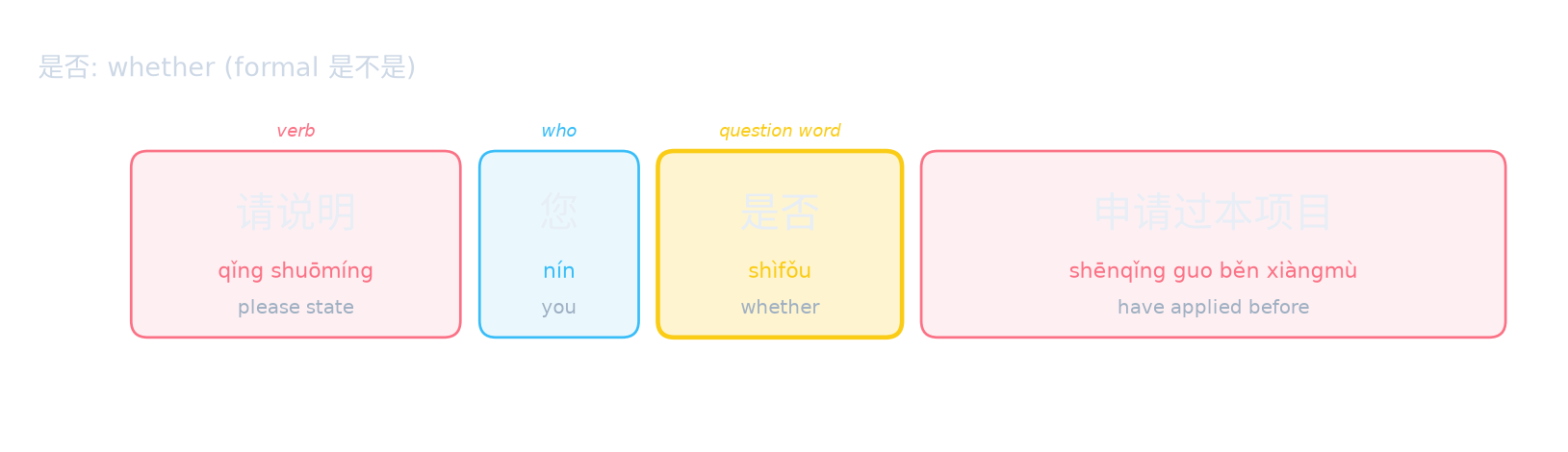
- to ask请to explain说明you (polite)您whether (or not)是否to apply for sth申请过本item项目。 – "Please state whether you have applied for this programme before."
whether (or not)是否 + verb = whether or not
- whether (or not)是否 = "whether (or not)", the formal form of is or isn't是不是: whether (or not)是否to agree同意, whether (or not)是否to participate参加, whether (or not)是否to need需要.
- It goes before the verb or adjective.
please请tell告诉us我们you您whether是否will attend参加。
Questions and embedded questions
- Direct: you (polite)您whether (or not)是否to agree同意this这个plan方案? – "Do you agree with this proposal?"
- Embedded: I / me我not不to know知道he / him他whether (or not)是否can / will会to come来。 – "I don't know whether he'll come."
I我don't不know知道he他whether是否will会come来。
No (yes/no ?)吗, no second negative
- whether (or not)是否 already makes it a question: you (polite)您whether (or not)是否to agree同意?, not you (polite)您whether (or not)是否to agree同意(yes/no ?)吗?
- Do not add not不 after it: whether (or not)是否to agree同意, not whether (or not)是否not不to agree同意 (unless you really mean "whether you disagree").
whether (or not)是否 versus is or isn't是不是 and whether or not能否
- is or isn't是不是 is the spoken form: you你is or isn't是不是rope累(completed / change)了?
- whether or not能否 = whether (one) can, also formal: whether or not能否on time按时to complete完成still / also还not不definite确定.
whether we can能否on time按时finish完成still还not不certain确定。
Recap
- whether (or not)是否 + verb = whether (or not) (formal is or isn't是不是); no (yes/no ?)吗 with it.
- whether or not能否 = whether one can.
Practise this pattern step by step.
… whether or not (at the end…与否 (whether … or not)
Success depends on it
- A coach explains what really decides a match.
- competition (sports etc)比赛success成功whether or not (at the end…与否,to hinge on取决于ordinarily平时(modifier / structural particle)的to train训练。 – "Whether the match succeeds or not depends on everyday training."
Verb / Adj + whether or not (at the end…与否 = whether … or not
- X whether or not (at the end…与否 = whether X or not, placed after the word: success成功whether or not (at the end…与否, to agree同意whether or not (at the end…与否, suitable合适whether or not (at the end…与否.
- It is formal and usually works as a topic or object.
agree同意or not与否,please请soon尽快reply回复。

With to hinge on取决于, variant of 关系关系to / arrive到, not to be concerned不管
- method方法correct正确whether or not (at the end…与否,variant of 关系关系to / arrive到outcome结果。 – "Whether the method is correct affects the result."
- not to be concerned不管you你to like喜欢whether or not (at the end…与否,all / both都want / will / need要to complete完成。 – "Whether you like it or not, you have to finish."
regardless of不管you你like it喜欢or not与否,still都must要finish完成。
Two-syllable words, formal style
- whether or not (at the end…与否 follows the predicate or issue being considered. Two-syllable examples are common, but syllable count alone does not decide whether the phrase is grammatical.
- In speech, use A-not-A: to succeed成not不success成功 / 喜不喜欢.
whether or not (at the end…与否 versus whether (or not)是否
- whether (or not)是否 goes before the verb: whether (or not)是否success成功.
- whether or not (at the end…与否 goes after it: success成功whether or not (at the end…与否. Both mean "whether or not"; whether or not (at the end…与否 often makes a noun-like topic.
whether是否succeed成功still还not不known知道。
Recap
- X whether or not (at the end…与否 = whether X or not, following the predicate or issue; common in formal topics.
- whether (or not)是否 goes before the verb; speech uses A-not-A.
Practise this pattern step by step.
Noun + (of — literary)之 + Noun (a literary (modifier / structural particle)的)
A literary title
- You see a museum banner introducing a famous city.
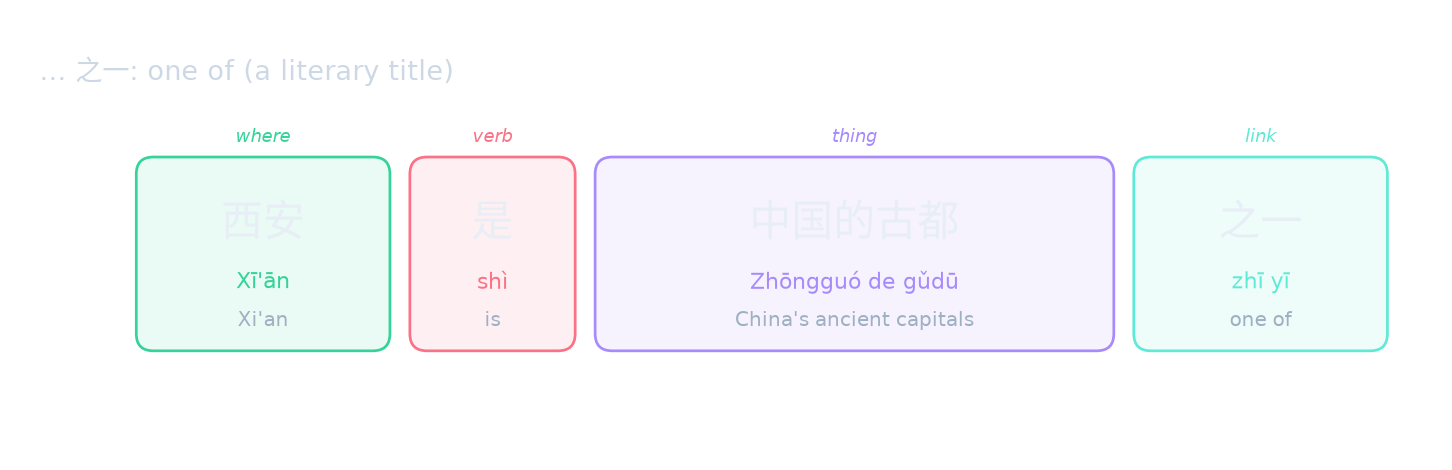
- Xi'an, sub-provincial city…西安to be / is是China中国(modifier / structural particle)的ancient capital古都one of (sth)之一,to have / there is有"world世界the four elements: earth…四大ancient capital古都one of (sth)之一"之称。 – "Xi'an is one of China's ancient capitals and is called one of the world's four great ancient capitals."
Noun + (of — literary)之 + Noun = a literary (modifier / structural particle)的
- (of — literary)之 links a modifier to a noun in formal or classical style: 中国之最 (China's greatest), 成功之路 (the road to success).
- It appears in fixed phrases and titles more than in everyday speech.
success成功of之the road路。
Fixed phrases you'll meet
- one of (sth)之一 = one of; (after a noun) between之间 = between; before之前 / after之后 = before / after; (after a noun N and before…之所以 = the reason why.
- cause原因one of (sth)之一 – "one of the reasons"; friend朋友(after a noun) between之间 – "between friends".
friends朋友between之间should要each other互相help帮助。
Written style
- Do not replace every (modifier / structural particle)的 with (of — literary)之 in speech; 我之书 sounds archaic. Say I / me我(modifier / structural particle)的book书.
- (of — literary)之 often sits between two-syllable words or in four-character set phrases: the whole year must be…一年之计在于春.
(of — literary)之 versus (modifier / structural particle)的
- (modifier / structural particle)的 is the everyday link: China中国(modifier / structural particle)的capital (city)首都.
- (of — literary)之 is the literary one, kept in titles and set phrases: China中国之窗 – "Window on China".
the year's一年of之plan计lies in在于spring春。
Recap
- Noun + (of — literary)之 + Noun = literary (modifier / structural particle)的, in titles and set phrases.
- Fixed: one of (sth)之一, (after a noun) between之间, before之前, after之后; everyday speech uses (modifier / structural particle)的.
Practise this pattern step by step.
Statement + (obviously)嘛 (self-evident)
Of course it's crowded
- Your friend complains about the crowds at the shopping mall on a Saturday.
- weekend周末(obviously)嘛,person人of course当然many多。 – "Well, it's the weekend – of course it's crowded."
Statement + (obviously)嘛 = it's obvious
- (obviously)嘛 at the end of a statement presents it as obvious, a reason the listener should accept.
- It can also follow a topic before the comment: weekend周末(obviously)嘛,….
he他is是new新arrived来的(after all)嘛,not不familiar熟悉very很normal正常。

Explaining and gentle urging
- Explaining: handwork手工to make做(modifier / structural particle)的(obviously)嘛,expensive贵erhua variant of 一点一点儿degree / adjective linker很regular正常。 – "It's handmade, after all – of course it's a bit pricey."
- Urging: erhua variant of 快点快点儿(obviously)嘛! – "Come on, hurry up!" (softly insistent)
by hand手工made做的(after all)嘛,expensive贵a bit一点儿very很normal正常。
(obviously)嘛 is not (yes/no ?)吗
- (yes/no ?)吗 asks a yes/no question; (obviously)嘛 states something obvious. you你to know知道(yes/no ?)吗? asks; you你to know知道(obviously)嘛 means "you know that, obviously".
- (obviously)嘛 is casual; leave it out of formal writing.
(obviously)嘛 versus (suggestion)吧 and modal particle indicating…呗
- (suggestion)吧 suggests or guesses: to walk走(suggestion)吧 / he / him他to be / is是teacher老师(suggestion)吧?
- modal particle indicating…呗 shrugs: "that's all there is to it": improbable不会to attend school就学modal particle indicating…呗.
don't不know how会then就learn学(simple)呗。
Recap
- Statement + (obviously)嘛 = it's obvious, after all; also gentle urging (erhua variant of 快点快点儿(obviously)嘛).
- Not a question ((yes/no ?)吗); casual only.
Practise this pattern step by step.
Sentence + modal particle indicating…呗 (a casual shrug)
Simple as that
- Your friend worries she doesn't know how to cook the dish for the party.
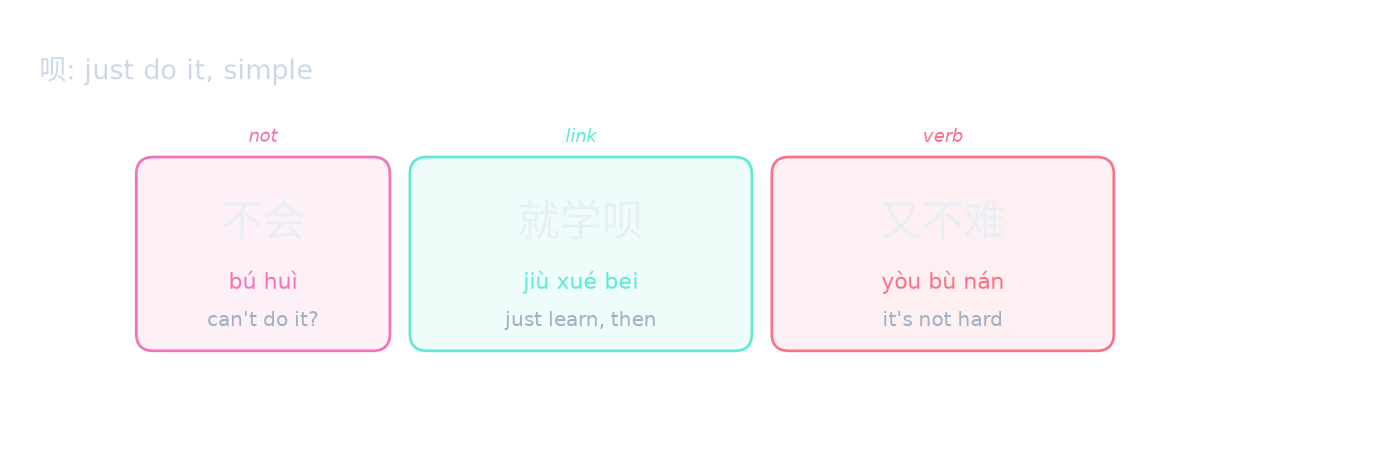
- improbable不会to attend school就学modal particle indicating…呗,again又不难。 – "If you don't know how, just learn – it's not hard."
Sentence + modal particle indicating…呗 = obviously, that's all
- modal particle indicating…呗 (bei) ends a sentence with a shrug: the answer is simple, no big deal.
- Common with then / just就: unexpectedly不想to go去then / just就don't别to go去modal particle indicating…呗.
don't不want to想go去then就don't别go去(simple)呗。
Casual answers
- A: we / us我们to go去where哪儿variant of 吃吃? B: as one wishes随便modal particle indicating…呗。 – "Wherever, doesn't matter."
- he / him他not不to come来(coll.) even if就算(completed / change)了modal particle indicating…呗。 – "If he's not coming, so be it."
whatever随便(no big deal)呗。
Very casual, can sound dismissive
- modal particle indicating…呗 can sound careless or impatient; avoid it with teachers or in formal situations.
- It is a statement, never a question: no question mark.
modal particle indicating…呗 versus (obviously)嘛 and (suggestion)吧
- (obviously)嘛 = it's obvious (explaining): weekend周末(obviously)嘛,人多.
- modal particle indicating…呗 = no big deal (shrugging): 人多then / just就person人many多modal particle indicating…呗. (suggestion)吧 = suggestion: to walk走(suggestion)吧.
people人many多(so be it)就people人many多(whatever)呗。
Recap
- Sentence + modal particle indicating…呗 = no big deal, that's all there is to it (casual shrug).
- Often with then / just就; can sound dismissive; (obviously)嘛 explains, (suggestion)吧 suggests.
Practise this pattern step by step.
Practice without the models
Choose a pattern, cover its teaching examples, and attempt its questions. Use the labels to find feedback in the separate key.
whether (or not)是否 (whether or not)
0501.1 Complete (form): “Please state whether you need a receipt.” to ask请to explain说明you (polite)您…………to need需要invoice发票。
0501.2 Which is correct?
- A. you (polite)您to agree同意whether (or not)是否?
- B. whether (or not)是否you (polite)您to agree同意(yes/no ?)吗?
- C. you (polite)您whether (or not)是否to agree同意?
- D. you (polite)您whether (or not)是否to agree同意(yes/no ?)吗?
0501.3 Build: “I don't know whether he'll come.”
Arrange all chunks: can / will会to come来。 / I / me我not不to know知道 / he / him他 / whether (or not)是否
0501.4 is or isn't是不是 is the spoken equivalent of whether (or not)是否.
True or false? Explain or repair the statement.
0501.5 The form asks a yes-or-no question about your previous applications. Close the examples. Say a Mandarin response, then write it in Chinese. Explain briefly in English what the lesson’s pattern adds. Compare with the model, then change one detail and try again.
Write or say your own response before reading the key.
… whether or not (at the end…与否 (whether … or not)
0502.1 Complete: “Whether it succeeds or not depends on training.” success成功…………,to hinge on取决于to train训练。
0502.2 Which word order is correct for whether (or not)是否?
- A. success成功whether (or not)是否and / with与
- B. whether (or not)是否success成功whether or not (at the end…与否
- C. success成功whether (or not)是否
- D. whether (or not)是否success成功
0502.3 Build: “Whether you like it or not, you must finish.”
Arrange all chunks: , / all / both都want / will / need要 / not to be concerned不管you你to like喜欢whether or not (at the end…与否 / to complete完成。
0502.4 In speech, 喜不喜欢 is more natural than to like喜欢whether or not (at the end…与否.
True or false? Explain or repair the statement.
0502.5 A coach explains what really decides a match. Close the examples. Say a Mandarin response, then write it in Chinese. Explain briefly in English what the lesson’s pattern adds. Compare with the model, then change one detail and try again.
Write or say your own response before reading the key.
Noun + (of — literary)之 + Noun (a literary (modifier / structural particle)的)
0503.1 Complete: “one of the reasons” cause原因…………one / a一
0503.2 Which sounds most natural in conversation?
- A. this这to be / is是I / me我(of — literary)之book书。
- B. this这to be / is是(of — literary)之I / me我book书。
- C. this这to be / is是book书(of — literary)之I / me我。
- D. this这to be / is是I / me我(modifier / structural particle)的book书。
0503.3 Match each phrase to its meaning.
-
- (after a noun) between之间
-
- before之前
-
- after之后
-
- one of (sth)之一
-
A. one of
-
B. before
-
C. after
-
D. between
0503.4 (of — literary)之 is common in titles and set phrases.
True or false? Explain or repair the statement.
0503.5 You see a museum banner introducing a famous city. Close the examples. Say a Mandarin response, then write it in Chinese. Explain briefly in English what the lesson’s pattern adds. Compare with the model, then change one detail and try again.
Write or say your own response before reading the key.
Statement + (obviously)嘛 (self-evident)
0504.1 Complete: “It's handmade, after all – of course it's pricey.” handwork手工to make做(modifier / structural particle)的…………,expensive贵erhua variant of 一点一点儿degree / adjective linker很regular正常。
0504.2 Which is a yes/no question?
- A. you你to know知道(obviously)嘛。
- B. you你to know知道modal particle indicating…呗。
- C. you你to know知道(yes/no ?)吗?
- D. weekend周末(obviously)嘛。
0504.3 Build: “It's the weekend – of course it's crowded.”
Arrange all chunks: weekend周末(obviously)嘛 / of course当然many多。 / , / person人
0504.4 erhua variant of 快点快点儿(obviously)嘛! is a soft, insistent urging.
True or false? Explain or repair the statement.
0504.5 Your friend complains about the crowds at the shopping mall on a Saturday. Close the examples. Say a Mandarin response, then write it in Chinese. Explain briefly in English what the lesson’s pattern adds. Compare with the model, then change one detail and try again.
Write or say your own response before reading the key.
Sentence + modal particle indicating…呗 (a casual shrug)
0505.1 Shrug: “If you don't want to go, just don't.” unexpectedly不想to go去then / just就don't别to go去…………。
0505.2 In which situation is modal particle indicating…呗 least appropriate?
- A. Chatting with a close friend
- B. Replying to a classmate's text
- C. Answering a question from your teacher in class
- D. Joking with a sibling
0505.3 Build: “If he's not coming, so be it.”
Arrange all chunks: modal particle indicating…呗。 / (coll.) even if就算(completed / change)了 / he / him他not不to come来
0505.4 modal particle indicating…呗 can end a question.
True or false? Explain or repair the statement.
0505.5 Your friend worries she doesn't know how to cook the dish for the party. Close the examples. Say a Mandarin response, then write it in Chinese. Explain briefly in English what the lesson’s pattern adds. Compare with the model, then change one detail and try again.
Write or say your own response before reading the key.
A fresh situation
R1. Interpret and repair. A learner adds (yes/no ?)吗 to to ask请to confirm确认whether (or not)是否to participate参加(yes/no ?)吗 and expects a straightforward indirect whether clause. Improve it.
R2. Use it yourself. Ask whether a plan is feasible using whether (or not)是否 and then express the same issue with whether or not (at the end…与否.
Write your responses before opening the key. Compare meaning as well as form; a different valid answer need not copy the model.
Open the answers after your attempt
Answers and explanations
Check after your attempt. For open tasks, compare the message and the stated criteria, then revise one detail.
whether (or not)是否 (whether or not)
0501.1 whether (or not)是否
whether (or not)是否 + verb.
0501.2 C. you (polite)您whether (or not)是否to agree同意?
whether (or not)是否 already makes the question; no (yes/no ?)吗.
0501.3 I / me我not不to know知道he / him他whether (or not)是否can / will会to come来。
Embedded question with whether (or not)是否.
0501.4 True.
True. whether (or not)是否 (“whether”) is formal and written: whether (or not)是否to participate参加. In speech the same meaning is expressed by the affirmative-negative form is or isn't是不是 (or to participate参加not不to participate参加).
0501.5 One possible response: to ask请to explain说明you (polite)您whether (or not)是否to apply for sth申请过本item项目。
Check meaning and form:
- My response conveys a message that fits the opening situation.
- I can explain the meaning of the pattern, rather than only naming it.
- whether (or not)是否 already makes it a question: you (polite)您whether (or not)是否to agree同意?, not you (polite)您whether (or not)是否to agree同意(yes/no ?)吗?
- Do not add not不 after it: whether (or not)是否to agree同意, not whether (or not)是否not不to agree同意 (unless you really mean "whether you disagree").
- I tried a second response with a name, time, place, or description changed.
This is supported productive practice. Compare meaning and structure; your answer need not copy the model. A partner or teacher must hear the spoken response to comment on pronunciation.
… whether or not (at the end…与否 (whether … or not)
0502.1 whether or not (at the end…与否
X whether or not (at the end…与否 = whether X or not.
0502.2 D. whether (or not)是否success成功
whether (or not)是否 goes before the verb; whether or not (at the end…与否 goes after.
0502.3 not to be concerned不管you你to like喜欢whether or not (at the end…与否,all / both都want / will / need要to complete完成。
not to be concerned不管 X whether or not (at the end…与否,all / both都….
0502.4 True.
True. whether or not (at the end…与否 (“or not”) is formal and written (success成功whether or not (at the end…与否). In speech you use the affirmative-negative question: you你喜不喜欢?
0502.5 One possible response: competition (sports etc)比赛success成功whether or not (at the end…与否,to hinge on取决于ordinarily平时(modifier / structural particle)的to train训练。
Check meaning and form:
- My response conveys a message that fits the opening situation.
- I can explain the meaning of the pattern, rather than only naming it.
- whether or not (at the end…与否 follows the predicate or issue being considered. Two-syllable examples are common, but syllable count alone does not decide whether the phrase is grammatical.
- In speech, use A-not-A: to succeed成not不success成功 / 喜不喜欢.
- I tried a second response with a name, time, place, or description changed.
This is supported productive practice. Compare meaning and structure; your answer need not copy the model. A partner or teacher must hear the spoken response to comment on pronunciation.
Noun + (of — literary)之 + Noun (a literary (modifier / structural particle)的)
0503.1 (of — literary)之
one of (sth)之一 = one of.
0503.2 D. this这to be / is是I / me我(modifier / structural particle)的book书。
(of — literary)之 is the classical, written equivalent of (modifier / structural particle)的. In conversation you say this这to be / is是I / me我(modifier / structural particle)的book书; (of — literary)之 survives mainly in titles and set phrases.
0503.3 1–D: (after a noun) between之间 = between; 2–B: before之前 = before; 3–C: after之后 = after; 4–A: one of (sth)之一 = one of
Fixed phrases with literary (of — literary)之.
0503.4 True.
True. (of — literary)之 appears in titles, slogans and fixed expressions: 成功之路, the whole year must be…一年之计在于春. In ordinary sentences (modifier / structural particle)的 is used.
0503.5 One possible response: Xi'an, sub-provincial city…西安to be / is是China中国(modifier / structural particle)的ancient capital古都one of (sth)之一,to have / there is有"world世界the four elements: earth…四大ancient capital古都one of (sth)之一"之称。
Check meaning and form:
- My response conveys a message that fits the opening situation.
- I can explain the meaning of the pattern, rather than only naming it.
- Do not replace every (modifier / structural particle)的 with (of — literary)之 in speech; 我之书 sounds archaic. Say I / me我(modifier / structural particle)的book书.
- (of — literary)之 often sits between two-syllable words or in four-character set phrases: the whole year must be…一年之计在于春.
- I tried a second response with a name, time, place, or description changed.
This is supported productive practice. Compare meaning and structure; your answer need not copy the model. A partner or teacher must hear the spoken response to comment on pronunciation.
Statement + (obviously)嘛 (self-evident)
0504.1 (obviously)嘛
(obviously)嘛 presents the reason as obvious.
0504.2 C. you你to know知道(yes/no ?)吗?
(yes/no ?)吗 asks; (obviously)嘛 states the obvious.
0504.3 weekend周末(obviously)嘛,person人of course当然many多。
Topic + (obviously)嘛, then the comment.
0504.4 True.
True. After a request, (obviously)嘛 makes it softer and slightly coaxing while still insistent: erhua variant of 快点快点儿(obviously)嘛! “Come on, hurry up!”
0504.5 One possible response: weekend周末(obviously)嘛,person人of course当然many多。
Check meaning and form:
- My response conveys a message that fits the opening situation.
- I can explain the meaning of the pattern, rather than only naming it.
- (yes/no ?)吗 asks a yes/no question; (obviously)嘛 states something obvious. you你to know知道(yes/no ?)吗? asks; you你to know知道(obviously)嘛 means "you know that, obviously".
- (obviously)嘛 is casual; leave it out of formal writing.
- I tried a second response with a name, time, place, or description changed.
This is supported productive practice. Compare meaning and structure; your answer need not copy the model. A partner or teacher must hear the spoken response to comment on pronunciation.
Sentence + modal particle indicating…呗 (a casual shrug)
0505.1 modal particle indicating…呗
modal particle indicating…呗 = no big deal.
0505.2 C. Answering a question from your teacher in class
modal particle indicating…呗 can sound careless with superiors.
0505.3 he / him他not不to come来(coll.) even if就算(completed / change)了modal particle indicating…呗。
Sentence + modal particle indicating…呗.
0505.4 False.
False. modal particle indicating…呗 ends a statement, often a suggestion or an “obviously” remark: improbable不会to attend school就学modal particle indicating…呗 “If you can't, just learn it.” It is not a question particle.
0505.5 One possible response: improbable不会to attend school就学modal particle indicating…呗,again又不难。
Check meaning and form:
- My response conveys a message that fits the opening situation.
- I can explain the meaning of the pattern, rather than only naming it.
- modal particle indicating…呗 can sound careless or impatient; avoid it with teachers or in formal situations.
- It is a statement, never a question: no question mark.
- I tried a second response with a name, time, place, or description changed.
This is supported productive practice. Compare meaning and structure; your answer need not copy the model. A partner or teacher must hear the spoken response to comment on pronunciation.
Fresh-situation answers
R1. to ask请to confirm确认whether (or not)是否to participate参加。whether (or not)是否 already embeds whether to participate inside the request. A direct alternative is you你to participate参加(yes/no ?)吗?The two structures should not be stacked mechanically.
R2. One possible response. to ask请to discuss讨论this这个plan计划whether (or not)是否feasible可行。to ask请to discuss讨论this这个plan计划feasible可行whether or not (at the end…与否。Both ask about feasibility without asserting it. whether or not (at the end…与否 follows the predicate; whether (or not)是否 precedes it.
Recall later. Later, turn a direct yes-no question into two indirect whether constructions.