Chinese course / HSK3 handouts
Verbs, ability & complements
Printable paper with separate answer pages Step-by-step lessons
Original teaching practice. Read one pattern, cover its model and try the questions before checking the separate answer section. Examples adapted from Chinese Grammar Wiki (AllSet Learning, CC BY-NC-SA) retain the course-reference provenance.
seemingly看起来 (looks / seems)
Judging by appearance
- A cake in the bakery window has thick cream and fresh strawberries. You haven't tasted it yet.
- this这个cake蛋糕seemingly看起来degree / adjective linker很to be fond of eating好吃。 – "This cake looks delicious."
Subject + seemingly看起来 + Adjective
- seemingly看起来 = "looks, seems (from what I can see)". It goes before the description, and degree / adjective linker很 often follows it.
- It reports an impression, not a fact you have checked.
he他looks看起来very很tired累。

Other senses: to listen to听(after a verb) indicating…起来, variant of 吃吃(after a verb) indicating…起来, to use / with用(after a verb) indicating…起来
- Sound: this这个plan主意to listen to听(after a verb) indicating…起来correct不错。 – "That idea sounds good."
- Taste and use: this这个vegetable菜variant of 吃吃(after a verb) indicating…起来a little有点hot (spicy)辣 – "This dish tastes a bit spicy." this这个cell phone手机to use / with用(after a verb) indicating…起来degree / adjective linker很convenient方便 – "This phone is easy to use."
this这个idea主意sounds听起来good不错。
An impression from the senses
- seemingly看起来 gives what you see, so it does not prove the cake tastes good; tasting is variant of 吃吃(after a verb) indicating…起来.
- For a guess that is not based on looks (he seems to have left), use as if好像: he / him他as if好像to walk走(completed / change)了.
seemingly看起来 versus it would appear看上去 and as if好像
- it would appear看上去 means almost the same as seemingly看起来 and is common for people's appearance: she / her她it would appear看上去degree / adjective linker很young年轻.
- as if好像 is a guess or a comparison: he / him他as if好像to fall ill生病(completed / change)了。 – "He seems to be ill (I suspect)."
he他seems好像be ill生病了。
Recap
- seemingly看起来 + Adj = looks …; to listen to听(after a verb) indicating…起来 = sounds …; variant of 吃吃(after a verb) indicating…起来 = tastes …; to use / with用(after a verb) indicating…起来 = is … to use.
- These give a first impression from one sense. A general guess uses as if好像.
Practise this pattern step by step.
to let / make让 / variant of 叫叫 / to ask请 / to make使 (make / let / ask someone do)
Who decides?
- You want to go out tonight, but your parents have other ideas.
- mama妈妈不让I / me我evening晚上to go out出去。 – "Mum won't let me go out in the evening."
A + to let / make让 / variant of 叫叫 / to ask请 + B + Verb
- A to let / make让 B + Verb: A lets or makes B do something. A variant of 叫叫 B + Verb: A tells B to do it (spoken). A to ask请 B + Verb: A politely invites or asks B.
- The person B is both the object of to let / make让 and the doer of the next verb.
the teacher老师made让us我们write写homework作业。

Telling, inviting, causing
- Telling: mama妈妈variant of 叫叫I / me我to go去买菜。 – "Mum told me to go and buy vegetables."
- Inviting: I / me我want / think / miss想to ask请you你to have a meal吃饭。 – "I'd like to treat you to a meal." Causing a feeling: this这个news消息to let / make让I / me我degree / adjective linker很happy高兴。 – "This news made me very happy."
this这个news消息made让me我very很happy高兴。
Order and negation
- Keep the order A + to let / make让 + B + Verb: mama妈妈to let / make让I / me我to go去, not mama妈妈to let / make让to go去I / me我.
- Negate the first verb to refuse permission: 不让I / me我to go去 = "won't let me go"; to let / make让I / me我not不to go去 changes the meaning to "tell me not to go".
to make使 for formal causes
- to make使 = "to cause, make", mainly in writing, with an abstract cause and a change of state: to move运动使人health健康。 – "Exercise makes people healthy."
- In speech, to let / make让 covers most of this: to move运动to let / make让person人degree / adjective linker很health健康.
exercise运动makes使people人healthy健康。
Recap
- A to let / make让/variant of 叫叫/to ask请 B + Verb: to let / make让 = let/make, variant of 叫叫 = tell (spoken), to ask请 = invite/ask politely.
- to let / make让 + person + feeling = make someone feel; to make使 is the formal written "cause". Refuse with 不让.
Practise this pattern step by step.
to pass经过 (after going through)
After three years of training
- A runner who trained every morning for three years has just won her first marathon.
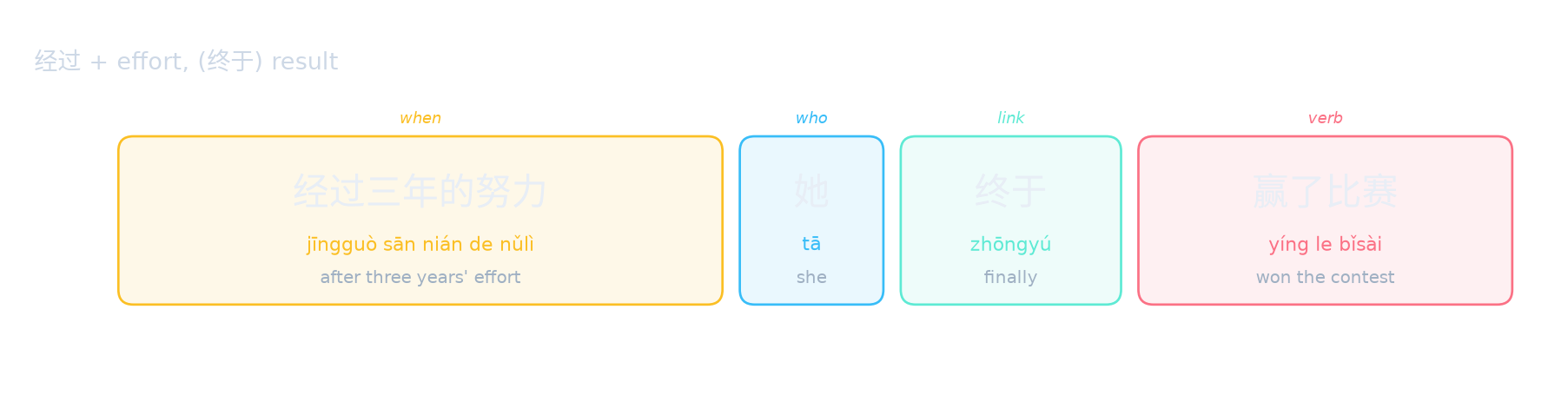
- to pass经过三年(modifier / structural particle)的to make an effort努力,she / her她finally终于to beat赢(completed / change)了competition (sports etc)比赛。 – "After three years of hard work, she finally won the race."
to pass经过 + process, result
- to pass经过 + a process (effort, discussion, time), then the result in the second clause.
- The process is usually a noun phrase: to pass经过一年(modifier / structural particle)的to learn学习, to pass经过everyone大家(modifier / structural particle)的to discuss讨论, to pass经过doctor医生(modifier / structural particle)的inspection检查.
after经过everyone's大家的discussion讨论,we我们decided决定go to去Shanghai上海。
to pass经过 as "pass by, go through"
- It is also a plain verb of movement: I / me我every day每天to go to work上班all / both都to pass经过this这个park (for public recreation)公园。 – "I pass this park every day on the way to work."
- 这趟war chariot (archaic)车to pass经过Beijing, capital of the…北京(yes/no ?)吗? – "Does this train go through Beijing?"
I我every day每天pass经过this这个park公园。
A process before a result
- to pass经过 needs a process that leads somewhere; for a simple "after (a time)", use after以后: to finish class下课after以后, not to pass经过to finish class下课.
- Put to pass经过 + process first and the result second: to pass经过inspection检查,doctor医生variant of 说说not / haven't没question问题.
to pass经过 versus to pass through通过
- to pass经过 stresses going through the process: to pass经过many times多次experiment试验 – "after many experiments".
- to pass through通过 stresses the means used to reach the goal: to pass through通过friend朋友,I / me我to find找到(completed / change)了to work工作 – "Through a friend, I found a job."
through通过a friend朋友,I我found找到了a job工作。
Recap
- to pass经过 + process, result = after going through …, …
- As a verb, to pass经过 = pass by / go through a place. For a plain "after", use after以后; for "by means of", to pass through通过.
Practise this pattern step by step.
should应该 / should该 (should, ought to)
A hot day out
- Your friend is going hiking at noon in 35 degrees with one small bottle of water.
- you你should应该多带a bit一点water水。 – "You should take some more water."
should应该 / should该 + Verb
- should应该 + Verb = "should, ought to": advice or duty. should该 is the shorter, spoken form.
- Negative: not不should应该 = "shouldn't": you你not不should应该这么晚to go to bed睡觉.
you你not不should应该so这么late晚go to bed睡觉。

It is time to …
- should该 + Verb + (completed / change)了 = "it's time to …": 十二点(completed / change)了,I / me我should该to walk走(completed / change)了。 – "It's twelve; I should be going."
- should该 + person + Verb = "it's someone's turn": should该you你(completed / change)了 – "Your turn."
twelve o'clock十二点了,I我should该go走了。
Form and position
- should应该 goes after the subject and before the verb: you你should应该rest休息, not should应该you你rest休息 (unless you mean "it's your turn").
- Put not不 before should应该 to say "shouldn't": you你not不should应该to go去, not you你should应该不去.
should应该 for "probably"
- should应该 can also be a confident guess: he / him他should应该already已经perfect到家(completed / change)了。 – "He should be home by now."
- Context tells you which one: advice to a person, or a guess about a situation.
he他should应该already已经arrive到home家了。
Recap
- should应该 / should该 + Verb = should; not不should应该 = shouldn't.
- should该…(completed / change)了 = it's time to …; should该you你(completed / change)了 = your turn; should应该 can also mean "probably".
Practise this pattern step by step.
difficult / hard难 + Verb (unpleasant to …)
The canteen's new dish
- You try the canteen's new soup. It is salty and cold.
- this这个汤太难to shout喝(completed / change)了! – "This soup tastes awful!" difficult / hard难 + a sense verb = unpleasant to …
difficult / hard难 + sense verb
- unpalatable难吃, difficult / hard难to shout喝, ugly难看, unpleasant to hear难听, unpleasant smell难闻 = bad-tasting (food), bad-tasting (drinks), ugly, unpleasant to hear, bad-smelling.
- They work like adjectives: degree / adjective linker很ugly难看, too太unpleasant to hear难听(completed / change)了. The opposites start with good好: to be fond of eating好吃, tasty (drinks)好喝, good-looking好看, pleasant to hear好听, 好闻.
this这(measure word)首song歌very很unpleasant to hear难听。

difficult / hard难 + other verbs: hard to …
- With most other verbs, difficult / hard难 means "difficult to": this这个letter字degree / adjective linker很difficult / hard难to write写。 – "This character is hard to write."
- he / him他(modifier / structural particle)的question问题很难to reply回答。 – "His question is hard to answer."
his他的question问题very很hard to难answer回答。
Unpleasant versus difficult
- unpalatable难吃 means it tastes bad, not that it is hard to eat; ugly难看 means ugly, not hard to see.
- to feel unwell难受 is a feeling: "feel unwell, upset": I / me我headache头疼,degree / adjective linker很to feel unwell难受.
difficult / hard难 + Verb versus no good不好 + Verb
- not不to be fond of eating好吃 is milder: "not tasty". unpalatable难吃 is stronger: "awful".
- no good不好to write写 (not easy to write) is similar to 很难to write写, but softer.
this这(measure word)个dish菜not不tasty好吃。
Recap
- difficult / hard难 + sense verb (unpalatable难吃, ugly难看, unpleasant to hear难听, unpleasant smell难闻, difficult / hard难to shout喝) = unpleasant to that sense; opposite good好 + verb.
- difficult / hard难 + other verbs = hard to do: 难写, difficult / hard难to reply回答. to feel unwell难受 = feel bad.
Practise this pattern step by step.
Verb + (completed / change)了 + Duration (did for a length of time)
How long did you wait?
- Your friend was very late for lunch, and now she asks how long you waited.
- I / me我to wait for等(completed / change)了you你一个hour小时! – "I waited for you for an hour!"
Verb + (completed / change)了 + Duration
- Subject + Verb + (completed / change)了 + duration = did it for that long (finished): I / me我to sleep睡(completed / change)了八个hour小时, 他学(completed / change)了两年.
- The duration comes after the verb, as in English "slept eight hours", never before it.
I我sleep睡了eight八个hours小时。

With an object: two patterns
- Duration before the object noun: 他学(completed / change)了三年Chinese language中文。 – "He studied Chinese for three years."
- Or repeat the verb: 他学to hit (the mark)中literature文学(completed / change)了三年。 A person object (you你, he / him他) goes before the duration: I / me我to wait for等(completed / change)了you你一个hour小时.
he他study学Chinese中文study学了three years三年。
Where the duration goes
- Duration after the verb: 我学(completed / change)了两年, not I / me我两年学了.
- With a noun object, do not put the duration last: 我学(completed / change)了两年Chinese language中文 or 我学to hit (the mark)中literature文学(completed / change)了两年, not 我学(completed / change)了Chinese language中文两年.
Finished, or still going?
- Verb + (completed / change)了 + duration with no final (completed / change)了 reports a finished period: I / me我at / in在Beijing, capital of the…北京to live住(completed / change)了两年 – "I lived in Beijing for two years (then left)."
- Adding a final (completed / change)了 says it is still going on; that pattern is the next lesson.
I我in在Beijing北京live住了two years两年。
Recap
- Verb + (completed / change)了 + duration = did it for that long: to wait for等(completed / change)了一个hour小时.
- With an object: 学了三年Chinese language中文 or 学中literature文学(completed / change)了三年; a pronoun object comes before the duration: to wait for等(completed / change)了you你一个hour小时.
Practise this pattern step by step.
Verb + (completed / change)了 + Duration + (completed / change)了 (have been …-ing)
Still waiting
- Your friend phones to ask where you are. You are still in the café where you have been since two o'clock.
- I / me我to wait for等(completed / change)了you你两个hour小时(completed / change)了! – "I've been waiting for you for two hours (and I'm still here)!"
Verb + (completed / change)了 + Duration + (completed / change)了
- The final (completed / change)了 says the period lasts up to now and may continue: 我学(completed / change)了三年Chinese language中文(completed / change)了 – "I've been studying Chinese for three years."
- Without it, the period is over: 我学(completed / change)了三年Chinese language中文 – "I studied Chinese for three years."
I我study学了three years三年Chinese中文了。

How long so far
- he / him他at / in在here这儿to work工作(completed / change)了十年(completed / change)了。 – "He has worked here for ten years (and still does)."
- Asking: you你学中literature文学(completed / change)了多长时间(completed / change)了? – "How long have you been learning Chinese?"
he他at在here这儿work工作了ten years十年了。
One (completed / change)了 or two
- Two (completed / change)了 = still going: to live住(completed / change)了两年(completed / change)了 (I still live here). One (completed / change)了 = finished: to live住(completed / change)了两年 (I moved away).
- The duration still goes after the verb: 学了三年(completed / change)了, not 三年to learn学(completed / change)了(completed / change)了.
With already已经
- already已经 often comes in front to stress the length: I / me我already已经to wait for等(completed / change)了一个hour小时(completed / change)了。 – "I've already been waiting an hour."
- The meaning of the two (completed / change)了 does not change; already已经 just adds emphasis.
I我already已经wait等了one一个hour小时了。
Recap
- Verb + (completed / change)了 + duration + (completed / change)了 = have been doing it for that long, up to now.
- One (completed / change)了 = a finished period; two (completed / change)了 = still going. already已经 adds emphasis.
Practise this pattern step by step.
not / haven't没means办法 + Verb (no way to / can't)
The shop is closed
- Your friend asks you to buy a cake on the way home, but every bakery has closed for the holiday.
- store商店all / both都to close a door关门(completed / change)了,I / me我not / haven't没means办法to buy买cake蛋糕。 – "The shops are all shut; there's no way I can buy a cake."
Subject + not / haven't没means办法 + Verb
- not / haven't没means办法 + Verb = "there's no way to …, can't (because the situation does not allow it)".
- It goes before the verb phrase: I / me我not / haven't没means办法to help帮you你, he / him他not / haven't没means办法to come来.
sorry对不起,I我have no way to没办法help帮you你。

On its own: "nothing can be done"
- As a short reply: A: to rain下雨(completed / change)了,competition (sports etc)比赛to cancel取消(completed / change)了。 B: not / haven't没means办法。 – "Oh well, nothing we can do."
- With erhua variant of 一点一点儿 for emphasis: I / me我erhua variant of 一点一点儿means办法all / both都not have / haven't没有。 – "I'm completely out of ideas."
I我a bit一点儿way办法(at all)都have not没有。
Circumstances, not skill
- not / haven't没means办法 means the situation blocks you; for a skill you lack, use improbable不会: I / me我improbable不会swimming游泳.
- Keep not / haven't没 (not not不): not / haven't没means办法, not not不means办法.
not / haven't没means办法 versus cannot不能
- cannot不能 is the general "can't / not allowed": here这里cannot不能to smoke (a cigarette…抽烟 – "You can't smoke here."
- not / haven't没means办法 suggests you have tried or thought about it and found no way: I / me我not / haven't没means办法connection联系he / him他 – "I have no way of contacting him."
I我have no way to没办法contact联系him他。
Recap
- not / haven't没means办法 + Verb = there's no way to …, the situation does not allow it.
- Alone, not / haven't没means办法 = "nothing can be done". A missing skill is improbable不会; a rule is cannot不能.
Practise this pattern step by step.
Verb reduplication (do a bit / give it a try)
Can I try it on?
- You see a jacket you like in a shop and want to try it before deciding.
- I / me我can / may可以试试这件clothes衣服(yes/no ?)吗? – "Can I try on this jacket?" Doubling the verb makes it light and casual.
One-syllable verbs: VV, Vone / a一V
- V + V or V + one / a一 + V = do it a little, give it a try: to take a look at看看 / to have a look看一看, 尝尝 / 尝一尝.
- The second syllable is said lightly. The effect is softer and friendlier than the bare verb.
you你taste尝(a bit)一taste尝this这个dish菜。

Two-syllable verbs: ABAB
- A two-syllable verb doubles as a whole: rest休息 → rest休息rest休息, to introduce (sb to sb)介绍 → to introduce (sb to sb)介绍to introduce (sb to sb)介绍, to discuss讨论 → to discuss讨论to discuss讨论.
- we / us我们to discuss讨论to discuss讨论this这个question问题(suggestion)吧。 – "Let's talk this over a bit."
you你tired累了,rest休息rest休息吧。
Verbs ABAB, adjectives AABB
- Two-syllable verbs repeat as ABAB (rest休息rest休息), not AABB (to rest休rest休息breath息); AABB is for adjectives (干干净净).
- Doubling adds "a bit", so do not add a duration as well: to take a look at看看, or to see看a moment一会儿, not to take a look at看看a moment一会儿.
Past tense: V(completed / change)了V
- For a short completed action, put (completed / change)了 in the middle: he / him他to see看(completed / change)了to see看watch (timepiece)表,then / just就to walk走(completed / change)了。 – "He glanced at his watch and left."
- Two-syllable verbs rarely take (completed / change)了 inside; use the plain verb + (completed / change)了 + (used after a verb) give it…一下: we / us我们to discuss讨论(completed / change)了(used after a verb) give it…一下.
he他look看了look看watch表,then就leave走了。
Recap
- VV / Vone / a一V (to take a look at看看, to have a look看一看) and ABAB (rest休息rest休息) = do a bit, give it a try; softer and casual.
- Completed: V(completed / change)了V (to see看(completed / change)了to see看). Adjectives double as AABB, verbs as ABAB.
Practise this pattern step by step.
degree / adjective linker很 + Verb (feeling verbs with degree / adjective linker很)
How much do you like it?
- A new friend asks whether you like Chinese food. You really do.
- I / me我degree / adjective linker很to like喜欢variant of 吃吃China中国vegetable菜。 – "I really like Chinese food."
degree / adjective linker很 + feeling verb
- Verbs of feeling and wanting take degree words just like adjectives: degree / adjective linker很to like喜欢, 很想, degree / adjective linker很anxious担心, degree / adjective linker很to hope希望, degree / adjective linker很to love爱.
- degree / adjective linker很 goes right before the verb: I / me我degree / adjective linker很homesick想家 – "I miss home very much."
I我very much很miss想home家。

Other degree words work too
- I / me我very非常anxious担心he / him他。 – "I'm extremely worried about him."
- we / us我们all / both都degree / adjective linker很to hope希望you你can / be able to能to come来。 – "We all very much hope you can come."
we我们all都very much很hope希望you你can能come来。
Feeling verbs only
- Ordinary action verbs do not take degree / adjective linker很: degree / adjective linker很variant of 吃吃, degree / adjective linker很to run跑, degree / adjective linker很to go去 are wrong. Say variant of 吃吃(degree marker)得很多, to run跑(degree marker)得很快.
- Put degree / adjective linker很 before the verb, not the object: degree / adjective linker很to like喜欢this这本书, not to like喜欢degree / adjective linker很this这本书.
很想 + Verb = really want to
- want / think / miss想 + another verb means "want to"; 很想 strengthens it: I / me我degree / adjective linker很want / think / miss想to go去to take a look at看看。 – "I'd really like to go and have a look."
- 很会 + Verb = "be good at": he / him他很会to prepare a meal做饭 – "He's a great cook."
he他very很good at会cooking做饭。
Recap
- degree / adjective linker很 + feeling verb (to like喜欢, want / think / miss想, anxious担心, to hope希望, to love爱) = like / want / worry … very much.
- Action verbs do not take degree / adjective linker很; use a (degree marker)得 complement instead. 很会 = good at.
Practise this pattern step by step.
Direction complement to come来 / to go去 (toward / away)
Come in, go out
- A friend knocks at your door; later your little brother runs off to play outside.
- 请进来! – "Please come in!" he / him他to go out出去(completed / change)了。 – "He's gone out." to come来 is towards the speaker, to go去 is away.
Verb + to come来 / to go去
- to come来 = movement towards the speaker; to go去 = movement away from the speaker.
- Combine with direction verbs: to come in进来/to go in进去, (after a verb, indicates…出来/to go out出去, to come up上来/to go up上去, to come down下来/to go down下去, to return回来/to return回去, see 过来过来/(verb suffix)过去.
you你quickly快come down下来吧!

A place goes before to come来 / to go去
- Verb + place + to come来/to go去: he / him他to return home回家to go去(completed / change)了。 – "He has gone back home." fast-forward (media player)快进classroom教室to come来! – "Come into the classroom, quick!"
- A thing you carry can come after: he / him他to bring带来(completed / change)了one / a一本书 / he / him他band带(completed / change)了one / a一本书to come来.
he他return回home家(away)去了。
The speaker decides to come来 or to go去
- Choose by where the speaker is: you are upstairs → to come up上来 (come up); you are downstairs → to go up上去 (go up).
- A place word never comes after to come来/to go去: to go forward进classroom教室to come来, not to come in进来classroom教室.
to bring拿来, band带to go去, 送来
- Bringing and taking work the same way: to ask请(把: marks the object)把book书to bring拿来。 – "Please bring the book (here)."
- I / me我to / for / give给he / him他to send送to go去(completed / change)了some一些fruit水果。 – "I took some fruit over to him."
please请把the book书bring拿(here)来。
Recap
- Verb + to come来 = towards the speaker; Verb + to go去 = away from the speaker.
- A place goes before to come来/to go去 (to return home回家to go去, to go forward进classroom教室to come来); to bring拿来/band带to go去 work the same way.
Practise this pattern step by step.
Potential complement (degree marker)得 / not不 (can / can't do it)
Can you understand him?
- Your teacher speaks quickly at the start of a new course, and your friend wonders if you follow.
- teacher老师variant of 说说(degree marker)得太快,I / me我unable to make sense of…听不懂。 – "The teacher talks too fast; I can't understand."
Verb + (degree marker)得 / not不 + result
- Verb + (degree marker)得 + result = can (manage to) do it; Verb + not不 + result = can't: to understand (by hearing)听得懂 / unable to make sense of…听不懂, can see看得见 / cannot see看不见.
- It says whether the result is possible, not whether you are allowed.
I我listen听(can)得understand懂Chinese中文。

Common pairs
- cannot see看不见 (can't see), 买不到 (can't get hold of), 吃不完 (can't finish eating), to have enough time来得及 (there's still time).
- so much这么多菜,we / us我们吃不完。 – "This much food – we can't finish it."
so这么much多food菜,we我们eat吃(cannot)不finish完。
Where not不 goes
- not不 goes between the verb and the result: unable to make sense of…听不懂, not not不to understand (on hearing)听懂.
- Ask with both forms: you你to understand (by hearing)听得懂unable to make sense of…听不懂? or you你to understand (by hearing)听得懂(yes/no ?)吗?
unable to make sense of…听不懂 versus not / haven't没to understand (on hearing)听懂
- unable to make sense of…听不懂 = can't understand (it is beyond me): he / him他(modifier / structural particle)的Shanghai municipality…上海old variant of 话话I / me我unable to make sense of…听不懂.
- not / haven't没to understand (on hearing)听懂 = didn't understand (this time): I'm sorry对不起,I / me我not / haven't没to understand (on hearing)听懂,to ask请to say again再说one time (all the way…一遍。
sorry对不起,I我did not没understand听懂。
Recap
- Verb + (degree marker)得 + result = can; Verb + not不 + result = can't (can see看得见 / cannot see看不见).
- not不 sits between verb and result. not / haven't没 + verb + result = it did not happen this time.
Practise this pattern step by step.
Verb + to go down下去 (keep …-ing)
Don't stop now
- You are halfway through a story and your listener is hooked.
- variant of 说说to go down下去,afterwards后来how about怎么样(completed / change)了? – "Keep going – what happened next?"
Verb + to go down下去
- Verb + to go down下去 = keep on doing, continue from now into the future: variant of 说说to go down下去, to read out读to go down下去, to live住to go down下去.
- It is often used with to continue继续, want / will / need要, want / think / miss想 or can / be able to能: I / me我want / think / miss想at / in在here这儿to live住to go down下去.
please请continue继续speak说(keep on)下去。

Perseverance
- to learn学Chinese language中文not不easy容易,but但是you你want / will / need要to press on坚持下去。 – "Learning Chinese isn't easy, but you must keep going."
- this way / so这样to go down下去won't do不行。 – "It can't go on like this." this way / so这样to go down下去 = if things continue this way.
like this这样(go on)下去not不OK行。
Continuing, not going down
- In this pattern to go down下去 means "continue", not physical movement down: to read out读to go down下去 = keep reading.
- With not不 for "can't go on": I / me我to listen to听not不to go down下去(completed / change)了 – "I can't bear to listen any more."
to go down下去 versus (after a verb) indicating…起来
- to go down下去 continues something already going: to sing唱to go down下去 – "keep singing".
- (after a verb) indicating…起来 starts something new: 唱起来 – "start singing": everyone大家all / both都唱起来(completed / change)了。
everyone大家all都sing唱(start)起来了。
Recap
- Verb + to go down下去 = keep on doing it, carry on (variant of 说说to go down下去, to press on坚持下去).
- this way / so这样to go down下去 = if this continues; to listen to听not不to go down下去 = can't bear to go on. (after a verb) indicating…起来 = start.
Practise this pattern step by step.
Result complements good好 / to finish完 / mistake错 (how it turned out)
Finished or not?
- Your mum asks about your homework before you go out to play.
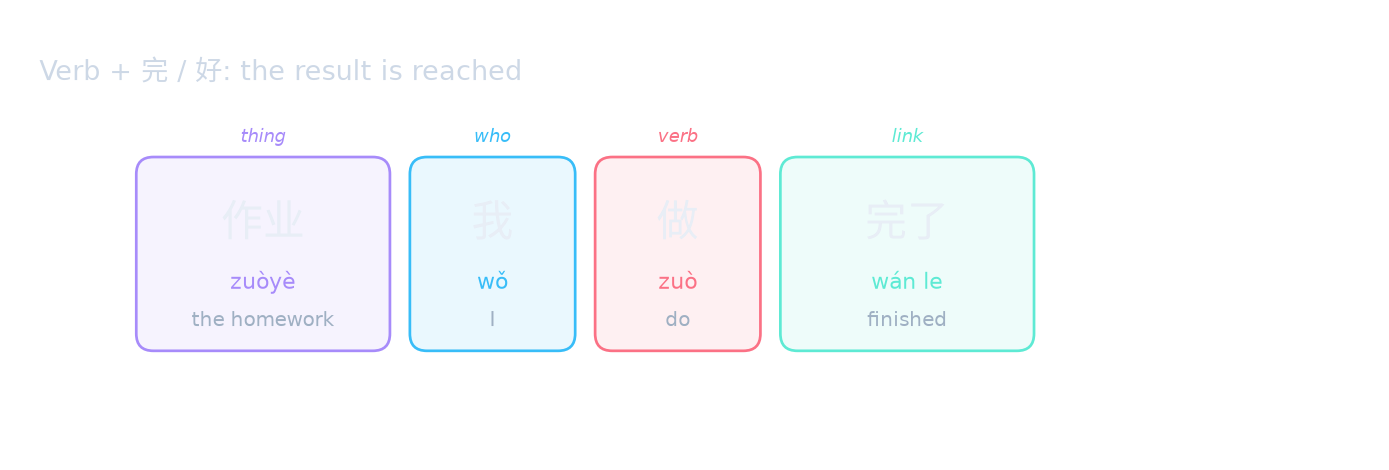
- school assignment作业I / me我to make做to finish完(completed / change)了! – "I've finished my homework!" to finish完 tells the result of the action: it is finished.
Verb + result complement
- Verb + good好 / to finish完 / mistake错 tells how the action ended: 做好 (done properly), variant of 吃吃to finish完 (eaten up), 写错 (written wrongly).
- (completed / change)了 normally follows the result: I / me我to write写to finish完(completed / change)了, he / him他to see看mistake错(completed / change)了.
I我write写wrongly错了one一个character字。
Ready, finished, wrong
- good好 = done and ready: cooked rice饭做好(completed / change)了,rapid快to come来variant of 吃吃(suggestion)吧! – "Dinner's ready, come and eat!"
- to finish完 = finished, nothing left: this这本书I / me我to see看to finish完(completed / change)了. mistake错 = wrong: I'm sorry对不起,I / me我to err打错telephone电话(completed / change)了。
dinner饭make做ready好了,quickly快come来eat吃吧!
Negate with not / haven't没, keep the pair together
- Negate with not / haven't没 and drop (completed / change)了: I / me我still / also还not / haven't没to make做to finish完, not I / me我not不to make做to finish完(completed / change)了.
- Nothing comes between the verb and its result: 做完作业, not 做作业to finish完.
to make做to finish完 versus 做好
- to make做to finish完 = finished, the job is over (maybe not well done).
- 做好 = done properly, ready to use: you你preparation准备好了吗? – "Are you ready?"
you你prepare准备ready好了吗?
Recap
- Verb + good好 / to finish完 / mistake错 (+ (completed / change)了) = done properly / finished / done wrongly.
- Negative: not / haven't没 + Verb + result (still / also还not / haven't没to make做to finish完). The result follows the verb directly.
Practise this pattern step by step.
Practice without the models
Choose a pattern, cover its teaching examples, and attempt its questions. Use the labels to find feedback in the separate key.
seemingly看起来 (looks / seems)
0301.1 Complete: “You look very happy today.” you你today今天…………degree / adjective linker很happy高兴。
0301.2 Your friend describes a plan on the phone. You say: “That sounds interesting.” Which fits?
- A. to listen to听(after a verb) indicating…起来degree / adjective linker很interesting有意思。
- B. to use / with用(after a verb) indicating…起来degree / adjective linker很interesting有意思。
- C. seemingly看起来degree / adjective linker很interesting有意思。
- D. variant of 吃吃(after a verb) indicating…起来degree / adjective linker很interesting有意思。
0301.3 Match each sense verb to its meaning.
-
- seemingly看起来
-
- to listen to听(after a verb) indicating…起来
-
- variant of 吃吃(after a verb) indicating…起来
-
- to use / with用(after a verb) indicating…起来
-
A. tastes
-
B. sounds
-
C. is … to use
-
D. looks
0301.4 Build: “This cake looks delicious.”
Arrange all chunks: degree / adjective linker很 / to be fond of eating好吃。 / this这个cake蛋糕 / seemingly看起来
0301.5 A cake in the bakery window has thick cream and fresh strawberries. You haven't tasted it yet. Close the examples. Say a Mandarin response, then write it in Chinese. Explain briefly in English what the lesson’s pattern adds. Compare with the model, then change one detail and try again.
Write or say your own response before reading the key.
to let / make让 / variant of 叫叫 / to ask请 / to make使 (make / let / ask someone do)
0302.1 Complete: “My dad doesn't let me play games.” (coll.) father爸爸not不…………I / me我玩游戏。
0302.2 You invite your teacher to dinner. Which verb is most polite? I / me我want / think / miss想__teacher老师to have a meal吃饭。
- A. variant of 叫叫
- B. to make使
- C. to let / make让
- D. to ask请
0302.3 Build: “This news made me very happy.”
Arrange all chunks: to let / make让 / I / me我 / degree / adjective linker很happy高兴。 / this这个news消息
0302.4 mama妈妈不让I / me我to go去 and mama妈妈to let / make让I / me我not不to go去 mean exactly the same.
True or false? Explain or repair the statement.
0302.5 You want to go out tonight, but your parents have other ideas. Close the examples. Say a Mandarin response, then write it in Chinese. Explain briefly in English what the lesson’s pattern adds. Compare with the model, then change one detail and try again.
Write or say your own response before reading the key.
to pass经过 (after going through)
0303.1 Complete: “After a check-up, the doctor said it was nothing serious.” …………inspection检查,doctor医生variant of 说说nothing没什么see 大夫大question问题。
0303.2 Which word fits? “After class, let's play basketball.” to finish class下课____,we / us我们to go去打篮球(suggestion)吧。
- A. finally终于
- B. to pass经过
- C. to pass through通过
- D. after以后
0303.3 Build: “I pass this park every day.”
Arrange all chunks: every day每天 / to pass经过 / this这个park (for public recreation)公园。 / I / me我
0303.4 to pass through通过friend朋友,I / me我to find找到(completed / change)了to work工作 stresses the means (a friend) rather than a long process.
True or false? Explain or repair the statement.
0303.5 A runner who trained every morning for three years has just won her first marathon. Close the examples. Say a Mandarin response, then write it in Chinese. Explain briefly in English what the lesson’s pattern adds. Compare with the model, then change one detail and try again.
Write or say your own response before reading the key.
should应该 / should该 (should, ought to)
0304.1 Advise: “You should see a doctor.” you你…………to go去to see看doctor医生。
0304.2 What does should该you你(completed / change)了 mean?
- A. It's your turn.
- B. You should be careful.
- C. You've arrived.
- D. You're probably right.
0304.3 Build: “It's twelve; I should be going.”
Arrange all chunks: , / to walk走(completed / change)了。 / 十二点(completed / change)了 / 我该
0304.4 In he / him他should应该already已经perfect到家(completed / change)了, should应该 is advice to him.
True or false? Explain or repair the statement.
0304.5 Your friend is going hiking at noon in 35 degrees with one small bottle of water. Close the examples. Say a Mandarin response, then write it in Chinese. Explain briefly in English what the lesson’s pattern adds. Compare with the model, then change one detail and try again.
Write or say your own response before reading the key.
difficult / hard难 + Verb (unpleasant to …)
0305.1 Complete: “This colour is ugly.” this这个color颜色degree / adjective linker很…………。
0305.2 Match each word to its meaning.
-
- unpalatable难吃
-
- unpleasant to hear难听
-
- 难写
-
- to feel unwell难受
-
A. sounds unpleasant
-
B. hard to write
-
C. feel unwell
-
D. tastes bad
0305.3 Which is the mildest way to say the food is not good?
- A. not不to be fond of eating好吃。
- B. too太unpalatable难吃(completed / change)了。
- C. unpalatable难吃extremely极了。
- D. degree / adjective linker很unpalatable难吃。
0305.4 Build: “His question is hard to answer.”
Arrange all chunks: degree / adjective linker很 / to reply回答。 / he / him他(modifier / structural particle)的question问题 / difficult / hard难
0305.5 You try the canteen's new soup. It is salty and cold. Close the examples. Say a Mandarin response, then write it in Chinese. Explain briefly in English what the lesson’s pattern adds. Compare with the model, then change one detail and try again.
Write or say your own response before reading the key.
Verb + (completed / change)了 + Duration (did for a length of time)
0306.1 Complete: “I slept for ten hours yesterday.” I / me我yesterday昨天to sleep睡…………十个hour小时。
0306.2 Which says “She studied piano for five years.”?
- A. 她学piano钢琴五年(completed / change)了to learn学。
- B. 她学(completed / change)了piano钢琴五年。
- C. she / her她五年学了piano钢琴。
- D. 她学(completed / change)了五年piano钢琴。
0306.3 Build: “I waited for you for an hour.”
Arrange all chunks: I / me我 / to wait for等(completed / change)了 / 一个hour小时。 / you你
0306.4 I / me我at / in在Beijing, capital of the…北京to live住(completed / change)了两年 can describe a stay that has ended.
True or false? Explain or repair the statement.
0306.5 Your friend was very late for lunch, and now she asks how long you waited. Close the examples. Say a Mandarin response, then write it in Chinese. Explain briefly in English what the lesson’s pattern adds. Compare with the model, then change one detail and try again.
Write or say your own response before reading the key.
Verb + (completed / change)了 + Duration + (completed / change)了 (have been …-ing)
0307.1 You still live here: “I've lived here for five years.” I / me我at / in在here这儿to live住(completed / change)了五年…………。
0307.2 Which sentence means the person still works at the bank?
- A. he / him他三年at / in在bank银行to work工作。
- B. he / him他at / in在bank银行to work工作(completed / change)了三年(completed / change)了。
- C. he / him他at / in在bank银行三年to work工作(completed / change)了。
- D. he / him他at / in在bank银行to work工作(completed / change)了三年。
0307.3 Build: “I've already been waiting for an hour.”
Arrange all chunks: to wait for等(completed / change)了 / 一个hour小时(completed / change)了。 / already已经 / I / me我
0307.4 我学(completed / change)了三年Chinese language中文 and 我学(completed / change)了三年Chinese language中文(completed / change)了 mean exactly the same.
True or false? Explain or repair the statement.
0307.5 Your friend phones to ask where you are. You are still in the café where you have been since two o'clock. Close the examples. Say a Mandarin response, then write it in Chinese. Explain briefly in English what the lesson’s pattern adds. Compare with the model, then change one detail and try again.
Write or say your own response before reading the key.
not / haven't没means办法 + Verb (no way to / can't)
0308.1 Complete: “The phone has no signal; I can't call you.” cell phone手机not have / haven't没有signal信号,I / me我…………to / for / give给you你to make a telephone call打电话。
0308.2 Which says “I can't swim (I never learned).”?
- A. I / me我swimming游泳not / haven't没means办法。
- B. I / me我not不means办法swimming游泳。
- C. I / me我not / haven't没means办法swimming游泳。
- D. I / me我improbable不会swimming游泳。
0308.3 Build: “Sorry, there's no way I can help you.”
Arrange all chunks: ,I / me我 / not / haven't没means办法 / I'm sorry对不起 / to help帮you你。
0308.4 not / haven't没means办法 can be a complete reply meaning “nothing can be done”.
True or false? Explain or repair the statement.
0308.5 Your friend asks you to buy a cake on the way home, but every bakery has closed for the holiday. Close the examples. Say a Mandarin response, then write it in Chinese. Explain briefly in English what the lesson’s pattern adds. Compare with the model, then change one detail and try again.
Write or say your own response before reading the key.
Verb reduplication (do a bit / give it a try)
0309.1 Double the verb to see看 to say “Let me have a look.” to let / make让I / me我…………。
0309.2 Which is the correct doubled form of rest休息?
- A. rest休息breath息
- B. to rest休rest休息breath息
- C. rest休息rest休息
- D. to rest休rest休息
0309.3 Build: “He glanced at his watch and left.”
Arrange all chunks: ,then / just就 / to see看(completed / change)了to see看watch (timepiece)表 / he / him他 / to walk走(completed / change)了。
0309.4 you你尝尝 sounds softer than you你old variant of 尝尝.
True or false? Explain or repair the statement.
0309.5 You see a jacket you like in a shop and want to try it before deciding. Close the examples. Say a Mandarin response, then write it in Chinese. Explain briefly in English what the lesson’s pattern adds. Compare with the model, then change one detail and try again.
Write or say your own response before reading the key.
degree / adjective linker很 + Verb (feeling verbs with degree / adjective linker很)
0310.1 Complete: “I miss my mum very much.” I / me我…………want / think / miss想I / me我mama妈妈。
0310.2 Which sentence is correct?
- A. he / him他degree / adjective linker很to like喜欢(cooked) rice米饭。
- B. he / him他degree / adjective linker很variant of 吃吃(cooked) rice米饭。
- C. he / him他(cooked) rice米饭degree / adjective linker很to like喜欢variant of 吃吃degree / adjective linker很。
- D. he / him他to like喜欢degree / adjective linker很(cooked) rice米饭。
0310.3 Build: “We all very much hope you can come.”
Arrange all chunks: degree / adjective linker很to hope希望 / you你 / can / be able to能to come来。 / we / us我们all / both都
0310.4 he / him他很会to prepare a meal做饭 means “He is very good at cooking.”
True or false? Explain or repair the statement.
0310.5 A new friend asks whether you like Chinese food. You really do. Close the examples. Say a Mandarin response, then write it in Chinese. Explain briefly in English what the lesson’s pattern adds. Compare with the model, then change one detail and try again.
Write or say your own response before reading the key.
Direction complement to come来 / to go去 (toward / away)
0311.1 You are inside the room and call to your friend at the door: “Come in!” to go forward进…………!
0311.2 You are on the ground floor talking about your friend upstairs: “He went up.” Which fits?
- A. 他来(bound form) up上(completed / change)了。
- B. he / him他to go up上去(completed / change)了。
- C. he / him他to come up上来(completed / change)了。
- D. he / him他to go去(bound form) up上(completed / change)了。
0311.3 Build: “Come into the classroom, quick!”
Arrange all chunks: rapid快 / to come来! / classroom教室 / to go forward进
0311.4 he / him他to come in进来classroom教室(completed / change)了 is correct.
True or false? Explain or repair the statement.
0311.5 A friend knocks at your door; later your little brother runs off to play outside. Close the examples. Say a Mandarin response, then write it in Chinese. Explain briefly in English what the lesson’s pattern adds. Compare with the model, then change one detail and try again.
Write or say your own response before reading the key.
Potential complement (degree marker)得 / not不 (can / can't do it)
0312.1 The words on the board are too small: “I can't see clearly.” I / me我to see看…………clear清楚。
0312.2 Which says “I can't understand Cantonese.”?
- A. I / me我not不to understand (on hearing)听懂Cantonese language广东话。
- B. I / me我not / haven't没to understand (by hearing)听得懂Cantonese language广东话。
- C. I / me我to understand (on hearing)听懂not不Cantonese language广东话。
- D. I / me我unable to make sense of…听不懂Cantonese language广东话。
0312.3 Match each form to its meaning.
-
- 买不到
-
- 吃不完
-
- to have enough time来得及
-
- can see看得见
-
A. there's still time
-
B. can't finish eating
-
C. can't get hold of
-
D. can see
0312.4 Build: “This much food – we can't finish it.”
Arrange all chunks: so much这么多菜 / we / us我们 / , / 吃不完。
0312.5 Your teacher speaks quickly at the start of a new course, and your friend wonders if you follow. Close the examples. Say a Mandarin response, then write it in Chinese. Explain briefly in English what the lesson’s pattern adds. Compare with the model, then change one detail and try again.
Write or say your own response before reading the key.
Verb + to go down下去 (keep …-ing)
0313.1 Encourage: “Keep reading!” to read out读…………!
0313.2 Everyone suddenly started laughing. Which fits? everyone大家all / both都to laugh笑____(completed / change)了。
- A. (verb suffix)过去
- B. to go down下去
- C. to go up上去
- D. (after a verb) indicating…起来
0313.3 Build: “It can't go on like this.”
Arrange all chunks: to go down下去 / won't do不行。 / this way / so这样
0313.4 In variant of 说说to go down下去, to go down下去 means the speaker walks downstairs.
True or false? Explain or repair the statement.
0313.5 You are halfway through a story and your listener is hooked. Close the examples. Say a Mandarin response, then write it in Chinese. Explain briefly in English what the lesson’s pattern adds. Compare with the model, then change one detail and try again.
Write or say your own response before reading the key.
Result complements good好 / to finish完 / mistake错 (how it turned out)
0314.1 Complete: “I've eaten up all the dumplings.” dumpling饺子I / me我all / both都variant of 吃吃…………(completed / change)了。
0314.2 Which says “I haven't finished reading this book yet.”?
- A. this这本书I / me我still / also还not / haven't没to see看to finish完。
- B. this这本书I / me我still / also还to see看没完。
- C. this这本书I / me我still / also还not / haven't没to see看to finish完(completed / change)了。
- D. this这本书I / me我still / also还not不to see看to finish完(completed / change)了。
0314.3 Match each phrase to its meaning.
-
- 做好(completed / change)了
-
- to make做to finish完(completed / change)了
-
- 写错(completed / change)了
-
A. written wrongly
-
B. finished
-
C. done and ready
0314.4 Build: “Are you ready?”
Arrange all chunks: preparation准备good好 / (completed / change)了 / (yes/no ?)吗? / you你
0314.5 Your mum asks about your homework before you go out to play. Close the examples. Say a Mandarin response, then write it in Chinese. Explain briefly in English what the lesson’s pattern adds. Compare with the model, then change one detail and try again.
Write or say your own response before reading the key.
A fresh situation
R1. Interpret and repair. A student means I have finished the homework but writes I / me我做作业to finish完(completed / change)了. Repair the result phrase.
R2. Use it yourself. Describe two years spent learning Chinese, then contrast being able to understand with not understanding on one occasion.
Write your responses before opening the key. Compare meaning as well as form; a different valid answer need not copy the model.
Open the answers after your attempt
Answers and explanations
Check after your attempt. For open tasks, compare the message and the stated criteria, then revise one detail.
seemingly看起来 (looks / seems)
0301.1 seemingly看起来
seemingly看起来 + Adj reports how someone looks.
0301.2 A. to listen to听(after a verb) indicating…起来degree / adjective linker很interesting有意思。
You heard the plan, so to listen to听(after a verb) indicating…起来.
0301.3 1–D: seemingly看起来 = looks; 2–B: to listen to听(after a verb) indicating…起来 = sounds; 3–A: variant of 吃吃(after a verb) indicating…起来 = tastes; 4–C: to use / with用(after a verb) indicating…起来 = is … to use
Sense verb + (after a verb) indicating…起来 = comes across as … to that sense.
0301.4 this这个cake蛋糕seemingly看起来degree / adjective linker很to be fond of eating好吃。
Subject + seemingly看起来 + degree / adjective linker很 + Adj.
0301.5 One possible response: this这个cake蛋糕seemingly看起来degree / adjective linker很to be fond of eating好吃。
Check meaning and form:
- My response conveys a message that fits the opening situation.
- I can explain the meaning of the pattern, rather than only naming it.
- seemingly看起来 gives what you see, so it does not prove the cake tastes good; tasting is variant of 吃吃(after a verb) indicating…起来.
- For a guess that is not based on looks (he seems to have left), use as if好像: he / him他as if好像to walk走(completed / change)了.
- I tried a second response with a name, time, place, or description changed.
This is supported productive practice. Compare meaning and structure; your answer need not copy the model. A partner or teacher must hear the spoken response to comment on pronunciation.
to let / make让 / variant of 叫叫 / to ask请 / to make使 (make / let / ask someone do)
0302.1 to let / make让
不让 + person + verb = not allow someone to do something.
0302.2 D. to ask请
to ask请 is the polite “invite / treat”.
0302.3 this这个news消息to let / make让I / me我degree / adjective linker很happy高兴。
Cause + to let / make让 + person + feeling.
0302.4 False.
不让I / me我to go去 refuses permission; to let / make让I / me我not不to go去 tells me not to go. The focus differs.
0302.5 One possible response: mama妈妈不让I / me我evening晚上to go out出去。
Check meaning and form:
- My response conveys a message that fits the opening situation.
- I can explain the meaning of the pattern, rather than only naming it.
- Keep the order A + to let / make让 + B + Verb: mama妈妈to let / make让I / me我to go去, not mama妈妈to let / make让to go去I / me我.
- Negate the first verb to refuse permission: 不让I / me我to go去 = "won't let me go"; to let / make让I / me我not不to go去 changes the meaning to "tell me not to go".
- I tried a second response with a name, time, place, or description changed.
This is supported productive practice. Compare meaning and structure; your answer need not copy the model. A partner or teacher must hear the spoken response to comment on pronunciation.
to pass经过 (after going through)
0303.1 to pass经过
to pass经过 + process (the check-up), then the result.
0303.2 D. after以后
A simple point in time takes after以后; to pass经过 needs a process.
0303.3 I / me我every day每天to pass经过this这个park (for public recreation)公园。
As a verb, to pass经过 takes the place as its object.
0303.4 True.
to pass through通过 = by means of; to pass经过 = after going through a process.
0303.5 One possible response: to pass经过三年(modifier / structural particle)的to make an effort努力,she / her她finally终于to beat赢(completed / change)了competition (sports etc)比赛。
Check meaning and form:
- My response conveys a message that fits the opening situation.
- I can explain the meaning of the pattern, rather than only naming it.
- to pass经过 needs a process that leads somewhere; for a simple "after (a time)", use after以后: to finish class下课after以后, not to pass经过to finish class下课.
- Put to pass经过 + process first and the result second: to pass经过inspection检查,doctor医生variant of 说说not / haven't没question问题.
- I tried a second response with a name, time, place, or description changed.
This is supported productive practice. Compare meaning and structure; your answer need not copy the model. A partner or teacher must hear the spoken response to comment on pronunciation.
should应该 / should该 (should, ought to)
0304.1 should应该
should应该 + verb gives advice.
0304.2 A. It's your turn.
should该 + person = it's that person's turn.
0304.3 十二点(completed / change)了,I / me我should该to walk走(completed / change)了。
should该 + verb + (completed / change)了 = it's time to.
0304.4 False.
Here should应该 is a confident guess: “he should be home by now.”
0304.5 One possible response: you你should应该多带a bit一点water水。
Check meaning and form:
- My response conveys a message that fits the opening situation.
- I can explain the meaning of the pattern, rather than only naming it.
- should应该 goes after the subject and before the verb: you你should应该rest休息, not should应该you你rest休息 (unless you mean "it's your turn").
- Put not不 before should应该 to say "shouldn't": you你not不should应该to go去, not you你should应该不去.
- I tried a second response with a name, time, place, or description changed.
This is supported productive practice. Compare meaning and structure; your answer need not copy the model. A partner or teacher must hear the spoken response to comment on pronunciation.
difficult / hard难 + Verb (unpleasant to …)
0305.1 ugly难看
ugly难看 = unpleasant to look at, ugly.
0305.2 1–D: unpalatable难吃 = tastes bad; 2–A: unpleasant to hear难听 = sounds unpleasant; 3–B: 难写 = hard to write; 4–C: to feel unwell难受 = feel unwell
With sense verbs difficult / hard难 means unpleasant; with other verbs it means hard to do; to feel unwell难受 is a feeling.
0305.3 A. not不to be fond of eating好吃。
not不to be fond of eating好吃 is milder than unpalatable难吃.
0305.4 he / him他(modifier / structural particle)的question问题很难to reply回答。
Topic + degree / adjective linker很 + difficult / hard难 + verb.
0305.5 One possible response: this这个汤太难to shout喝(completed / change)了!
Check meaning and form:
- My response conveys a message that fits the opening situation.
- I can explain the meaning of the pattern, rather than only naming it.
- unpalatable难吃 means it tastes bad, not that it is hard to eat; ugly难看 means ugly, not hard to see.
- to feel unwell难受 is a feeling: "feel unwell, upset": I / me我headache头疼,degree / adjective linker很to feel unwell难受.
- I tried a second response with a name, time, place, or description changed.
This is supported productive practice. Compare meaning and structure; your answer need not copy the model. A partner or teacher must hear the spoken response to comment on pronunciation.
Verb + (completed / change)了 + Duration (did for a length of time)
0306.1 (completed / change)了
Verb + (completed / change)了 + duration.
0306.2 D. 她学(completed / change)了五年piano钢琴。
The duration goes between (completed / change)了 and the noun object.
0306.3 I / me我to wait for等(completed / change)了you你一个hour小时。
A pronoun object comes before the duration.
0306.4 True.
With no final (completed / change)了, the period is reported as complete.
0306.5 One possible response: I / me我to wait for等(completed / change)了you你一个hour小时!
Check meaning and form:
- My response conveys a message that fits the opening situation.
- I can explain the meaning of the pattern, rather than only naming it.
- Duration after the verb: 我学(completed / change)了两年, not I / me我两年学了.
- With a noun object, do not put the duration last: 我学(completed / change)了两年Chinese language中文 or 我学to hit (the mark)中literature文学(completed / change)了两年, not 我学(completed / change)了Chinese language中文两年.
- I tried a second response with a name, time, place, or description changed.
This is supported productive practice. Compare meaning and structure; your answer need not copy the model. A partner or teacher must hear the spoken response to comment on pronunciation.
Verb + (completed / change)了 + Duration + (completed / change)了 (have been …-ing)
0307.1 (completed / change)了
The final (completed / change)了 shows it continues up to now.
0307.2 B. he / him他at / in在bank银行to work工作(completed / change)了三年(completed / change)了。
Two (completed / change)了 = still going.
0307.3 I / me我already已经to wait for等(completed / change)了一个hour小时(completed / change)了。
already已经 + verb + (completed / change)了 + duration + (completed / change)了.
0307.4 False.
The first is a finished period; the second continues up to now.
0307.5 One possible response: I / me我to wait for等(completed / change)了you你两个hour小时(completed / change)了!
Check meaning and form:
- My response conveys a message that fits the opening situation.
- I can explain the meaning of the pattern, rather than only naming it.
- Two (completed / change)了 = still going: to live住(completed / change)了两年(completed / change)了 (I still live here). One (completed / change)了 = finished: to live住(completed / change)了两年 (I moved away).
- The duration still goes after the verb: 学了三年(completed / change)了, not 三年to learn学(completed / change)了(completed / change)了.
- I tried a second response with a name, time, place, or description changed.
This is supported productive practice. Compare meaning and structure; your answer need not copy the model. A partner or teacher must hear the spoken response to comment on pronunciation.
not / haven't没means办法 + Verb (no way to / can't)
0308.1 not / haven't没means办法
The situation blocks the call, so not / haven't没means办法 + verb.
0308.2 D. I / me我improbable不会swimming游泳。
A skill you have not learned takes improbable不会.
0308.3 I'm sorry对不起,I / me我not / haven't没means办法to help帮you你。
Subject + not / haven't没means办法 + verb phrase.
0308.4 True.
It is a common short reply when a situation cannot be changed.
0308.5 One possible response: store商店all / both都to close a door关门(completed / change)了,I / me我not / haven't没means办法to buy买cake蛋糕。
Check meaning and form:
- My response conveys a message that fits the opening situation.
- I can explain the meaning of the pattern, rather than only naming it.
- not / haven't没means办法 means the situation blocks you; for a skill you lack, use improbable不会: I / me我improbable不会swimming游泳.
- Keep not / haven't没 (not not不): not / haven't没means办法, not not不means办法.
- I tried a second response with a name, time, place, or description changed.
This is supported productive practice. Compare meaning and structure; your answer need not copy the model. A partner or teacher must hear the spoken response to comment on pronunciation.
Verb reduplication (do a bit / give it a try)
0309.1 to take a look at看看
VV or Vone / a一V makes it a light “have a look”.
0309.2 C. rest休息rest休息
Two-syllable verbs repeat as ABAB.
0309.3 he / him他to see看(completed / change)了to see看watch (timepiece)表,then / just就to walk走(completed / change)了。
V(completed / change)了V for a brief completed action.
0309.4 True.
Doubling makes an invitation light and friendly.
0309.5 One possible response: I / me我can / may可以试试这件clothes衣服(yes/no ?)吗?
Check meaning and form:
- My response conveys a message that fits the opening situation.
- I can explain the meaning of the pattern, rather than only naming it.
- Two-syllable verbs repeat as ABAB (rest休息rest休息), not AABB (to rest休rest休息breath息); AABB is for adjectives (干干净净).
- Doubling adds "a bit", so do not add a duration as well: to take a look at看看, or to see看a moment一会儿, not to take a look at看看a moment一会儿.
- I tried a second response with a name, time, place, or description changed.
This is supported productive practice. Compare meaning and structure; your answer need not copy the model. A partner or teacher must hear the spoken response to comment on pronunciation.
degree / adjective linker很 + Verb (feeling verbs with degree / adjective linker很)
0310.1 degree / adjective linker很
Feeling verbs such as want / think / miss想 take degree / adjective linker很.
0310.2 A. he / him他degree / adjective linker很to like喜欢(cooked) rice米饭。
degree / adjective linker很 + feeling verb is correct; an action verb such as variant of 吃吃 does not take degree / adjective linker很.
0310.3 we / us我们all / both都degree / adjective linker很to hope希望you你can / be able to能to come来。
all / both都 + degree / adjective linker很 + feeling verb + clause.
0310.4 True.
很会 + verb = be good at doing it.
0310.5 One possible response: I / me我degree / adjective linker很to like喜欢variant of 吃吃China中国vegetable菜。
Check meaning and form:
- My response conveys a message that fits the opening situation.
- I can explain the meaning of the pattern, rather than only naming it.
- Ordinary action verbs do not take degree / adjective linker很: degree / adjective linker很variant of 吃吃, degree / adjective linker很to run跑, degree / adjective linker很to go去 are wrong. Say variant of 吃吃(degree marker)得很多, to run跑(degree marker)得很快.
- Put degree / adjective linker很 before the verb, not the object: degree / adjective linker很to like喜欢this这本书, not to like喜欢degree / adjective linker很this这本书.
- I tried a second response with a name, time, place, or description changed.
This is supported productive practice. Compare meaning and structure; your answer need not copy the model. A partner or teacher must hear the spoken response to comment on pronunciation.
Direction complement to come来 / to go去 (toward / away)
0311.1 to come来
Movement towards the speaker takes to come来.
0311.2 B. he / him他to go up上去(completed / change)了。
He moved away from you (upwards), so to go up上去.
0311.3 fast-forward (media player)快进classroom教室to come来!
Verb + place + to come来.
0311.4 False.
The place goes before to come来: 他进classroom教室to come来(completed / change)了.
0311.5 One possible response: 请进来!
Check meaning and form:
- My response conveys a message that fits the opening situation.
- I can explain the meaning of the pattern, rather than only naming it.
- Choose by where the speaker is: you are upstairs → to come up上来 (come up); you are downstairs → to go up上去 (go up).
- A place word never comes after to come来/to go去: to go forward进classroom教室to come来, not to come in进来classroom教室.
- I tried a second response with a name, time, place, or description changed.
This is supported productive practice. Compare meaning and structure; your answer need not copy the model. A partner or teacher must hear the spoken response to comment on pronunciation.
Potential complement (degree marker)得 / not不 (can / can't do it)
0312.1 not不
Verb + not不 + result = can't. 看不清楚 = can't see clearly.
0312.2 D. I / me我unable to make sense of…听不懂Cantonese language广东话。
not不 goes between the verb and the result.
0312.3 1–C: 买不到 = can't get hold of; 2–B: 吃不完 = can't finish eating; 3–A: to have enough time来得及 = there's still time; 4–D: can see看得见 = can see
Verb + (degree marker)得/not不 + result says whether the result is possible.
0312.4 so much这么多菜,we / us我们吃不完。
Verb + not不 + to finish完 = can't finish.
0312.5 One possible response: teacher老师variant of 说说(degree marker)得太快,I / me我unable to make sense of…听不懂。
Check meaning and form:
- My response conveys a message that fits the opening situation.
- I can explain the meaning of the pattern, rather than only naming it.
- not不 goes between the verb and the result: unable to make sense of…听不懂, not not不to understand (on hearing)听懂.
- Ask with both forms: you你to understand (by hearing)听得懂unable to make sense of…听不懂? or you你to understand (by hearing)听得懂(yes/no ?)吗?
- I tried a second response with a name, time, place, or description changed.
This is supported productive practice. Compare meaning and structure; your answer need not copy the model. A partner or teacher must hear the spoken response to comment on pronunciation.
Verb + to go down下去 (keep …-ing)
0313.1 to go down下去
Verb + to go down下去 = continue doing it.
0313.2 D. (after a verb) indicating…起来
Starting a new action takes (after a verb) indicating…起来; to go down下去 continues an action already going.
0313.3 this way / so这样to go down下去won't do不行。
this way / so这样to go down下去 + won't do不行.
0313.4 False.
Here to go down下去 means “continue”.
0313.5 One possible response: variant of 说说to go down下去,afterwards后来how about怎么样(completed / change)了?
Check meaning and form:
- My response conveys a message that fits the opening situation.
- I can explain the meaning of the pattern, rather than only naming it.
- In this pattern to go down下去 means "continue", not physical movement down: to read out读to go down下去 = keep reading.
- With not不 for "can't go on": I / me我to listen to听not不to go down下去(completed / change)了 – "I can't bear to listen any more."
- I tried a second response with a name, time, place, or description changed.
This is supported productive practice. Compare meaning and structure; your answer need not copy the model. A partner or teacher must hear the spoken response to comment on pronunciation.
Result complements good好 / to finish完 / mistake错 (how it turned out)
0314.1 to finish完
variant of 吃吃to finish完 = eaten up, finished.
0314.2 A. this这本书I / me我still / also还not / haven't没to see看to finish完。
not / haven't没 + verb + result, with no (completed / change)了.
0314.3 1–C: 做好(completed / change)了 = done and ready; 2–B: to make做to finish完(completed / change)了 = finished; 3–A: 写错(completed / change)了 = written wrongly
The result word tells how the action ended.
0314.4 you你preparation准备好了吗?
preparation准备 + good好 + (completed / change)了 + (yes/no ?)吗.
0314.5 One possible response: school assignment作业I / me我to make做to finish完(completed / change)了!
Check meaning and form:
- My response conveys a message that fits the opening situation.
- I can explain the meaning of the pattern, rather than only naming it.
- Negate with not / haven't没 and drop (completed / change)了: I / me我still / also还not / haven't没to make做to finish完, not I / me我not不to make做to finish完(completed / change)了.
- Nothing comes between the verb and its result: 做完作业, not 做作业to finish完.
- I tried a second response with a name, time, place, or description changed.
This is supported productive practice. Compare meaning and structure; your answer need not copy the model. A partner or teacher must hear the spoken response to comment on pronunciation.
Fresh-situation answers
R1. I / me我做完作业(completed / change)了。to finish完 follows to make做 directly; the object follows to make做to finish完. I / me我(把: marks the object)把school assignment作业to make做to finish完(completed / change)了 is another valid ordering with (把: marks the object)把.
R2. One possible response. 我学(completed / change)了两年Chinese language中文。this这个sentence句子I / me我看得懂,but可是yesterday昨天not / haven't没to see看to understand懂that那封信。两年 is two years. 看得懂 concerns ability; not / haven't没to see看to understand懂 reports a particular unsuccessful attempt.
Recall later. Later, pair a potential complement with a result from one actual attempt.