الأرض، الشمس والقمر
مُقدَّم| English | المعنى |
|---|---|
| Moon/muːn/ | القمر |
| orbital speed/ˈɔːbɪtl spiːd/ | سرعة مدارية |
| rotates/rəʊˈteɪts/ | يدور حول محوره |
| orbits/ˈɔːbɪts/ | يدور حول |
| seasons/ˈsiːznz/ | فصول السنة |
| phases/ˈfeɪzɪz/ | أطوار القمر |
| period/ˈpɪərɪəd/ | الزمن الدوري |
Days, months and years
- A day, a month and a year all come from motion in space.
- The Earth spins, the Moon 月球 circles us, and we circle the Sun.
- Let's see what each motion gives us — and how to find an orbital speed 轨道速率.
The spinning, orbiting Earth
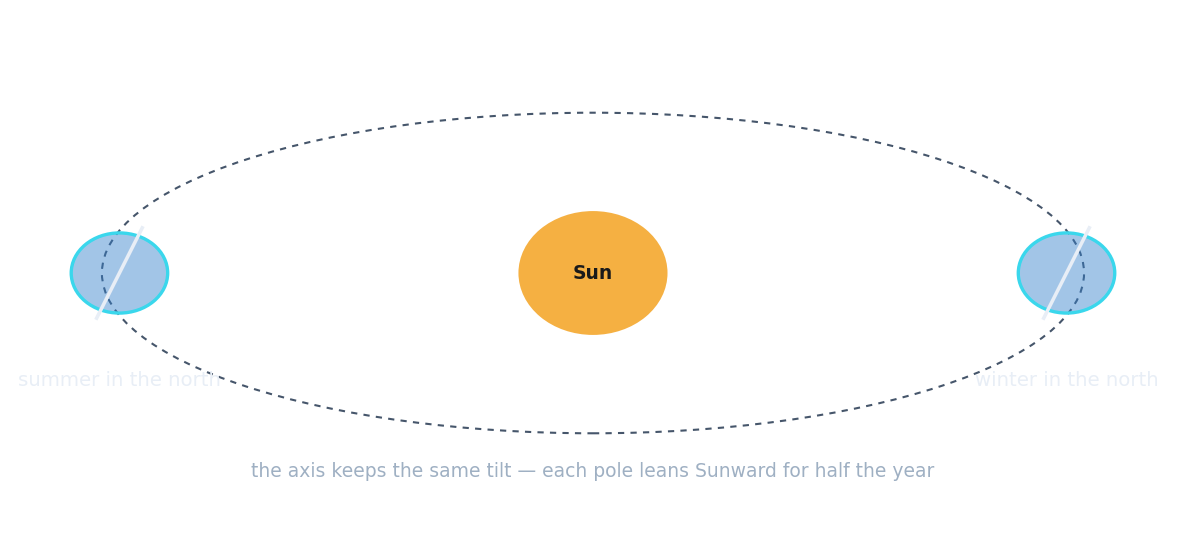
- The Earth rotates 自转 on its axis once in about $24$ hours — giving day and night.
- It orbits 公转 the Sun once in about $365$ days — one year.
- Its axis is tilted, so each half of the Earth leans toward the Sun for part of the year — giving the seasons 季节.
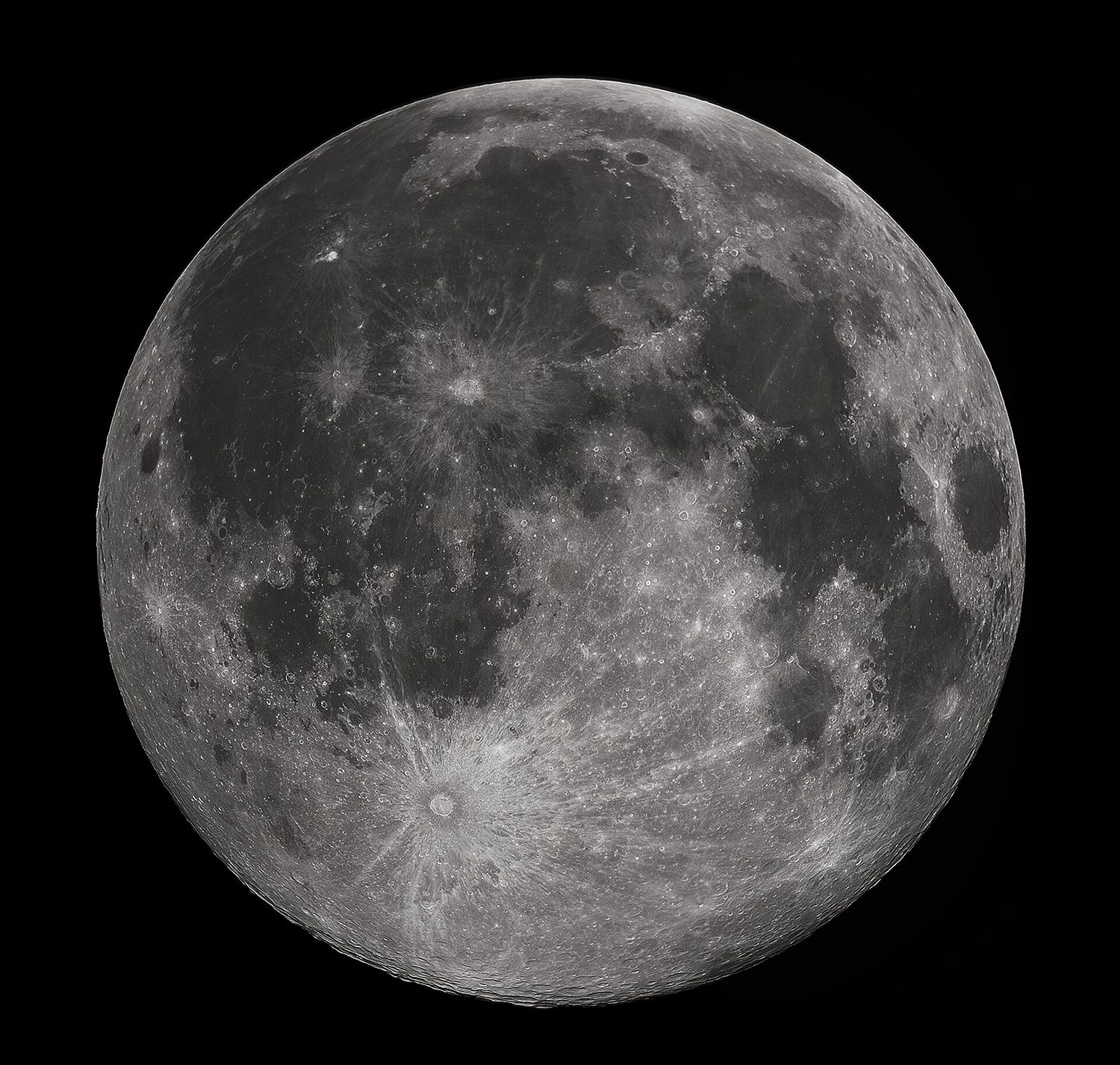
The full Moon, Earth's natural satellite
لماذا يتغير شكل القمر
الشمس تضيء دائماً نصف القمر؛ الطور هو ببساطة مقدار هذا النصف المضاء الذي يواجهنا أثناء دوران القمر — إنه ليس ظل الأرض.
ما الذي يسبب النهار والليل؟
الصعوبة 1/5 · 100 عملة + مكافأة صغيرة عند الإنجاز الأول اليوم
تدور الأرض مرة واحدة في حوالي 24 ساعة، لذا فإن كل مكان يواجه الشمس (نهار) ثم يبتعد عنها (ليل).
ما الذي يسبب الفصول؟
الصعوبة 1/5 · 100 عملة + مكافأة صغيرة عند الإنجاز الأول اليوم
المحور المائل يعني أن كل نصف كرة يميل نحو الشمس لنصف السنة (الصيف) وبعيداً عنها لنصف آخر (الشتاء).
The Moon
- The Moon orbits the Earth once in about one month.
- As it goes round, we see different amounts of its lit side — the phases 月相 (new, half, full).
- From shortest to longest: day (Earth's spin) < month (Moon's orbit) < year (Earth's orbit).
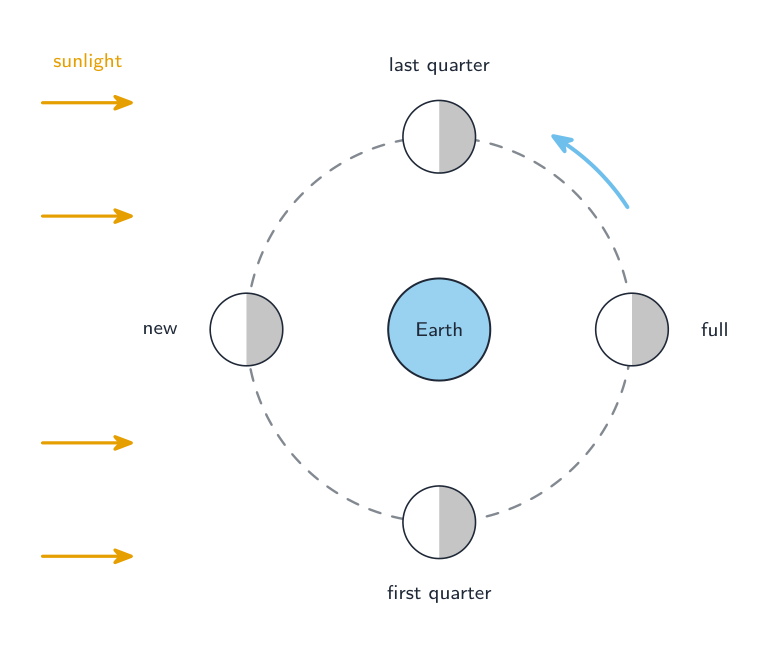
The Moon's lit half always faces the Sun, so as it orbits we see different amounts of it — new, half and full
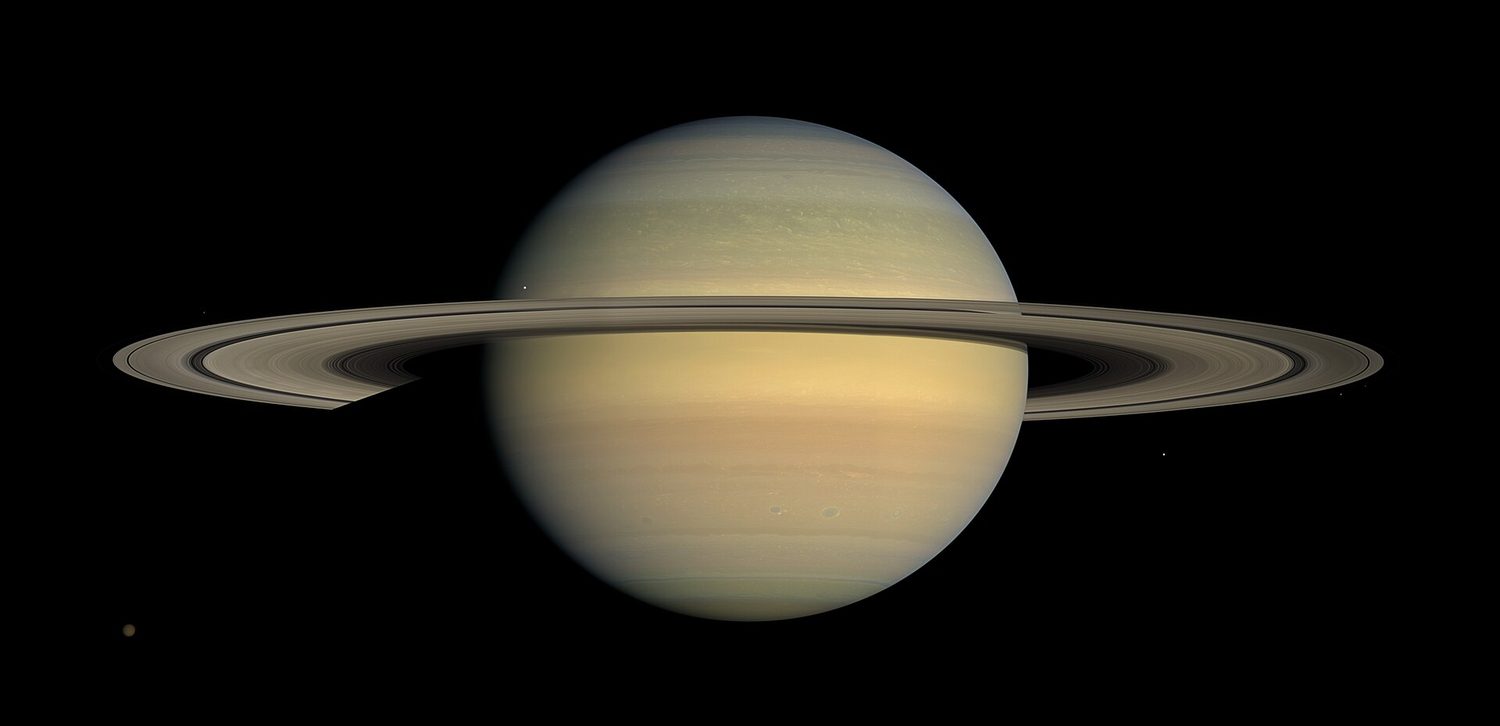
Saturn and its rings, photographed by the Cassini spacecraft
رتب هذه من الأقصر وقتاً إلى الأطول وقتاً.
الصعوبة 3/5 · 200 عملة + مكافأة صغيرة عند الإنجاز الأول اليوم
اليوم (~24 ساعة) < الشهر (~1 دورة قمرية) < السنة (~365 يومًا).
تحدث أطوار القمر لأننا نرى كميات مختلفة من جانبها المضاء أثناء مدارها.
الصعوبة 1/5 · 100 عملة + مكافأة صغيرة عند الإنجاز الأول اليوم
أثناء مدار القمر حول الأرض، يتغير الكسر من جانبه المضاء بالشمس الذي يمكننا رؤيته، مما يعطي القمر الجديد والنصف والقمر الكامل.
Orbital speed
- One full orbit covers the circumference $2\pi r$, where $r$ is the orbit radius.
- The orbital speed is that distance divided by the period 周期 $T$ (the time for one orbit):
- The same equation works for planets, moons and satellites.
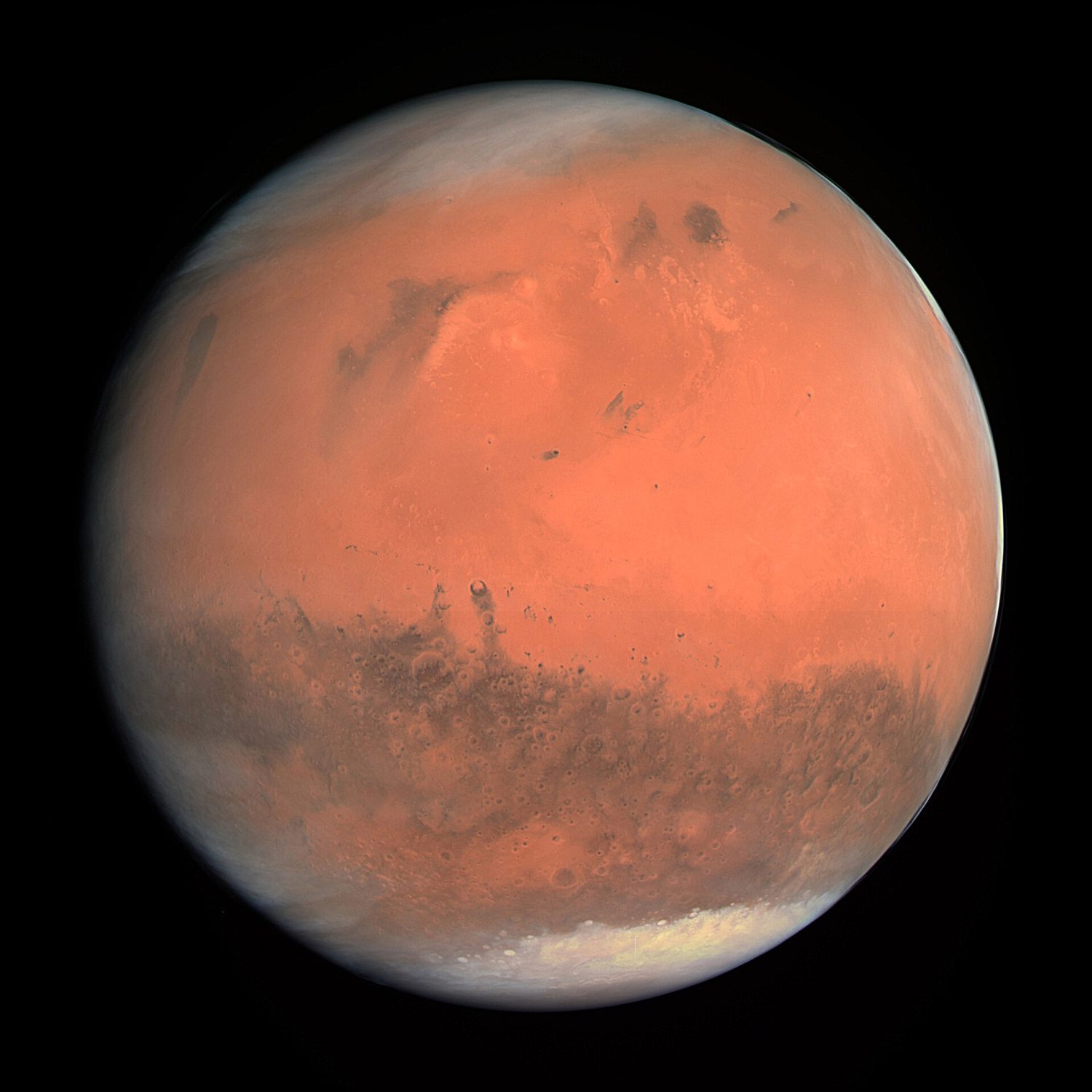
Mars, the red planet, one of the rocky inner planets
يدور قمر اصطناعي عند نصف قطر $r = 7.0 \times 10^6\ \text{m}$ مع فترة $T = 5800\ \text{s}$. ما هي سرعته المدارية، بوحدة م/ث؟
الصعوبة 2/5 · 140 عملة + مكافأة صغيرة عند الإنجاز الأول اليوم
$v = \dfrac{2\pi r}{T} = \dfrac{2\pi \times 7.0 \times 10^6}{5800} \approx 7600\ \text{m/s}$.
مقارنة بالكواكب القريبة من الشمس، الكواكب الخارجية تدور:
الصعوبة 1/5 · 100 عملة + مكافأة صغيرة عند الإنجاز الأول اليوم
جاذبية الشمس أضعف في الخارج، لذا تتحرك الكواكب الخارجية ببطء أكبر في مداراتها.
Worked examples
1. The Earth orbits the Sun at $r = 1.5 \times 10^{11}\ \text{m}$ in $T = 3.15 \times 10^7\ \text{s}$ (one year). $v = \dfrac{2\pi r}{T} = \dfrac{2\pi \times 1.5 \times 10^{11}}{3.15 \times 10^7} \approx 3.0 \times 10^4\ \text{m/s}$.
2. The Moon orbits the Earth at $r = 3.8 \times 10^8\ \text{m}$ in $27.3$ days $= 2.36 \times 10^6\ \text{s}$. $v = \dfrac{2\pi \times 3.8 \times 10^8}{2.36 \times 10^6} \approx 1.0 \times 10^3\ \text{m/s}$.
Seasons come from the tilt of the Earth's axis, not from the Earth moving closer to the Sun. A day is one spin on the axis; a year is one orbit of the Sun.
You've got it
- Earth spins → day/night; orbits the Sun → year; tilt → seasons
- the Moon orbits Earth in ~1 month, giving its phases
- day < month < year
- orbital speed $v = \dfrac{2\pi r}{T}$
Write from the data: find the orbital speed
- A satellite orbits at radius 4.0 times 10 to the 7 metres with period 8.0 times 10 to the 4 seconds. Use pi = 3.14.
- Find the orbital speed. Seasons come from the tilt of Earth's axis.
قمر اصطناعي نصف قطره المداري 4.0 مرة × 10 أس 7 متر وفترة دوره 8.0 مرة × 10 أس 4 ثانية. باستخدام باي = 3.14، ما هي سرعته المدارية، وما الذي يسبب الفصول؟
2 × 3.14 × 4.0 × 10 أس 7، مقسومًا على 8.0 × 10 أس 4، يساوي 3140 متر في الثانية.
ما هي السرعة المدارية؟
الصعوبة 1/5 · 100 عملة + مكافأة صغيرة عند الإنجاز الأول اليوم
2 × باي × r مقسومًا على T مع باي = 3.14 يساوي 3140 متر في الثانية.