النظائر
مُقدَّم| English | المعنى |
|---|---|
| isotopes/ˈaɪsətəʊps/ | نظائر |
| relative atomic mass/ˈrelətɪv əˈtɒmɪk mæs/ | الكتلة الذرية النسبية |
Same element, different mass
- All atoms of an element have the same number of protons — but they don't all weigh the same.
- Atoms of the same element with different numbers of neutrons are isotopes 同位素.
مختبر النظائر
Classify isotope facts by proton, neutron and mass number.
Isotopes are atoms of the same element with different numbers of:
الصعوبة 1/5 · 100 عملة + مكافأة صغيرة عند الإنجاز الأول اليوم
Isotopes differ only in neutron number.
Chlorine-37 has 17 protons. How many neutrons does it have?
الصعوبة 2/5 · 140 عملة + مكافأة صغيرة عند الإنجاز الأول اليوم
Neutrons = mass number − protons = 37 − 17 = 20.
Isotopes of an element always have the same number of ______.
الصعوبة 1/5 · 100 عملة + مكافأة صغيرة عند الإنجاز الأول اليوم
Same protons means it is still the same element.
What isotopes are
- Isotopes are atoms of the same element with the same protons but different neutrons.
- So they have the same atomic number but different mass numbers.
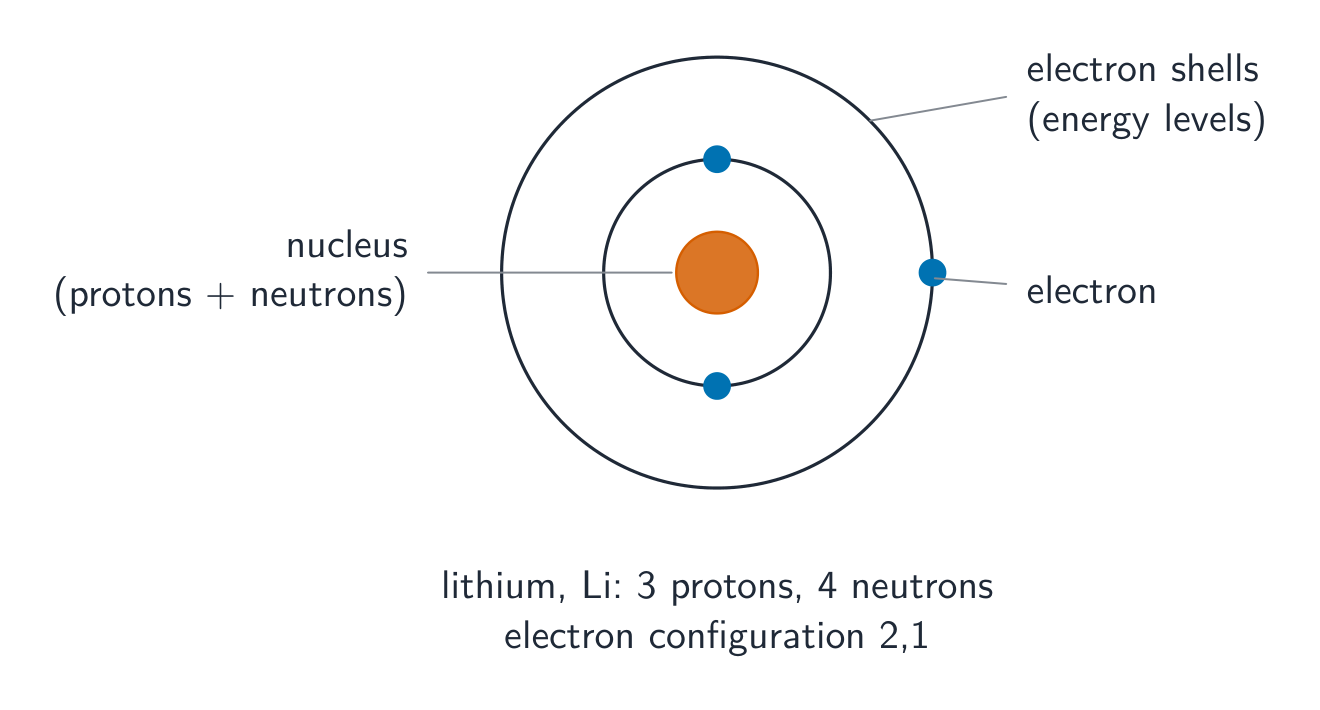
An atom's protons, neutrons and electrons — isotopes of an element differ only in their number of neutrons
البروتونات والنيوترونات والنظائر
Change the neutrons to make isotopes (same element, different mass number); change the electrons to make ions.
Isotopes of an element react chemically:
الصعوبة 1/5 · 100 عملة + مكافأة صغيرة عند الإنجاز الأول اليوم
Same electrons → same chemistry.
Same chemistry
- Isotopes have the same number of electrons, so they react chemically the same.
- Only their mass differs (and sometimes radioactivity).
Worked example. Chlorine-35 and chlorine-37 are isotopes: both have 17 protons (and 17 electrons), but one has 18 neutrons and the other 20. They behave identically in reactions.
Relative atomic mass is the mass of the most common isotope of an element.
الصعوبة 1/5 · 100 عملة + مكافأة صغيرة عند الإنجاز الأول اليوم
False. It is the weighted average mass of all the element's isotopes, which takes into account how common each isotope is.
Relative atomic mass 相对原子质量
- Because an element is a mix of isotopes, we use an average mass: the relative atomic mass (Ar).
- It is the average mass of the isotopes, weighted by how common each is.
Isotopes differ in neutrons, not protons. Changing the proton number would change the element entirely. Isotopes are the same element — only the neutron count (and mass) changes.
Worked example: calculating Ar
Chlorine is 75% chlorine-35 and 25% chlorine-37. Find its relative atomic mass.
- The answer lies between 35 and 37, closer to 35 because chlorine-35 is more common.
Boron is 20% boron-10 and 80% boron-11. Calculate its relative atomic mass.
الصعوبة 2/5 · 140 عملة + مكافأة صغيرة عند الإنجاز الأول اليوم
(10 × 20 + 11 × 80) ÷ 100 = (200 + 880) ÷ 100 = 10.8.
Copper has two isotopes, copper-63 and copper-65, and Ar = 63.5. Which isotope is more common?
الصعوبة 1/5 · 100 عملة + مكافأة صغيرة عند الإنجاز الأول اليوم
63.5 is closer to 63, so copper-63 makes up most of the atoms (about 75%).
You've got it
- isotopes = same element, same protons, different neutrons (different mass)
- they have the same electrons, so the same chemistry
- relative atomic mass (Ar) is the weighted average mass of an element's isotopes
Write from the data given
- Magnesium-25 has atomic number 12.
- Chlorine-37 in the lesson has 17 protons and 20 neutrons.
How many neutrons are in magnesium-25?
Neutrons equal 25 minus the 12 protons.
How many neutrons are in magnesium-25?
الصعوبة 1/5 · 100 عملة + مكافأة صغيرة عند الإنجاز الأول اليوم
25 minus 12 is 13. Other options — 20 (the chlorine-37 count); 12 (the proton number).