Electronic configuration and the Periodic Table
مُقدَّم| English | المعنى |
|---|---|
| electronic configuration/ɪlekˈtrɒnɪk kənˌfɪɡjəˈreɪʃn/ | التوزيع الإلكتروني |
| group/ɡruːp/ | مجموعة |
| period/ˈpɪərɪəd/ | الزمن الدوري |
How electrons are arranged
- Electrons aren't scattered randomly — they fill up shells around the nucleus in a set order.
- This arrangement explains the whole shape of the Periodic Table.
What is the maximum number of electrons in the first (innermost) shell?
الصعوبة 2/5 · 140 عملة + مكافأة صغيرة عند الإنجاز الأول اليوم
The first shell holds up to 2 electrons.
Filling the shells
- Electrons fill the innermost shell first, then the next.
- The shells hold up to 2, then 8, then 8 electrons (at this level).
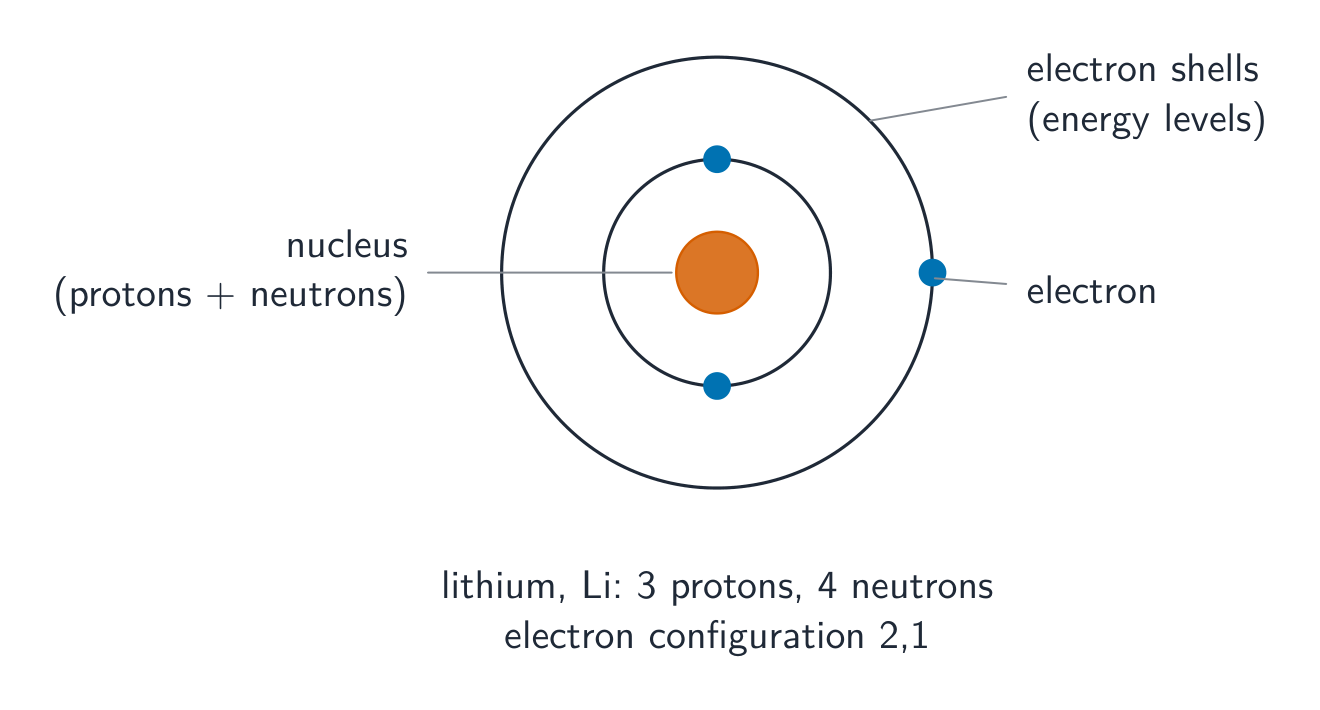
An atom has a tiny nucleus of protons and neutrons, with electrons in shells around it
The electronic configuration of sodium (11 electrons) is:
الصعوبة 1/5 · 100 عملة + مكافأة صغيرة عند الإنجاز الأول اليوم
Fill inner shells first: 2, 8, then 1.
Chlorine has 17 electrons, giving the configuration 2, 8, ______.
الصعوبة 1/5 · 100 عملة + مكافأة صغيرة عند الإنجاز الأول اليوم
2 + 8 + 7 = 17 electrons.
Writing the configuration
- The electronic configuration 电子排布 lists how many electrons are in each shell.
- Example: sodium (11 electrons) is 2, 8, 1.
Worked example. Chlorine has 17 electrons. Fill the shells: 2, then 8, then the remaining 7 → configuration 2, 8, 7. The 7 outer electrons place it in Group 族 VII.
املأ مدارات الإلكترونات
Electrons fill the inner shell first (max 2), then the next (max 8). The number in the OUTER shell is the group number — chlorine's 2,8,7 puts it in Group VII.
An element with 7 electrons in its outer shell is in:
الصعوبة 1/5 · 100 عملة + مكافأة صغيرة عند الإنجاز الأول اليوم
Outer electrons = group number, so 7 → Group VII.
The number of electron shells an atom uses equals its period number.
الصعوبة 1/5 · 100 عملة + مكافأة صغيرة عند الإنجاز الأول اليوم
Period = number of occupied shells.
Link to the Periodic Table
- The number of outer-shell electrons = the group number.
- The number of shells used = the period 周期 number.
The outer shell decides the chemistry. Elements in the same group have the same number of outer electrons, so they react in similar ways. That's why the group number is so important.
Configurations, groups and periods
| Element | Electrons | Configuration | Group | Period |
|---|---|---|---|---|
| lithium | 3 | 2, 1 | I | 2 |
| carbon | 6 | 2, 4 | IV | 2 |
| neon | 10 | 2, 8 | VIII (0) | 2 |
| magnesium | 12 | 2, 8, 2 | II | 3 |
| sulfur | 16 | 2, 8, 6 | VI | 3 |
| potassium | 19 | 2, 8, 8, 1 | I | 4 |
- Noble gases have a full outer shell, which is why they are unreactive.
Calcium has 20 electrons. What is its electronic configuration?
الصعوبة 1/5 · 100 عملة + مكافأة صغيرة عند الإنجاز الأول اليوم
Fill 2, then 8, then 8, leaving 2 in the fourth shell. Two outer electrons: Group II, period 4.
An element has the configuration 2, 8, 5. Which period is it in?
الصعوبة 2/5 · 140 عملة + مكافأة صغيرة عند الإنجاز الأول اليوم
It uses three shells, so period 3 (it is phosphorus, in Group V).
You've got it
- electrons fill shells from the inside out: 2, 8, 8
- the electronic configuration lists electrons per shell (e.g. sodium 2,8,1)
- outer electrons = group number; number of shells = period number
Write from the data given
- An atom has the electronic configuration 2, 8, 8, 1.
- The first shell still holds at most 2 electrons, which is the lesson's shell limit and not the question here.
Which period is this element in?
The period equals the number of occupied shells.
What is the period of 2, 8, 8, 1?
الصعوبة 1/5 · 100 عملة + مكافأة صغيرة عند الإنجاز الأول اليوم
Four numbers in the configuration mean four shells. Other options — Period 2 (the first-shell maximum); Period 1 (the outer-electron count).