خطة التعلم الخاصة بك · متابعة · مراجعة →
Adj + 死了 (extremely …)
مُقدَّميبقى موقعك المحفوظ في هذا المتصفح. لا يكتمل استئناف الموقع الدرس أو الإجابة على أسئلته.
 3:48
HSK 4 القواعد 01: الصفات
نمطان يحملان الكثير من HSK 4. 全 قبل الاسم يشتمل على الكل مرة واحدة، والصفة متبوعة بـ 死了 ترفع الشعور إلى حدّه الأقصى. كلاهما يُختَبَر…
شروحات إنجليزية + أمثلة ماندرين · التسميات تتبع النص المنطوق
في هذا الدرس
Melting in July
- You come into the classroom after cycling across town in 38 degrees.
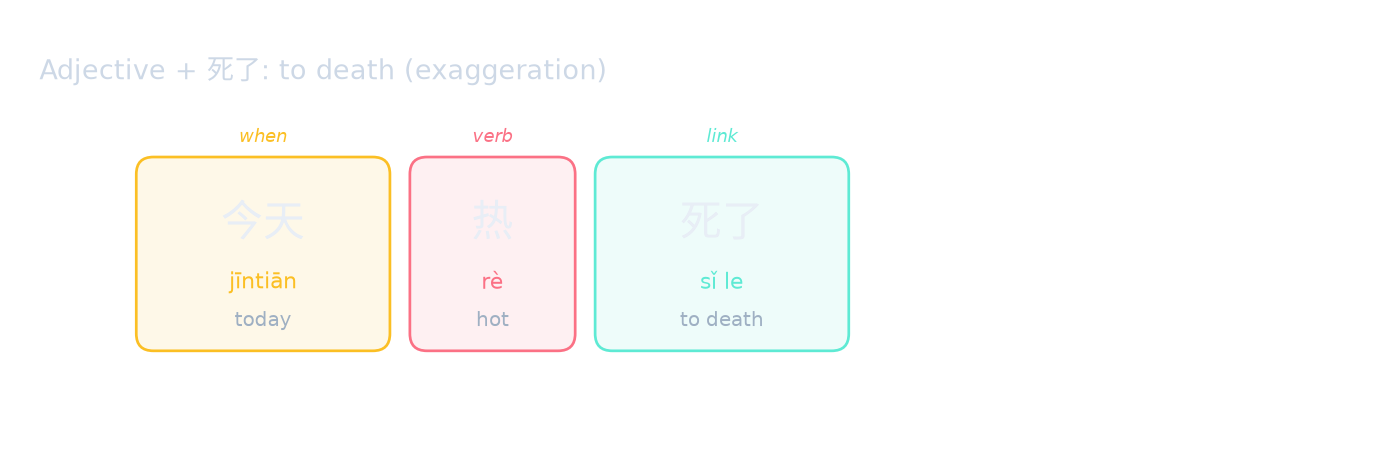
- today今天hot热to death死(completed / change)了! — "It's boiling today!" to death死(completed / change)了 exaggerates a feeling to the extreme.
- Goal: make a feeling or quality extreme with adjective + to death死(completed / change)了 (tired累to death死(completed / change)了, hot热to death死(completed / change)了) in casual speech.
Adjective + to death死(completed / change)了
- Adj + to death死(completed / change)了 = "extremely, to death" in casual speech: tired累to death死(completed / change)了, to starve to death饿死(completed / change)了, busy忙to death死(completed / change)了.
- It ends the clause, and the adjective stands alone: cold冷to death死(completed / change)了, not degree / adjective linker很cold冷to death死(completed / change)了.
I我hungry饿to death死了,quickly快eat吃饭吧!
Complain to a friend: “I'm exhausted!” 我累____!
الصعوبة 1/5 · 100 عملة + مكافأة صغيرة عند الإنجاز الأول اليوم
Adj + 死了 exaggerates the feeling.
Mostly complaints, sometimes joy
- Complaints are typical: this这个homework作业hard难to death死(completed / change)了。 — "This homework is impossibly hard."
- Strong positive feelings work too: to hear听到this这个news; message消息,I我happy; glad高兴to death死(completed / change)了! — "I was over the moon when I heard!"
this这个homework作业hard难to death死了。
Build: “This homework is impossibly hard.”
الصعوبة 3/5 · 200 عملة + مكافأة صغيرة عند الإنجاز الأول اليوم
Subject + Adj + 死了.
Casual only
- Use it with friends and family; in an essay or a formal email, write very非常tired累 or very十分hungry饿 instead.
- No degree / adjective linker很 or very非常 in front, and nothing between the adjective and to death死(completed / change)了: tired累to death死(completed / change)了, not degree / adjective linker很tired累to death死(completed / change)了.
Which sentence suits a formal report?
الصعوبة 1/5 · 100 عملة + مكافأة صغيرة عند الإنجاز الأول اليوم
死了 is casual; a report uses 非常 or 十分.
to death死(completed / change)了 versus extremely极了 and (degree marker)得extremely; terrible要命
- 好极了 sounds enthusiastic and fits praise; good好to death死(completed / change)了 is rare, because to death死(completed / change)了 leans to complaints.
- (degree marker)得extremely; terrible要命 is equally colloquial: tired累(degree marker)得extremely; terrible要命 — "dead tired". With verbs of missing: miss想to death死you你(completed / change)了 — "I miss you like crazy."
I我miss想to death死you你了!
想死你了 means “I miss you terribly.”
الصعوبة 1/5 · 100 عملة + مكافأة صغيرة عند الإنجاز الأول اليوم
With 想 (miss), 死 exaggerates the longing.
Recap
- Adj + to death死(completed / change)了 = extremely (colloquial, often a complaint): hot热to death死(completed / change)了, tired累to death死(completed / change)了, hard难to death死(completed / change)了.
- No degree / adjective linker很 before it; keep it out of formal writing, where very非常 / very十分 fit.
Read the full reference: HSK 4 grammar — Adjectives.
You come into the classroom after cycling across town in 38 degrees. Close the examples. Say a Mandarin response, then write it in Chinese. Explain briefly in English what the lesson’s pattern adds. Compare with the model, then change one detail and try again.
This is supported productive practice. Compare meaning and structure; your answer need not copy the model. A partner or teacher must hear the spoken response to comment on pronunciation.
ما المشكلة؟ لا يرى ذلك سوى فريق الموقع.