Measures of Development
مُقدَّم| English | المعنى |
|---|---|
| development/dɪˈveləpmənt/ | التنمية |
| GDP per capita/ˌdʒiː diː ˈpiː pɜː ˈkæpɪtə/ | إجمالي الناتج المحلي للفرد |
| Gini coefficient/ˈdʒiːni ˌkəʊɪˈfɪʃənt/ | معامل جيني |
| Human Development Index/ˈhjuːmən dɪˈveləpmənt ˈɪndeks/ | مؤشر التنمية البشرية |
| Gender Inequality Index/ˈdʒendə ɪniːˈkwɒlɪti ˈɪndeks/ | مؤشر عدم المساواة بين الجنسين |
Richer, but less developed?
- Equatorial Guinea earns more per person than Sri Lanka (about 17,000 vs 14,000 US dollars a year, adjusted for prices), mainly from oil. Yet people in Sri Lanka live more than ten years longer on average and spend more years in school.
- Development 发展 means improving people's economic and social well-being. No single number shows it, so geographers use several measures, each with strengths and weaknesses.
Equatorial Guinea has a higher income per person than Sri Lanka but a lower life expectancy. What does this show?
الصعوبة 1/5 · 100 عملة + مكافأة صغيرة عند الإنجاز الأول اليوم
Development includes health and education, not only income.
Economic measures
| Measure | What it counts | Weakness |
|---|---|---|
| GDP per capita 人均国内生产总值 | value of goods and services produced inside a country, per person | an average: hides inequality; misses the informal economy (unregistered street sellers, home work) |
| GNI per capita | income earned by a country's people and firms, including abroad, per person | same average problem |
| Sectoral structure | share of workers in primary, secondary and tertiary jobs | does not show wages or living conditions |
| Gini coefficient 基尼系数 | income inequality: 0 = everyone equal, 1 = one person has everything | says nothing about average income |
- Figures are usually adjusted for purchasing power parity (PPP), because a dollar buys more in some countries than in others.
Match each measure to what it shows.
الصعوبة 2/5 · 140 عملة + مكافأة صغيرة عند الإنجاز الأول اليوم
Each economic measure answers a different question.
A Gini coefficient of 0.6 shows more income inequality than one of 0.3.
الصعوبة 1/5 · 100 عملة + مكافأة صغيرة عند الإنجاز الأول اليوم
Closer to 1 means more unequal.
Social and demographic measures
- Health: life expectancy, infant mortality rate (deaths under age 1 per 1,000 births), access to health care.
- Education and society: literacy rate, years of schooling, total fertility rate (usually lower in more developed countries), access to clean water and electricity.
The Human Development Index
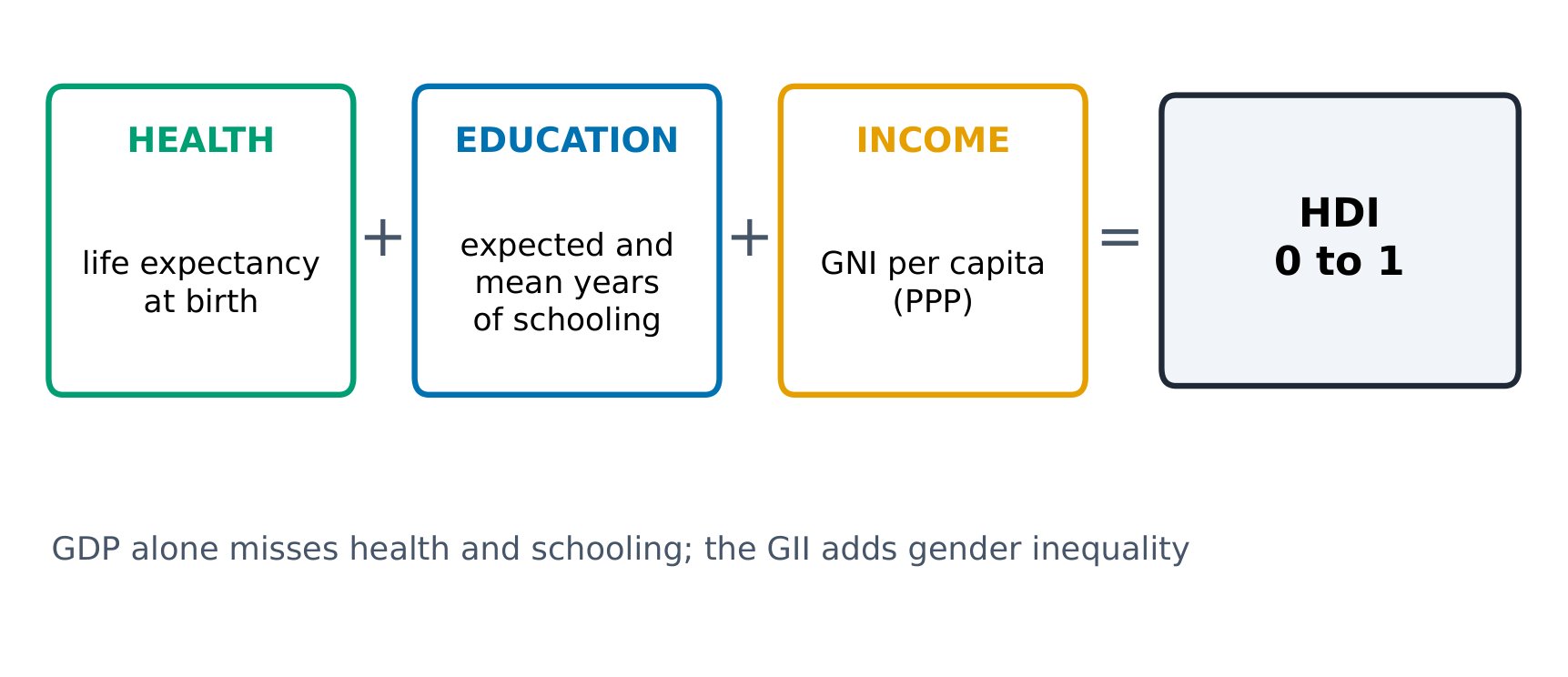
- The Human Development Index 人类发展指数 (HDI), published by the United Nations, combines three dimensions: a long and healthy life (life expectancy), knowledge (years of schooling) and a decent standard of living (GNI per capita, PPP). It runs from 0 to 1: Norway scores about 0.97, Niger about 0.39.
- Back to the hook: Sri Lanka's HDI (about 0.78) is well above Equatorial Guinea's (about 0.65), because health and education count, not only income.
Which development measure?
Match each measure to what it captures.
Which are dimensions of the Human Development Index?
الصعوبة 2/5 · 140 عملة + مكافأة صغيرة عند الإنجاز الأول اليوم
Seats in parliament belong to the Gender Inequality Index.
Gender inequality
- The Gender Inequality Index 性别不平等指数 (GII) measures the gap between women and men in reproductive health (maternal deaths, teenage births), empowerment (seats in parliament, secondary education) and the labour market (share of women in work). 0 means equal; higher scores mean more inequality.
- Countries with similar HDI can have very different GII, so it shows a part of development that averages hide.
Which is part of the Gender Inequality Index?
الصعوبة 1/5 · 100 عملة + مكافأة صغيرة عند الإنجاز الأول اليوم
Parliament seats measure empowerment, one of the GII's three dimensions.
Worked FRQ answer
(A) Identify the three dimensions of the HDI. Health (life expectancy), education (years of schooling) and standard of living (GNI per capita).
(B) Explain why GDP per capita alone can give a misleading picture of development. It is an average, so in a country where a small group earns most of the oil income, GDP per capita can be high while most people remain poor and lack health care and schooling.
(C) Explain ONE advantage of the GII over the HDI for studying development. The GII shows inequality between women and men, such as access to education and political power, which the HDI's national averages hide.
- Why it scores: (B) explains why the average misleads (distribution of income) with a type of country; (C) names what the GII adds.
A high income is not the same as high development. Always ask how the income is shared (Gini) and whether it turns into health and education (HDI).
Economic measures: GDP and GNI per capita (PPP), sectoral structure and the Gini coefficient. Social measures: life expectancy, infant mortality, literacy and fertility. The HDI combines health, education and income (0 to 1). The GII measures gaps between women and men. Use several measures together.
FRQ practice. (A) Define the informal economy. (B) Explain why a large informal economy makes GDP per capita less accurate. (C) Explain why infant mortality rate is a useful measure of development.
Say what each measure includes and leaves out.