بيانات حضرية
مُقدَّم 8:14
المدن وأنماط استخدام الأراضي الحضرية والعمليات المتعلقة بها
أكثر من نصف سكان الأرض يعيشون الآن في مدينة، ولا يزال هذا الجزء يتزايد. يمكن للمدينة جذب الأموال والوظائف والأفكار من جميع أنحاء العالم. وعلى مستوى…
سرد باللغة الإنجليزية · ترجمة نصية بالإنجليزية و中文 يمكنك التبديل بينهما
In this lesson
| English | المعنى |
|---|---|
| urban data/ˈɜːbən ˈdeɪtə/ | البيانات الحضرية |
| smart cities/smɑːt ˈsɪtiz/ | المدن الذكية |
| privacy/ˈprɪvəsi/ | الخصوصية |
Where do the buses run late?
- In 2013, Seoul analysed about 3 billion anonymous late-night phone calls and texts to see where people were at night. The data showed crowds of night-shift workers and students with no bus home. The city used it to plan its late-night "Owl Bus" routes along exactly those corridors.
- Urban data 城市数据 is information about cities, such as population, housing, traffic and services. Planners use it to see patterns and decide where to invest, but every data source has limits.
Sources of urban data
| Source | What it shows | Limitation |
|---|---|---|
| Census | population, age, income, housing by district | only every 5–10 years; may undercount informal settlements |
| Surveys | travel habits, opinions, needs | small samples; people may not answer honestly |
| Satellite images | land use, city growth, green space | show what is there, not who lives there |
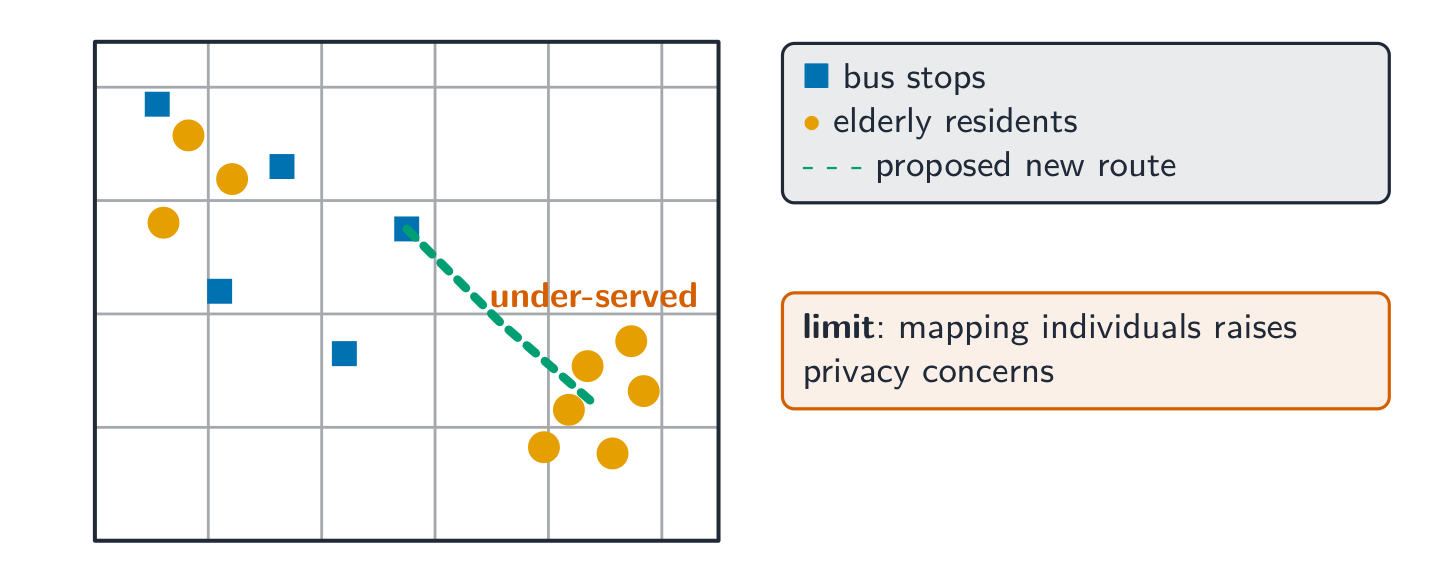
| Sensors and phone data | real-time traffic, crowds, air quality | privacy concerns; poorer residents may own fewer phones |
Match each data source to its main limitation.
الصعوبة 2/5 · 140 عملة + مكافأة صغيرة عند الإنجاز الأول اليوم
Every source leaves something out.
Data at different scales
- City-wide averages can hide large differences. A city with good average income can still have neighbourhoods where most homes lack piped water.
- Comparing data at the city, district and block scale shows where needs are greatest, so services can go to the people who need them.
Benefit or concern of urban data?
Sort each item as a benefit or a concern of using urban data.
A high city-wide average income proves that every neighbourhood is well off.
الصعوبة 1/5 · 100 عملة + مكافأة صغيرة عند الإنجاز الأول اليوم
Averages hide local differences; compare smaller scales.
Smart cities and privacy
- Smart cities 智慧城市 use sensors and real-time data to run services: traffic lights that respond to queues, bins that report when full, apps that show bus arrivals.
- Benefits: less congestion, lower energy use, faster emergency response. Costs: surveillance and loss of privacy 隐私, data controlled by private companies, and people without smartphones left out.
Which are concerns about smart cities?
الصعوبة 2/5 · 140 عملة + مكافأة صغيرة عند الإنجاز الأول اليوم
Faster emergency response is a benefit.
Worked FRQ answer
(A) Identify ONE source of urban data. The national census.
(B) Explain how planners could use census data to decide where to build a new school. By mapping the number of school-age children in each district and comparing it with existing school places, planners can see which districts have the biggest shortage.
(C) Explain ONE limitation of using phone-location data to plan public transport. People without smartphones, often older or poorer residents, do not appear in the data, so their travel needs may be ignored.
- Why it scores: (B) shows the comparison that leads to the decision; (C) names who is missing and the effect.
Quantitative data does not explain everything. Numbers show where problems are; interviews and surveys explain why people make the choices they do.
Urban data comes from the census, surveys, satellite images and sensors; each has limits. Scale matters: averages hide local needs. Smart cities use real-time data to improve services but raise privacy and inclusion concerns.
FRQ practice. A city wants to reduce traffic jams. (A) Identify ONE type of urban data it could collect. (B) Explain how the data could guide a decision. (C) Explain ONE ethical concern.
Data, decision, ethics.