Consequences of Agricultural Practices
مُقدَّم| English | المعنى |
|---|---|
| desertification/dɪˌzɜːtɪfɪˈkeɪʃn/ | التصحّر |
| soil erosion/sɔɪl ɪˈrəʊʒn/ | تآكل التربة |
| eutrophication/ˌjuːtrəfɪˈkeɪʃn/ | الاستهلاك الغذائي الزائد |
| biodiversity/ˌbaɪəʊdaɪˈvɜːsɪti/ | التنوع البيولوجي |
A sea that disappeared
- In 1960, the Aral Sea in Central Asia was the world's fourth-largest lake. Soviet planners then diverted its two feeding rivers to irrigate cotton fields. By the 2010s, the sea had lost about 90% of its water; fishing towns were left tens of kilometres from the shore, and dust storms carried salt and pesticides across the region.
- Farming changes the land, water and living things around it. Some changes are planned (new fields), others are side effects (polluted rivers). The exam asks you to link each practice to its consequence.
Practices and the land they change
| Practice | What it changes | Possible consequence |
|---|---|---|
| Irrigation | moves water from rivers and aquifers to fields | shrinking rivers and lakes (Aral Sea); soil salinization (salt left behind as water evaporates) |
| Clearing forest (incl. slash-and-burn) | forest → fields or pasture | deforestation, habitat loss, carbon released, soil erosion |
| Draining wetlands | marsh → farmland | lost habitats and natural flood control |
| Terrace farming | steep slopes → flat steps | reduces soil erosion on hillsides |
| Overgrazing in dry lands | removes plant cover | desertification 荒漠化 (Sahel) |
Which environmental harm?
Sort each impact by the environmental harm it describes.
Match each practice to a possible consequence.
الصعوبة 2/5 · 140 عملة + مكافأة صغيرة عند الإنجاز الأول اليوم
Practice → consequence.
Terrace farming increases soil erosion on hillsides.
الصعوبة 1/5 · 100 عملة + مكافأة صغيرة عند الإنجاز الأول اليوم
Flat steps slow running water and reduce erosion.
Soil and land
- Soil erosion 土壤侵蚀: bare fields lose topsoil to wind and rain. In the 1930s US Dust Bowl, ploughed grasslands in a drought blew away in huge dust storms.
- Desertification: dry land loses its plant cover and fertility through overgrazing, over-farming and drought, so it turns towards desert.
Water and wildlife
- Fertiliser run-off causes eutrophication 富营养化: nutrients feed algae blooms that use up oxygen in lakes and coastal waters, killing fish (the "dead zone" in the Gulf of Mexico).
- Pesticides can harm bees and birds; growing one crop over large areas (monoculture) reduces biodiversity 生物多样性 and makes crops vulnerable to a single pest.
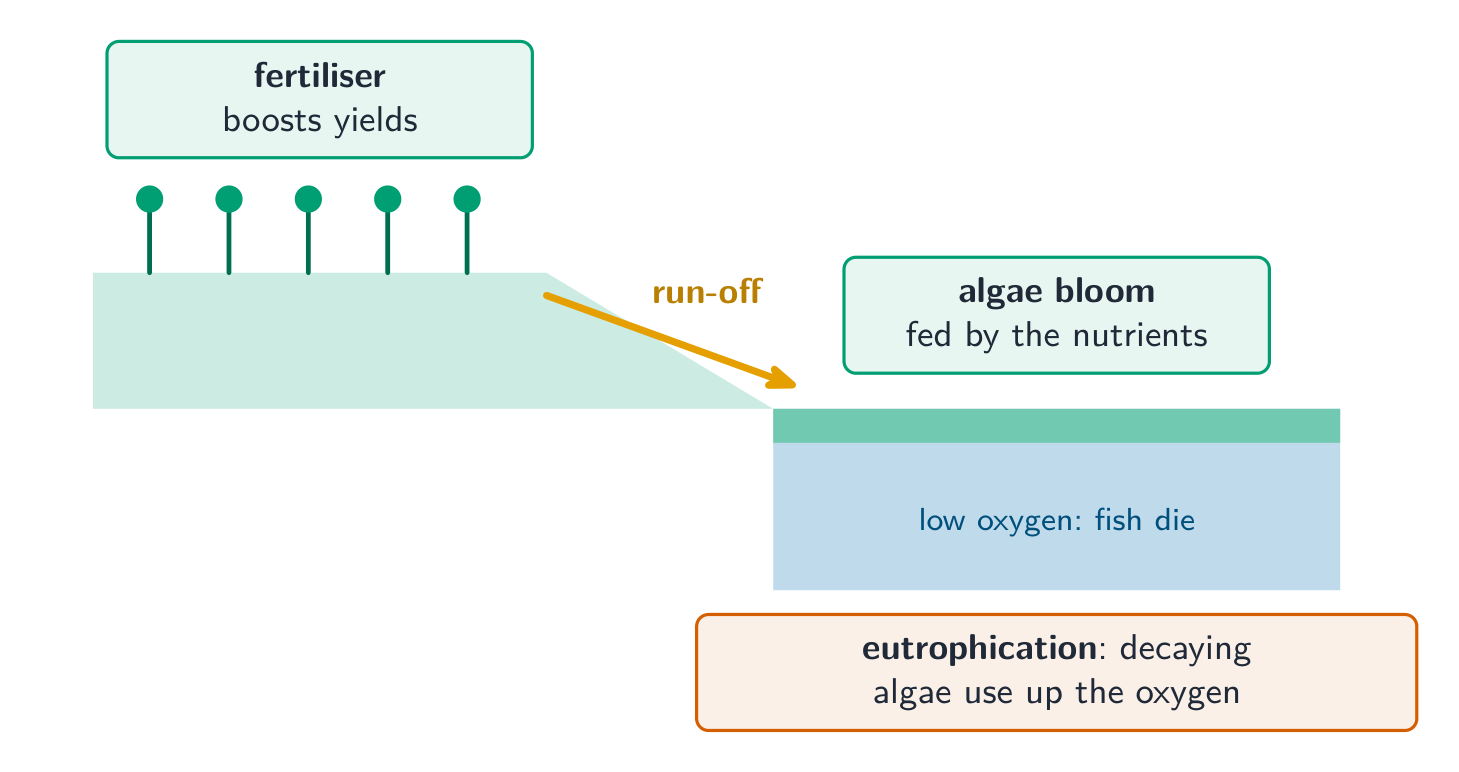
Put the steps of eutrophication in order.
الصعوبة 3/5 · 200 عملة + مكافأة صغيرة عند الإنجاز الأول اليوم
More nutrients lead to less oxygen.
Conservation responses
- Contour ploughing and terracing slow water running down slopes; cover crops and crop rotation protect and restore soil; buffer strips of plants along rivers catch fertiliser run-off.
- Drip irrigation delivers water to plant roots with less waste, which reduces both water loss and salinization.
Which are conservation practices?
الصعوبة 2/5 · 140 عملة + مكافأة صغيرة عند الإنجاز الأول اليوم
Draining wetlands destroys habitat and flood control.
Worked FRQ answer
(A) Describe soil salinization. The build-up of salt in soil when irrigation water evaporates and leaves its dissolved salts behind.
(B) Explain how irrigation for cotton caused environmental damage around the Aral Sea. Rivers that fed the sea were diverted to irrigate cotton, so the sea shrank; its exposed bed, full of salt and farm chemicals, was blown by the wind onto farmland and towns, harming soils and people's health.
(C) Explain ONE conservation practice that reduces soil erosion. Terracing turns a steep slope into flat steps, so rain soaks in instead of running downhill and washing topsoil away.
- Why it scores: (B) is a full cause → effect chain; (C) explains how the practice works.
Name the practice, then the consequence, then the mechanism. "Farming causes pollution" earns nothing; "fertiliser run-off feeds algae that remove oxygen from the water" does.
Agricultural practices change the land: irrigation (shrinking water bodies, salinization), forest clearing (deforestation), wetland draining and overgrazing (desertification). Side effects include soil erosion, eutrophication, pesticide harm and lost biodiversity. Conservation: terracing, contour ploughing, cover crops, rotation, buffer strips and drip irrigation.
FRQ practice. (A) Identify ONE environmental consequence of pastoral nomadism or ranching in dry regions. (B) Explain how it happens. (C) Explain ONE way governments or farmers can reduce it.
Practice, mechanism, response.