The Green Revolution
مُقدَّم| English | المعنى |
|---|---|
| Green Revolution/ɡriːn ˌrevəˈluːʃn/ | الثورة الخضراء |
| high-yield varieties/haɪ jiːld vəˈraɪətiz/ | الأنواع عالية الإنتاجية |
| biodiversity/ˌbaɪəʊdaɪˈvɜːsɪti/ | التنوع البيولوجي |
Famine expected, famine avoided
- In the mid-1960s, after two failed monsoons, many experts predicted mass famine in India. Instead, Indian wheat production rose from about 12 million tonnes in 1965 to over 20 million tonnes by 1970, and India stopped needing large food imports.
- The change was part of the Green Revolution 绿色革命: the spread of new farming technology from the 1940s (Mexico) to the 1960s–70s (South and Southeast Asia).
The four parts of the package
| Part | What it is | Why it raised yields |
|---|---|---|
| High-yield varieties 高产品种 (HYVs) | new wheat and rice bred by scientists such as Norman Borlaug | short, strong stems hold more grain without falling over |
| Chemical fertiliser | added nitrogen and other nutrients | HYVs give big harvests only with plenty of nutrients |
| Pesticides | chemicals that kill insects and weeds | protect uniform crops that pests could otherwise destroy |
| Irrigation and machinery | wells, pumps, canals, tractors | steady water allows two or three harvests a year |
- The seeds only work with the rest of the package, so farmers needed money, water and roads to benefit.
Which were parts of the Green Revolution package?
الصعوبة 2/5 · 140 عملة + مكافأة صغيرة عند الإنجاز الأول اليوم
The package depended on chemicals, not organic methods.
Benefits
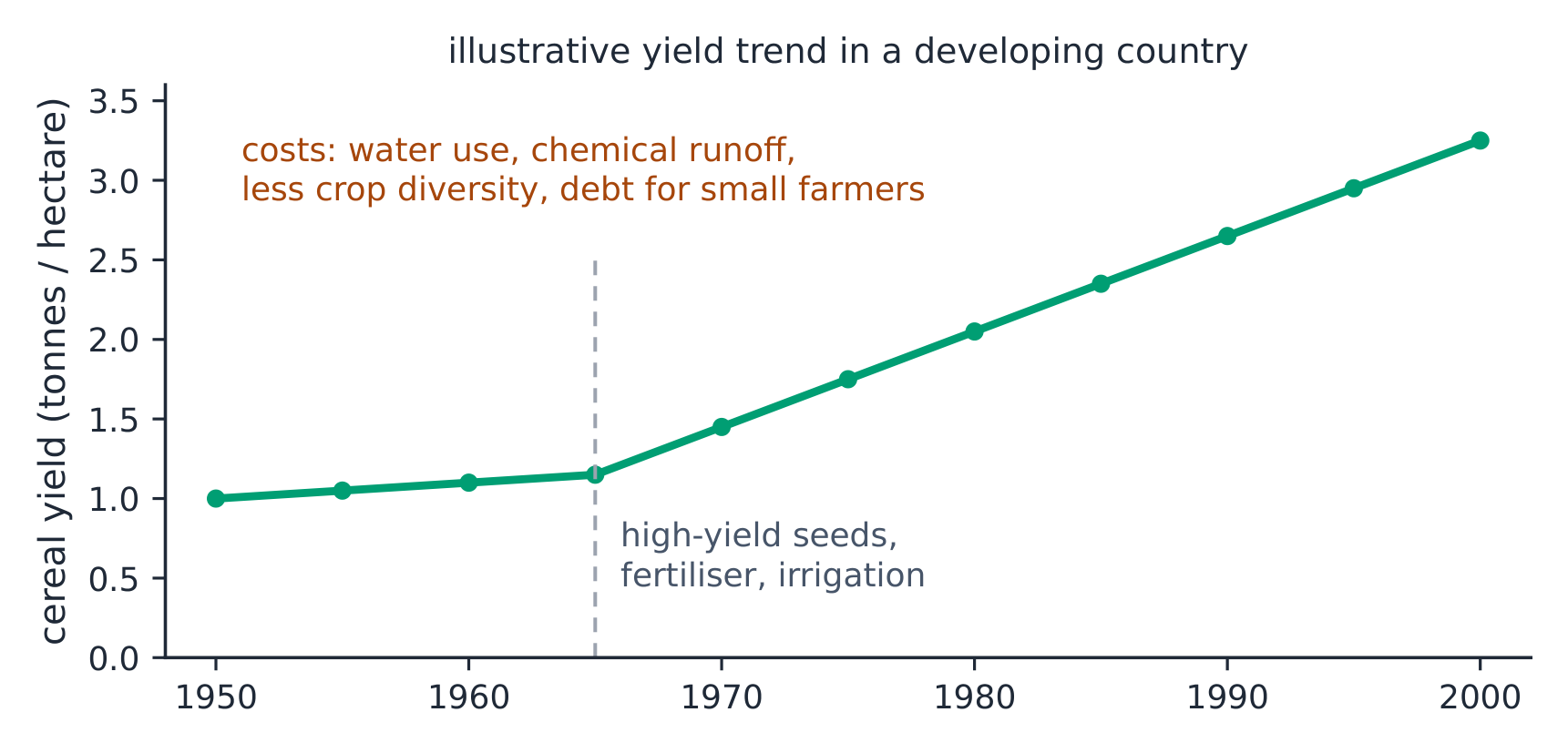
- More food from the same land: yields of wheat and rice roughly doubled in many areas, feeding fast-growing populations and lowering food prices.
- Fewer famines: Mexico, India, the Philippines and others became nearly self-sufficient in grain, which seemed to answer Malthus's warning.
هل فائدة الثورة الخضراء أم تكلفتها؟
Sort each outcome as a benefit or a cost of the Green Revolution.
A district harvested 2 tonnes of grain per hectare; after new seeds, fertiliser and irrigation it harvested 4.6 tonnes on the same land. By what percentage did the yield rise?
الصعوبة 2/5 · 140 عملة + مكافأة صغيرة عند الإنجاز الأول اليوم
(4.6 − 2) ÷ 2 × 100 = 130%.
Environmental costs
- Water: pumping for irrigation has lowered groundwater levels sharply in parts of Indian Punjab; fertiliser runoff pollutes rivers and lakes.
- Soil and biodiversity 生物多样性: heavy chemical use damages soil; farmers replaced many local varieties with a few HYVs, so one disease or pest can destroy large areas of crops.
Social costs and where it did not reach
- Inequality: richer farmers with land, water and credit gained most; poorer farmers often fell into debt buying seeds and chemicals each year. Machines replaced some farm workers, pushing them to cities.
- Uneven spread: sub-Saharan Africa gained much less, because its main crops (cassava, millet, sorghum) were not the focus of research, most farms depend on rain rather than irrigation, and roads and credit were limited.
Match each cost to its type.
الصعوبة 2/5 · 140 عملة + مكافأة صغيرة عند الإنجاز الأول اليوم
Evaluate questions expect both environmental and social costs.
Why did the Green Revolution have less effect in sub-Saharan Africa?
الصعوبة 1/5 · 100 عملة + مكافأة صغيرة عند الإنجاز الأول اليوم
Crop focus, rain-fed farming, roads and credit all limited the spread.
Worked FRQ answer
(A) Describe ONE technology of the Green Revolution. High-yield varieties of wheat and rice, bred to produce more grain per plant.
(B) Explain ONE positive effect of the Green Revolution in South Asia. Higher yields on the same land increased food production faster than population grew, so India avoided the famines predicted in the 1960s and depended less on food imports.
(C) Explain why the Green Revolution had less effect in sub-Saharan Africa. Research focused on wheat and rice, not the region's main crops such as cassava and sorghum, and most farmers relied on rainfall rather than irrigation, which HYVs need to reach high yields.
- Why it scores: each part gives a mechanism (why yields rose, why Africa gained less), not only a label.
Give both sides. The Green Revolution saved millions from hunger and caused water depletion, pollution, debt and lost biodiversity. An answer with only one side cannot reach full marks on an "evaluate" question.
The Green Revolution combined high-yield varieties, fertiliser, pesticides and irrigation to raise yields, mainly in Mexico and Asia from the 1940s–70s. Benefits: more food, fewer famines. Costs: groundwater loss, pollution, lost biodiversity, debt and inequality. It reached sub-Saharan Africa much less.
Evaluate (in 4–5 sentences) whether the Green Revolution was a success for India. Give one benefit, one cost and a judgement.
Evaluate means weigh both sides and decide.