Defining Political Boundaries
مُقدَّم| English | المعنى |
|---|---|
| boundary/ˈbaʊndəri/ | حدود |
| antecedent/ˌæntɪˈsiːdənt/ | حدود سابقة |
| subsequent/ˈsʌbsɪkwənt/ | حدود لاحقة |
| superimposed/ˌsuːpərɪmˈpəʊzd/ | حدود مستحثة |
| relic/ˈrelɪk/ | حدود أثرية |
A line drawn with a ruler
- Look at a map of Africa: many borders are perfectly straight lines. At the Berlin Conference (1884–85), European powers divided Africa among themselves, often using lines of latitude, longitude and rivers, with almost no African leaders present. Some borders split one people between several states; others joined rival groups inside one.
- A boundary 边界 marks the limit of a state's territory. Geographers classify boundaries by when and how they were drawn, which helps explain many conflicts today.
Types by origin
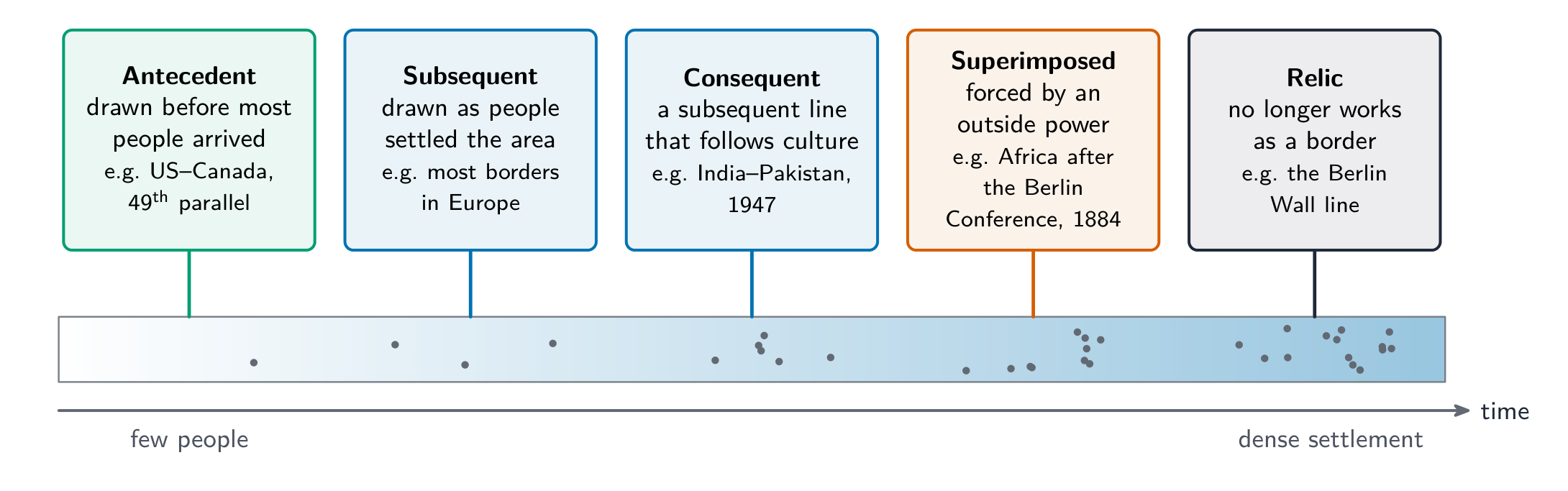
| Type | How it was drawn | Example |
|---|---|---|
| Antecedent 先成边界 | before the area was densely settled | US–Canada border along the 49th parallel |
| Subsequent 后成边界 | after people settled, as the cultural landscape developed | most borders in Western Europe |
| Consequent (a kind of subsequent) | deliberately along cultural lines (religion, language, ethnicity) | India–Pakistan, 1947 (by religion) |
| Superimposed 叠加边界 | forced on an area by an outside power, ignoring local cultures | many African borders after 1884 |
| Geometric | a straight line, often latitude or longitude | US–Canada west of the Great Lakes; Egypt–Sudan |
| Relic 残余边界 | no longer works as a border, but traces remain | the Berlin Wall line; Hadrian's Wall |
أي نوع من الحدود؟
Sort each boundary by its origin type.
Match each boundary type to its description.
الصعوبة 2/5 · 140 عملة + مكافأة صغيرة عند الإنجاز الأول اليوم
Timing, culture, outside power, no longer in use.
Many African borders were drawn by European powers at the Berlin Conference. What type are they?
الصعوبة 1/5 · 100 عملة + مكافأة صغيرة عند الإنجاز الأول اليوم
They were imposed by outsiders who ignored local cultures.
One border, several labels
- The types describe different things, so a border can have two labels. The 49th parallel is both antecedent (drawn before settlement) and geometric (a straight line).
- Many African borders are both superimposed (drawn by Europeans) and geometric (straight lines through areas they had never visited).
A boundary can be both antecedent and geometric.
الصعوبة 1/5 · 100 عملة + مكافأة صغيرة عند الإنجاز الأول اليوم
The 49th parallel was drawn before settlement (antecedent) and is a straight line (geometric).
Why origin matters: consequences
- Superimposed boundaries that split ethnic groups can lead to conflict and separatist movements. The Somali people, for example, live in Somalia, Ethiopia, Kenya and Djibouti.
- Consequent boundaries can also cause crisis: the 1947 partition of India by religion led to the movement of about 15 million people and at least several hundred thousand deaths.
Why can superimposed boundaries lead to conflict?
الصعوبة 1/5 · 100 عملة + مكافأة صغيرة عند الإنجاز الأول اليوم
Ignoring local cultures creates divided peoples and rival groups.
Worked FRQ answer
(A) Define a superimposed boundary. A boundary drawn and imposed on an area by an outside power, without regard for the cultures already living there.
(B) Explain how superimposed boundaries can lead to conflict within a state. They often place rival ethnic or religious groups inside one state, so groups compete for control of the government, which can lead to civil war, as in Nigeria in 1967–70.
(C) Explain why the US–Canada boundary has caused little conflict. It is an antecedent boundary drawn before dense settlement, so it did not cut through established communities, and both states share similar languages and political systems.
- Why it scores: precise definition, then each explanation links the boundary's origin to its consequence.
Antecedent and subsequent are about timing; superimposed is about who drew the line; geometric is about shape. Check which question the prompt is asking.
Antecedent boundaries come before settlement; subsequent after it (consequent ones follow cultural lines); superimposed boundaries are forced by outsiders; geometric boundaries are straight lines; relic boundaries no longer function. A boundary's origin helps explain conflict along it.
FRQ practice. (A) Identify the type of boundary created when India and Pakistan were divided by religion in 1947. (B) Explain ONE consequence of this boundary. (C) Explain why a relic boundary can still matter today.
Link origin to consequence.