Introduction to Entropy
مُقدَّم| English | المعنى |
|---|---|
| entropy/ˈentrəpi/ | إنتروبيا |
Nature's drift toward spreading out
- A drop of dye spreads through water; perfume spreads across a room; heat flows from hot coffee into the air. None of these ever runs backwards on its own.
- Matter and energy tend to spread out, because spread-out states can happen in far more ways. Entropy measures this spreading.
What entropy measures
- Entropy 熵 ($S$) measures how spread out matter and energy are: the more ways the particles and their energy can be arranged, the higher the entropy.
- In any spontaneous change, the total entropy of system plus surroundings increases. The system alone can lose entropy if the surroundings gain more.
Entropy is a measure of...
الصعوبة 1/5 · 100 عملة + مكافأة صغيرة عند الإنجاز الأول اليوم
Entropy tracks disorder, not energy directly.
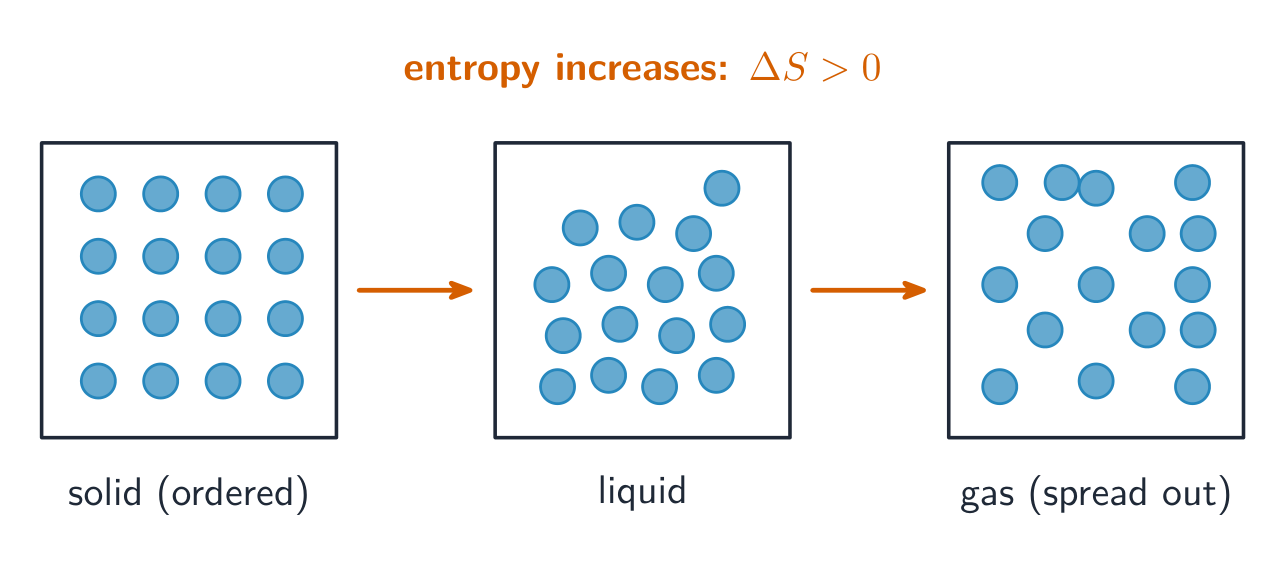
Gas beats liquid beats solid
- For the same substance, $S(\text{gas})\gg S(\text{liquid})>S(\text{solid})$. Gas particles move freely through a large volume, so they have far more possible arrangements.
- So melting, boiling and sublimation have $\Delta S>0$; freezing and condensing have $\Delta S<0$.
More or less entropy?
Sort each by whether it has higher or lower entropy.
When ice melts to water, the entropy...
الصعوبة 1/5 · 100 عملة + مكافأة صغيرة عند الإنجاز الأول اليوم
Liquid water is more disordered than solid ice.
For equal amounts of the same substance under comparable conditions, order the states by typical entropy, LOWEST to HIGHEST.
الصعوبة 3/5 · 200 عملة + مكافأة صغيرة عند الإنجاز الأول اليوم
Solid < liquid < gas in entropy.
Among the three states, a ____ has the highest entropy.
الصعوبة 1/5 · 100 عملة + مكافأة صغيرة عند الإنجاز الأول اليوم
Gas particles are the most spread out and disordered.
Predicting the sign of $\Delta S$
- Moles of gas usually decide it: more gas molecules on the product side → $\Delta S>0$; fewer → $\Delta S<0$.
- With no change in gas moles, look for other signs: a solid forming a solution, more particles overall, or a higher temperature all raise entropy. Larger, more complex molecules also have higher $S$.
Producing more moles of gas generally suggests an entropy change that is...
الصعوبة 1/5 · 100 عملة + مكافأة صغيرة عند الإنجاز الأول اليوم
More gas molecules means more disorder -- positive entropy change.
Dissolving a solid can increase system entropy, but ordering of water around ions can make the change negative.
الصعوبة 1/5 · 100 عملة + مكافأة صغيرة عند الإنجاز الأول اليوم
Both solute dispersal and solvent ordering count. The net entropy of dissolution can have either sign.
Predict the sign. Give the sign of $\Delta S$ for each reaction.
- $\text{CaCO}_3(s)\rightarrow\text{CaO}(s)+\text{CO}_2(g)$: 0 → 1 mol gas, so $\Delta S>0$.
- $2\text{SO}_2(g)+\text{O}_2(g)\rightarrow2\text{SO}_3(g)$: 3 → 2 mol gas, so $\Delta S<0$.
- $\text{Ag}^+(aq)+\text{Cl}^-(aq)\rightarrow\text{AgCl}(s)$: free ions lock into a solid, so $\Delta S<0$.
What is the sign of $\Delta S$ for $\text{N}_2(g)+3\text{H}_2(g)\rightarrow2\text{NH}_3(g)$?
الصعوبة 1/5 · 100 عملة + مكافأة صغيرة عند الإنجاز الأول اليوم
Fewer gas molecules means fewer possible arrangements, so entropy decreases.
Select جميعها the processes with $\Delta S>0$.
الصعوبة 2/5 · 140 عملة + مكافأة صغيرة عند الإنجاز الأول اليوم
Melting and making a gas from liquids raise entropy. Deposition and 2 → 1 mol gas lower it.
Compare entropies. Which has the higher standard entropy in each pair: (a) H₂O(l) or H₂O(g); (b) CH₄(g) or C₂H₆(g)?
- (a) H₂O(g): the gas phase has far more arrangements (189 vs 70 J mol⁻¹ K⁻¹).
- (b) C₂H₆(g): more atoms per molecule give more ways to vibrate and rotate (229 vs 186 J mol⁻¹ K⁻¹).
Which has the highest standard entropy?
الصعوبة 1/5 · 100 عملة + مكافأة صغيرة عند الإنجاز الأول اليوم
A gas beats a liquid or solid, and the larger gas molecule has more ways to move and vibrate.
- Count gas moles first. Moles of solid or liquid hardly matter when gases are present.
- Entropy is not energy. A cold gas can still have much more entropy than a hot solid.
- "Spontaneous" depends on the total entropy change. A reaction with $\Delta S_{\text{system}}<0$ can still happen if it releases enough heat to the surroundings (see Gibbs energy, 9.3).
Entropy measures the spreading of matter and energy; spontaneous change increases the total entropy of system plus surroundings. $S$(gas) ≫ $S$(liquid) > $S$(solid). To predict the sign of $\Delta S$, compare moles of gas first; more gas, more particles, dissolving solids and larger molecules raise entropy.