How Catalysts Speed Things Up
مُقدَّم| English | المعنى |
|---|---|
| catalyst/ˈkætəlɪst/ | عامل حفاز |
| intermediate/ˌɪntəˈmiːdɪət/ | A species formed in one step of a reaction mechanism and consumed in a later step. |
| active site/ˈæktɪv saɪt/ | The region of an enzyme where a substrate binds and the reaction is catalysed. |
A shortcut over the mountain
- Hydrogen peroxide on a shelf breaks down so slowly you never notice. Add a pinch of manganese(IV) oxide, or a drop of blood, and it fizzes with oxygen at once.
- The added substance is a catalyst 催化剂. It opens a lower pass over the energy barrier, and it comes out unchanged at the end.
A lower activation energy
- A catalyst provides a different mechanism with a lower activation energy. A larger fraction of collisions now has enough energy, so the reaction goes faster.
- The reactant and product levels do not change, so $\Delta H$ is the same with or without the catalyst.
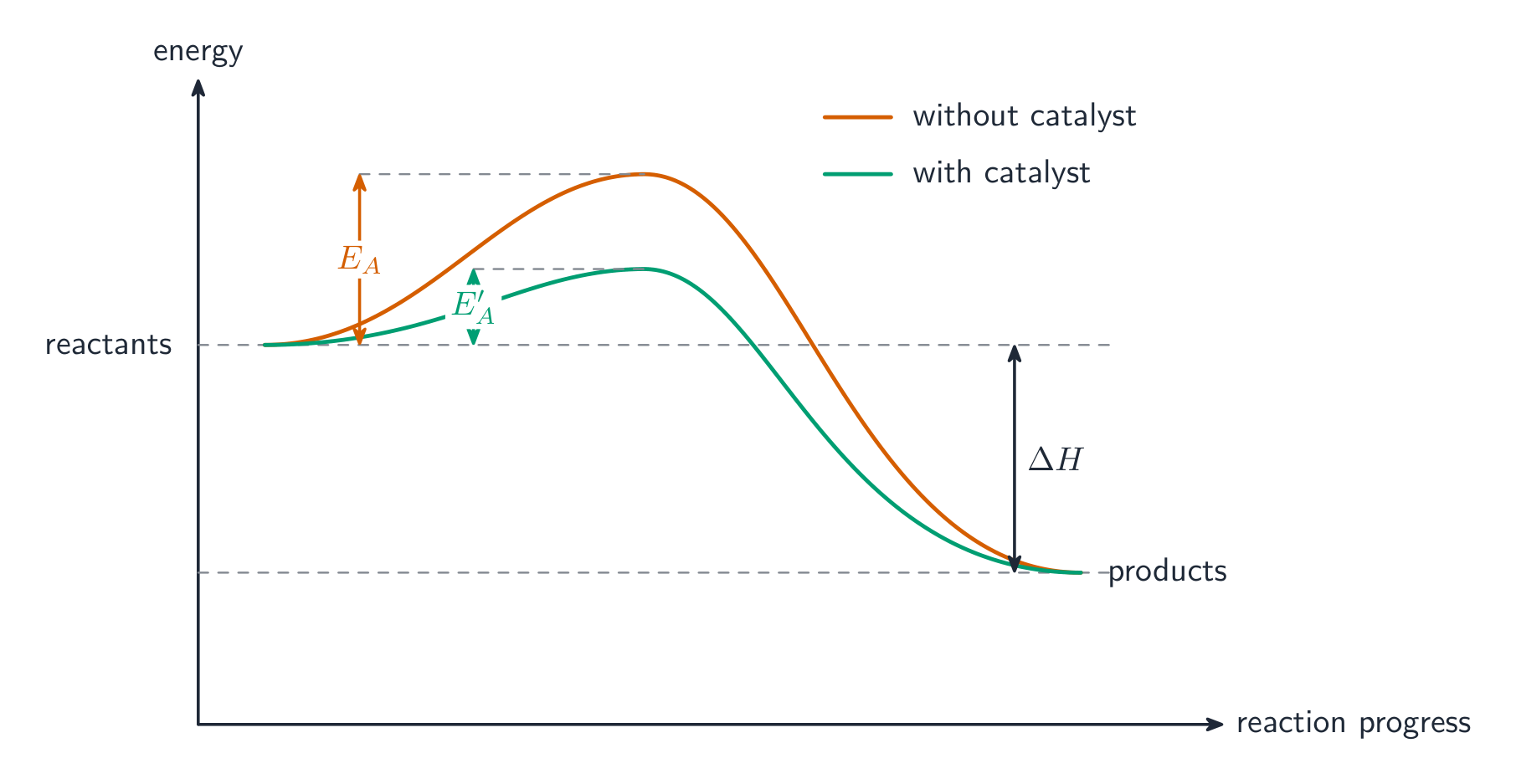
A catalyst speeds a reaction by...
الصعوبة 1/5 · 100 عملة + مكافأة صغيرة عند الإنجاز الأول اليوم
An alternate path with a lower barrier lets more collisions succeed.
A catalyst offers an alternate pathway with a lower ____ energy.
الصعوبة 1/5 · 100 عملة + مكافأة صغيرة عند الإنجاز الأول اليوم
The lower activation energy is what speeds the reaction.
Used, then given back
- In a mechanism, a catalyst is used up in an early step and made again in a later step. It cancels out of the overall equation.
- An intermediate 中间体 is the opposite: made in an early step and used up later. Both cancel; the order tells them apart.
A catalyst is consumed (used up) by the reaction.
الصعوبة 1/5 · 100 عملة + مكافأة صغيرة عند الإنجاز الأول اليوم
A catalyst is regenerated, not used up.
Three kinds of catalysis
- Acid–base catalysis: a reactant gains or loses H⁺, which makes it react faster. Surface catalysis: reactants stick to a solid surface (Pt, Ni, MnO₂), where bonds weaken.
- Enzyme catalysis: a protein holds the reactant in an active site 活性位点 with exactly the right shape and orientation. Enzymes are very specific.
How a catalyst helps
A catalyst opens a new pathway with a lower activation energy - the enthalpy change stays the same.
Adding a catalyst changes which of these?
الصعوبة 1/5 · 100 عملة + مكافأة صغيرة عند الإنجاز الأول اليوم
It only changes the rate, not $\Delta H$ or the equilibrium position.
A catalyst speeds up only the forward reaction.
الصعوبة 1/5 · 100 عملة + مكافأة صغيرة عند الإنجاز الأول اليوم
False. A catalyst lowers the barrier for both directions, so it speeds up both directions without changing $K$; the forward and reverse rates are equal at equilibrium.
Enzymes are best described as...
الصعوبة 1/5 · 100 عملة + مكافأة صغيرة عند الإنجاز الأول اليوم
Enzymes are highly specific catalysts in living things.
Enzymes speed reactions partly by holding the reactant in the right orientation in the active site.
الصعوبة 1/5 · 100 عملة + مكافأة صغيرة عند الإنجاز الأول اليوم
The active site fits the reactant, so collisions there have the right orientation and the barrier is lower.
Catalyst or intermediate? The decomposition of H₂O₂ with iodide ions goes in two steps:
- Step 1: $\text{H}_2\text{O}_2+\text{I}^-\rightarrow\text{H}_2\text{O}+\text{IO}^-$. Step 2: $\text{H}_2\text{O}_2+\text{IO}^-\rightarrow\text{H}_2\text{O}+\text{O}_2+\text{I}^-$.
- I⁻ is used in step 1 and made in step 2: the catalyst. IO⁻ is made in step 1 and used in step 2: an intermediate. Overall: $2\text{H}_2\text{O}_2\rightarrow2\text{H}_2\text{O}+\text{O}_2$.
Mechanism: Step 1 $\text{Ce}^{4+}+\text{Mn}^{2+}\rightarrow\text{Ce}^{3+}+\text{Mn}^{3+}$; Step 2 $\text{Ce}^{4+}+\text{Mn}^{3+}\rightarrow\text{Ce}^{3+}+\text{Mn}^{4+}$; Step 3 $\text{Tl}^{+}+\text{Mn}^{4+}\rightarrow\text{Tl}^{3+}+\text{Mn}^{2+}$. Which species is the catalyst?
الصعوبة 1/5 · 100 عملة + مكافأة صغيرة عند الإنجاز الأول اليوم
Mn²⁺ is used in step 1 and made again in step 3, so it is the catalyst. Mn³⁺ and Mn⁴⁺ are made then used: intermediates.
What changes, what doesn't. A catalyst lowers $E_a$ from 100 kJ mol⁻¹ to 60 kJ mol⁻¹ for a reaction with $\Delta H=-40$ kJ mol⁻¹.
- The rate rises sharply, because a much larger fraction of collisions clears 60 kJ mol⁻¹.
- $\Delta H$ stays $-40$ kJ mol⁻¹. The reverse $E_a$ falls by the same 40 kJ mol⁻¹ (from 140 to 100), so the reverse reaction speeds up too.
Without a catalyst, $E_a$ = 120 kJ mol⁻¹ and $\Delta H$ = +30 kJ mol⁻¹. A catalyst lowers the forward $E_a$ to 80 kJ mol⁻¹. What is the reverse $E_a$ with the catalyst, in kJ mol⁻¹?
الصعوبة 2/5 · 140 عملة + مكافأة صغيرة عند الإنجاز الأول اليوم
Reverse $E_a$ = forward $E_a$ − $\Delta H$ = 80 − 30 = 50 kJ mol⁻¹.
- A catalyst does not change $\Delta H$ or the equilibrium position. It speeds the forward and reverse reactions equally, so equilibrium is only reached sooner.
- Catalyst: in first, out later. Intermediate: out first, in later. Neither appears in the overall equation.
- A catalyst lowers the barrier; it does not give particles more energy.
A catalyst speeds a reaction by giving a different mechanism with a lower activation energy. In a mechanism it is used up first and regenerated later (an intermediate is the reverse). It works by acid–base, surface or enzyme catalysis, and it changes neither $\Delta H$ nor the equilibrium position.