Three Ways to Represent a Reaction
مُقدَّم| English | المعنى |
|---|---|
| macroscopic/ˌmækrəˈskɒpɪk/ | مجهري |
| particulate/pəˈtɪkjʊleɪt/ | جسيم |
| symbolic/sɪmˈbɒlɪk/ | رمزي |
One event, three viewpoints
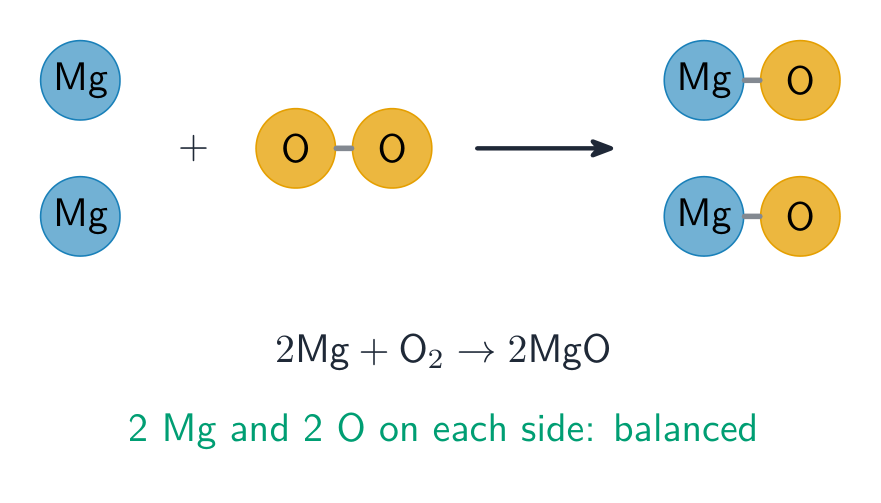
- Watch magnesium burn: a bright flash and white ash. Zoom in and you would see atoms rearranging. Write it down and it becomes $2\text{Mg}+\text{O}_2\rightarrow2\text{MgO}$.
- The same event can be told in three ways. AP questions often give you one and ask for another.
The macroscopic view
- The macroscopic 宏观 level is what you see, feel and measure: colour, bubbles, temperature, mass.
- It is the evidence that a reaction happened.
Observing bubbles and a temperature rise is which level?
الصعوبة 1/5 · 100 عملة + مكافأة صغيرة عند الإنجاز الأول اليوم
What you directly see and measure is the macroscopic level.
The particulate view
- The particulate 微粒 level draws atoms, molecules and ions as particles. It explains the macroscopic change.
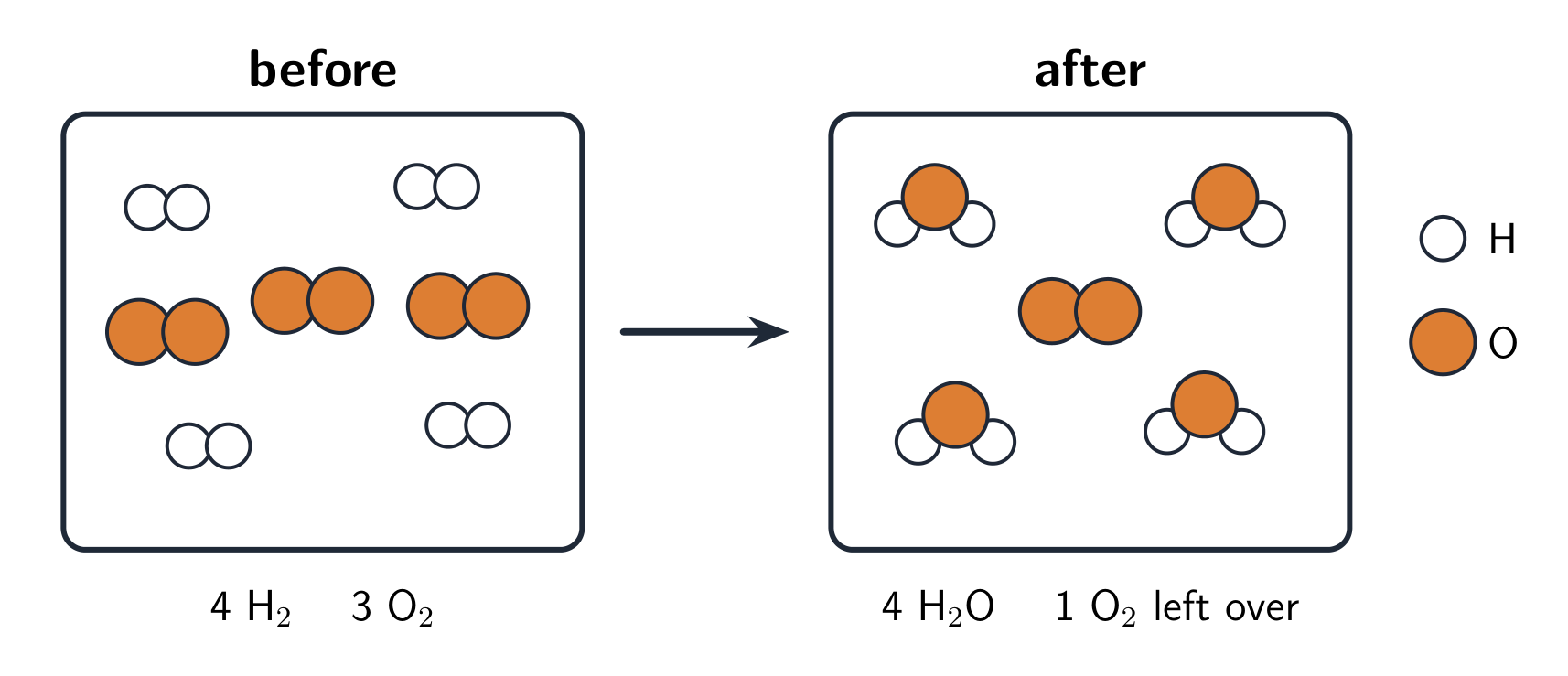
- In a correct diagram, every atom in the "before" box appears in the "after" box. Atoms are rearranged, never created or destroyed.
A diagram of individual atoms rearranging is which level?
الصعوبة 1/5 · 100 عملة + مكافأة صغيرة عند الإنجاز الأول اليوم
The particulate level shows the actual atoms and molecules.
The particulate view gives the ____ for the macroscopic observations.
الصعوبة 1/5 · 100 عملة + مكافأة صغيرة عند الإنجاز الأول اليوم
Rearranging atoms explains why the observed change occurs.
A particle diagram can show more O atoms after a reaction than before.
الصعوبة 1/5 · 100 عملة + مكافأة صغيرة عند الإنجاز الأول اليوم
Atoms are rearranged, never created or destroyed, so each element has the same count before and after.
The symbolic view
- The symbolic 符号 level is the balanced equation. Coefficients give the ratio of particles, not the actual numbers in a sample.
- The diagram above shows 4 H₂ reacting with 2 O₂: the ratio 2 : 1 in $2\text{H}_2+\text{O}_2\rightarrow2\text{H}_2\text{O}$.
ثلاث طرق لرؤية تفاعل
Sort each description by the level chemists are working at.
المعادلة $\text{C} + \text{O}_2 \to \text{CO}_2$ is which level?
الصعوبة 1/5 · 100 عملة + مكافأة صغيرة عند الإنجاز الأول اليوم
Formulas and coefficients are the symbolic representation.
Match each description to its level.
الصعوبة 2/5 · 140 عملة + مكافأة صغيرة عند الإنجاز الأول اليوم
Observations = macroscopic, atoms = particulate, equation = symbolic.
Diagram to equation. Use the particle diagram above.
- Before: 4 H₂ and 3 O₂. After: 4 H₂O and 1 O₂. So 4 H₂ and 2 O₂ were used up.
- Ratio 4 : 2 : 4 simplifies to 2 : 1 : 2. H₂ ran out first: it is the limiting reactant, and O₂ is in excess. The leftover O₂ stays in the "after" box.
The three levels describe the same single event.
الصعوبة 1/5 · 100 عملة + مكافأة صغيرة عند الإنجاز الأول اليوم
They are three views of one reaction, not three different reactions.
A "before" box has 5 CO and 2 O₂. They react as $2\text{CO}+\text{O}_2\rightarrow2\text{CO}_2$. What is in the "after" box?
الصعوبة 1/5 · 100 عملة + مكافأة صغيرة عند الإنجاز الأول اليوم
2 O₂ need 4 CO, so O₂ is limiting. 4 CO + 2 O₂ make 4 CO₂, and 1 CO is left over.
Equation to diagram. A box holds 3 N₂ and 6 H₂, reacting as $\text{N}_2+3\text{H}_2\rightarrow2\text{NH}_3$. What should the "after" box show?
- 6 H₂ need 2 N₂, so H₂ is limiting. 2 N₂ and 6 H₂ make 4 NH₃.
- After: 4 NH₃ and 1 N₂ left over. Check atoms: N is 6 before and $4+2=6$ after; H is 12 before and 12 after.
A box holds 2 N₂ and 9 H₂, reacting as $\text{N}_2+3\text{H}_2\rightarrow2\text{NH}_3$. How many NH₃ molecules form?
الصعوبة 2/5 · 140 عملة + مكافأة صغيرة عند الإنجاز الأول اليوم
2 N₂ need 6 H₂; there are 9, so N₂ is limiting. 2 N₂ make 4 NH₃, with 3 H₂ left over.
- The three levels describe the same event. Coefficients give the ratio; a diagram can show any multiple of it.
- Leftover reactant must appear in the "after" box. A common wrong answer leaves it out.
- Keep particles intact: draw H₂O as one O joined to two H, not as separate atoms floating apart.
A reaction can be told three ways: macroscopic (what you observe, the evidence), particulate (atoms rearranging, the explanation) and symbolic (the balanced equation, the ratio). Atom counts must match between "before" and "after" boxes, and any excess reactant is still there at the end.