الذوبانية
مُقدَّم| English | المعنى |
|---|---|
| hydrogen bond/ˈhaɪdrədʒn bɒnd/ | An attraction between a hydrogen atom bonded to an electronegative atom and a suitable electronegative atom with a lone pair. |
| ion–dipole attraction | ion–dipole attraction |
| saturated solution/ˈsætʃəreɪtɪd səˈluːʃn/ | محلول مشبع |
| supersaturated solution | supersaturated solution |
| solubility curve/ˌsɒljuːˈbɪlɪti kɜːv/ | solubility curve |
Why oil and water won't mix
- Stir salt into water and it disappears. Stir in cooking oil and it floats as a separate layer, however hard you shake.
- AP questions ask you to explain this with particles: which attractions are broken, which new ones form, and whether the new ones are strong enough.
Like dissolves like
- Polar solvents (water) tend to dissolve polar and ionic solutes. Nonpolar solvents (hexane, oil) tend to dissolve nonpolar solutes.
- "Like" means similar intermolecular forces: hydrogen bonding with hydrogen bonding, dispersion forces with dispersion forces.

As a general guide, a polar solvent like water is more likely to dissolve which class of solutes, provided solute–solvent attractions can overcome existing attractions?
الصعوبة 1/5 · 100 عملة + مكافأة صغيرة عند الإنجاز الأول اليوم
Polar water can stabilize polar molecules and ions. This is a guide: some ionic solids remain poorly soluble because their lattice attractions are too strong.
Oil (nonpolar) dissolves readily in water (polar).
الصعوبة 1/5 · 100 عملة + مكافأة صغيرة عند الإنجاز الأول اليوم
Unlike polarities do not mix, so oil and water separate.
The guiding rule for dissolving is "like dissolves ____".
الصعوبة 1/5 · 100 عملة + مكافأة صغيرة عند الإنجاز الأول اليوم
Similar polarities dissolve each other.
Dissolving in three steps
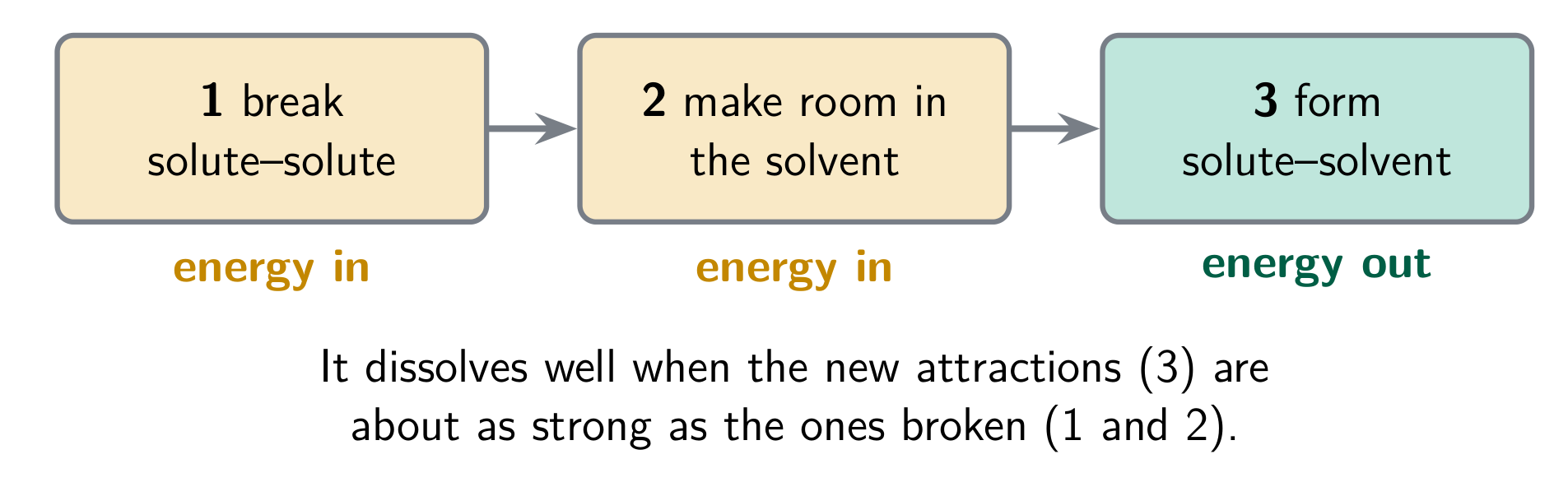
- Solute particles must separate (1), solvent particles must move apart to make room (2), and new solute–solvent attractions form (3).
- Steps 1 and 2 need energy; step 3 releases it. A solute dissolves well when the new attractions are about as strong as the ones broken.
Methanol or hexane in water? Methanol, $\text{CH}_3\text{OH}$, mixes with water in any amount; hexane, $\text{C}_6\text{H}_{14}$, does not.
- Methanol has an O–H group, so it can form hydrogen bonds with water. The new methanol–water hydrogen bonds replace the water–water ones that were broken.
- Hexane has only dispersion forces. Water molecules would lose their hydrogen bonds to make room for it and get only weak attractions back, so hexane stays as a separate layer.
- Iodine, $\text{I}_2$, is nonpolar: it dissolves much better in hexane (purple solution) than in water.
Which liquid mixes completely with water, and why?
الصعوبة 1/5 · 100 عملة + مكافأة صغيرة عند الإنجاز الأول اليوم
Methanol's O–H group forms hydrogen bonds with water, replacing the water–water hydrogen bonds that are broken. Hexane offers only weak attractions, so it separates.
Ionic solids in water
- Water's partial charges surround each ion: the O end ($\delta-$) faces cations, the H ends ($\delta+$) face anions. These ion–dipole attractions 离子-偶极作用 pay for pulling the ions out of the lattice.
- If the lattice attractions are stronger than what hydration gives back, the solid is only slightly soluble: NaCl dissolves well, but AgCl and $\text{CaCO}_3$ hardly dissolve.
Soluble or insoluble?
Use the solubility rules to sort each ionic compound.
When NaCl dissolves, which end of a water molecule points towards a Na⁺ ion?
الصعوبة 1/5 · 100 عملة + مكافأة صغيرة عند الإنجاز الأول اليوم
Opposite charges attract. The partly negative O end faces the cation; the partly positive H ends face Cl⁻.
Saturated, unsaturated, supersaturated
- A saturated solution 饱和溶液 holds the maximum amount of solute at that temperature; extra solid just sits at the bottom. An unsaturated solution can dissolve more.
- A supersaturated solution 过饱和溶液 holds more than the maximum, usually after careful cooling. It is unstable: one seed crystal makes the extra solute crystallise.
A solution holding the maximum solute at a given temperature is...
الصعوبة 1/5 · 100 عملة + مكافأة صغيرة عند الإنجاز الأول اليوم
At the maximum it is saturated; more solute just settles out.
Dropping one seed crystal into a supersaturated solution makes the extra solute crystallise.
الصعوبة 1/5 · 100 عملة + مكافأة صغيرة عند الإنجاز الأول اليوم
A supersaturated solution holds more than the maximum and is unstable; a seed crystal starts crystallisation until the solution is just saturated.
Temperature and solubility
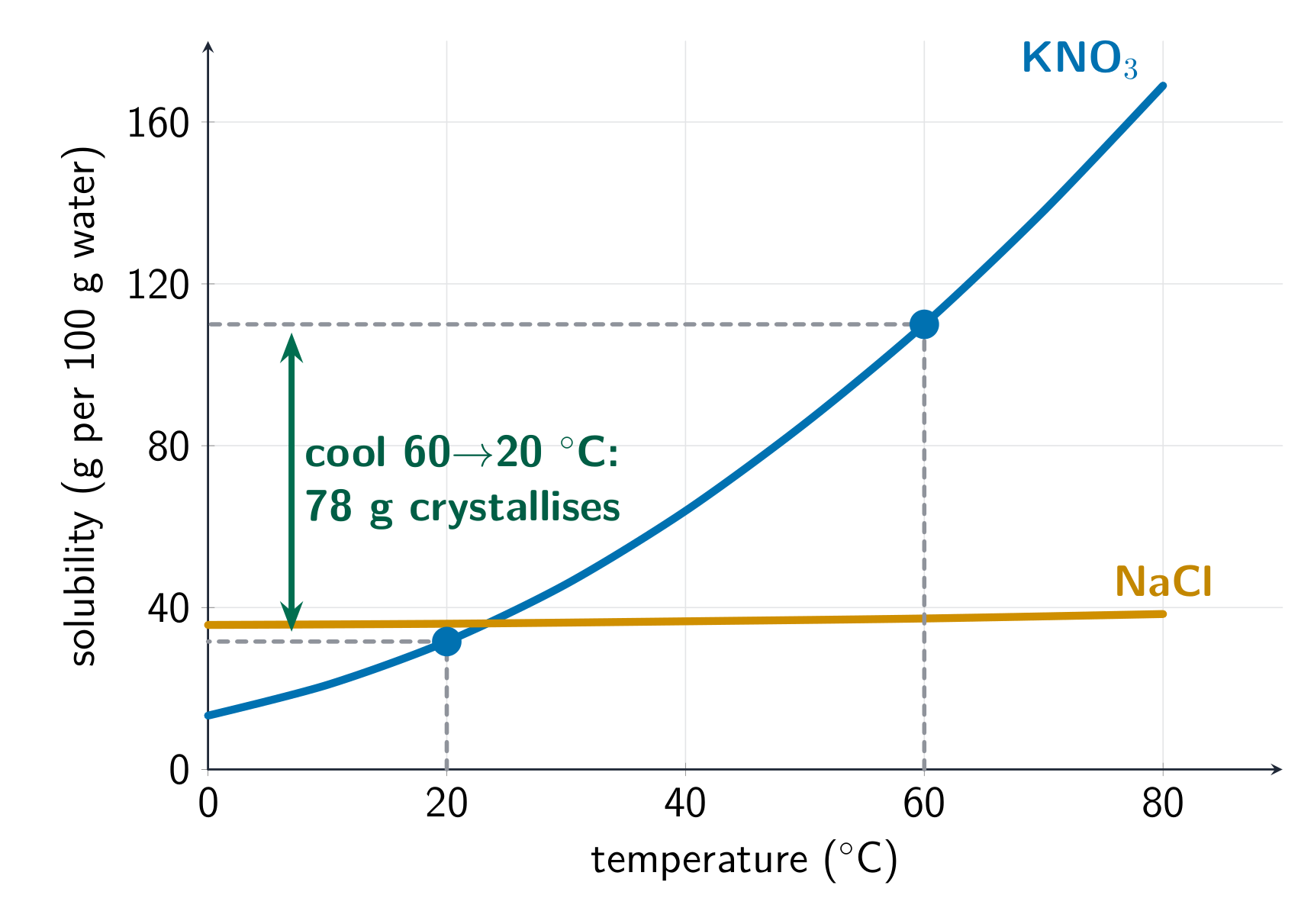
- For most solids, solubility rises with temperature, sometimes steeply ($\text{KNO}_3$), sometimes hardly at all (NaCl).
- Gases are the opposite: they are less soluble in warm water, because faster gas particles escape more easily. Warm soda goes flat; warm lakes hold less oxygen.
As temperature rises, the solubility of most gases in water...
الصعوبة 1/5 · 100 عملة + مكافأة صغيرة عند الإنجاز الأول اليوم
Gases become less soluble in warmer water -- warm soda goes flat.
Most solids dissolve more in hot solvent than in cold.
الصعوبة 1/5 · 100 عملة + مكافأة صغيرة عند الإنجاز الأول اليوم
Higher temperature usually raises a solid's solubility.
Reading a solubility curve. A saturated solution of $\text{KNO}_3$ in 100 g of water at 60 °C is cooled to 20 °C. What mass of crystals forms?
- At 60 °C, 100 g of water holds 110 g of $\text{KNO}_3$. At 20 °C it holds only 31.6 g.
- Crystals formed $=110-31.6\approx78$ g.
- For 50 g of water, halve both numbers: about 39 g of crystals.
KNO3 dissolves to 110 g per 100 g water at 60 °C and 31.6 g at 20 °C. A saturated solution in 100 g water is cooled from 60 °C to 20 °C. What mass of KNO3 crystallises, in grams?
الصعوبة 2/5 · 140 عملة + مكافأة صغيرة عند الإنجاز الأول اليوم
110 − 31.6 = 78.4 g of crystals form, because cold water can hold only 31.6 g.
- "Like dissolves like" is a guide, not a rule: many ionic solids (AgCl, $\text{BaSO}_4$) barely dissolve in water even though water is polar, because their lattice attractions are too strong.
- Always explain with both sides: which attractions are broken and which new ones form. "It is polar" alone does not earn the point.
- Do not say gases dissolve better when warm: warm water holds less gas.
- A solute dissolves well when the new solute–solvent attractions are about as strong as the solute–solute and solvent–solvent attractions it replaces.
- Ions dissolve in water through ion–dipole attractions; a strong lattice can still make an ionic solid only slightly soluble.
- Saturated = the maximum at that temperature. Solids usually dissolve more when hot; gases dissolve less.