Intermolecular and Interparticle Forces
مُقدَّم| English | المعنى |
|---|---|
| intermolecular forces/ˌɪntəməˈlekjʊlə ˈfɔːsɪz/ | Attractions between separate molecules. |
| London dispersion force | A weak attraction between temporary dipoles; present between all molecules and stronger for larger electron clouds. |
| polarizable | Describes an electron cloud that is easily distorted to form a temporary dipole; larger clouds are more polarizable. |
| dipole–dipole force | The attraction between the positive end of one polar molecule and the negative end of another. |
| hydrogen bond/ˈhaɪdrədʒn bɒnd/ | An attraction between a hydrogen atom bonded to an electronegative atom and a suitable electronegative atom with a lone pair. |
| ion–dipole force | The attraction between an ion and the oppositely charged end of a polar molecule, as when salts dissolve in water. |
Why is water a liquid?
- Water ($\text{H}_2\text{O}$, 18 g/mol) boils at $100^\circ\text{C}$. Methane ($\text{CH}_4$, 16 g/mol) boils at $-162^\circ\text{C}$. The molecules are about the same size, so why is one a liquid and the other a gas?
- The answer is the intermolecular forces 分子间作用力: attractions between molecules. They are much weaker than covalent bonds inside molecules, but they decide melting points, boiling points and whether things mix.
London dispersion forces: in every molecule
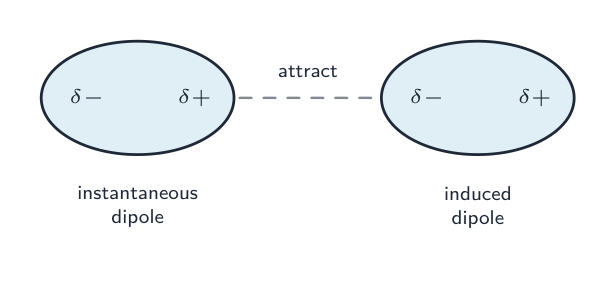
- Electrons move all the time. At any instant the electron cloud can be uneven, giving a temporary dipole that induces a dipole in a neighbour. This attraction is a London dispersion force 伦敦色散力.
- More electrons make a larger, more polarizable 易极化的 electron cloud, so dispersion forces grow with size: $\text{CH}_4$ ($-162^\circ\text{C}$) $<$ $\text{C}_2\text{H}_6$ ($-89$) $<$ $\text{C}_3\text{H}_8$ ($-42$) $<$ $\text{C}_4\text{H}_{10}$ ($-1^\circ\text{C}$).
Which halogen has the highest boiling point?
الصعوبة 1/5 · 100 عملة + مكافأة صغيرة عند الإنجاز الأول اليوم
All are non-polar, so dispersion decides. $\text{I}_2$ has the most electrons and the most polarizable cloud.
Shape changes contact
- Long, straight molecules touch each other along more of their length than compact, ball-shaped ones. More contact gives stronger dispersion forces.
- Pentane and its isomer 2,2-dimethylpropane both have formula $\text{C}_5\text{H}_{12}$. Straight-chain pentane boils at $36^\circ\text{C}$; the ball-shaped isomer boils at $10^\circ\text{C}$.
Two isomers with the same formula always have the same boiling point, because they have the same number of electrons.
الصعوبة 1/5 · 100 عملة + مكافأة صغيرة عند الإنجاز الأول اليوم
Shape matters. A straight chain has more surface contact and stronger dispersion than a compact, branched isomer.
Dipole–dipole forces: polar molecules
- A polar molecule has a permanent dipole. The $\delta+$ end of one molecule attracts the $\delta-$ end of the next: a dipole–dipole force 偶极-偶极作用, which adds to dispersion.
- Compare molecules of nearly equal size: $\text{Br}_2$ (160 g/mol, non-polar) boils at $59^\circ\text{C}$, while ICl (162 g/mol, polar) boils at $97^\circ\text{C}$.
Hydrogen bonds: H on N, O or F
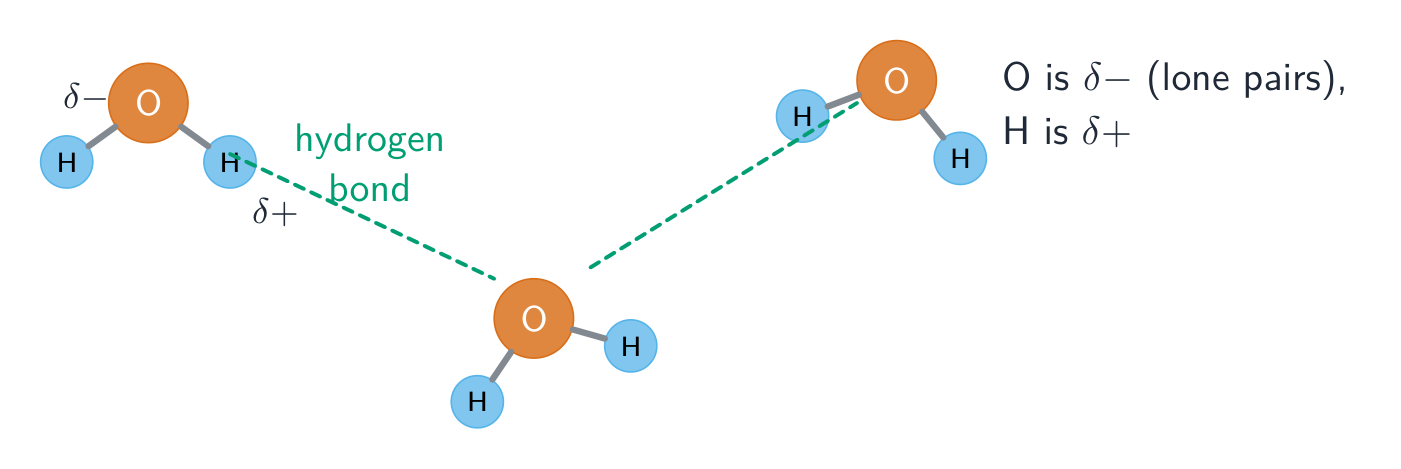
- When H is bonded to N, O or F, the H is strongly $\delta+$ and very small. It is attracted to a lone pair on an N, O or F of another molecule. This hydrogen bond 氢键 is the strongest of the three forces for molecules of similar size.
- Same size, three forces: propane ($-42^\circ\text{C}$, dispersion), dimethyl ether $\text{CH}_3\text{OCH}_3$ ($-24^\circ\text{C}$, adds dipole–dipole), ethanol $\text{CH}_3\text{CH}_2\text{OH}$ ($78^\circ\text{C}$, adds hydrogen bonds).
Which intermolecular force?
Identify the strongest force acting between each pair of molecules.
Match each substance with the strongest intermolecular force between its molecules.
الصعوبة 2/5 · 140 عملة + مكافأة صغيرة عند الإنجاز الأول اليوم
$\text{CO}_2$ is non-polar (linear); $\text{CH}_3\text{Cl}$ is polar; $\text{NH}_3$ has H bonded to N.
Which substances form hydrogen bonds between their own molecules? Select all that apply.
الصعوبة 2/5 · 140 عملة + مكافأة صغيرة عند الإنجاز الأول اليوم
Each has H bonded directly to O, F or N. In dimethyl ether the H atoms are on C.
Explain why HF boils at $20^\circ\text{C}$ but HCl boils at $-85^\circ\text{C}$, even though HCl has more electrons.
- HCl has more electrons, so its dispersion forces are a little stronger.
- But HF molecules form hydrogen bonds (H bonded to F), and HCl molecules cannot (Cl is not N, O or F).
- Hydrogen bonds need much more energy to overcome, so HF boils higher.
Size can beat polarity
- The ranking dispersion $<$ dipole–dipole $<$ hydrogen bond holds only for molecules of similar size. A large non-polar molecule can have stronger total attractions than a small polar one.
- $\text{CCl}_4$ (non-polar, 74 electrons) boils at $77^\circ\text{C}$; $\text{CH}_2\text{Cl}_2$ (polar, 42 electrons) boils at $40^\circ\text{C}$. Iodine, $\text{I}_2$, is a solid at room temperature with dispersion forces alone.
Why does non-polar $\text{CCl}_4$ boil higher than polar $\text{CH}_2\text{Cl}_2$?
الصعوبة 1/5 · 100 عملة + مكافأة صغيرة عند الإنجاز الأول اليوم
With 74 electrons against 42, dispersion in $\text{CCl}_4$ outweighs the dipole–dipole forces in $\text{CH}_2\text{Cl}_2$.
Ions and polar molecules
- An ion attracts the oppositely charged end of polar molecules: an ion–dipole force 离子-偶极作用. This is why NaCl dissolves in water: water molecules surround each ion.
- A polar molecule can also induce a dipole in a non-polar one (dipole–induced dipole). This weak attraction lets a little $\text{O}_2$ dissolve in water, enough for fish to breathe.
Water molecules surround $\text{Na}^+$ و $\text{Cl}^-$ ions through ion–____ forces.
الصعوبة 1/5 · 100 عملة + مكافأة صغيرة عند الإنجاز الأول اليوم
Each ion attracts the oppositely charged end of polar water molecules.
Rank by boiling point: $\text{CH}_3\text{CH}_2\text{CH}_2\text{OH}$ (propan-1-ol, 60 g/mol), $\text{CH}_3\text{CH}_2\text{CH}_2\text{CH}_3$ (butane, 58 g/mol), $\text{CH}_3\text{COCH}_3$ (propanone, 58 g/mol).
- All three are similar in size, so the type of force decides.
- Butane: dispersion only (lowest, $-1^\circ\text{C}$). Propanone: polar C=O, adds dipole–dipole ($56^\circ\text{C}$). Propanol: O–H, adds hydrogen bonds (highest, $97^\circ\text{C}$).
Order from LOWEST to HIGHEST boiling point (all have similar molar mass).
الصعوبة 3/5 · 200 عملة + مكافأة صغيرة عند الإنجاز الأول اليوم
Dispersion only → adds dipole–dipole → adds hydrogen bonds.
Boiling separates molecules; it never breaks the covalent bonds inside them. When you explain a boiling-point difference, name the force in each substance and say which is stronger and why (more electrons, more polar, or hydrogen bonding). "Water has hydrogen bonds" alone is not a full comparison.
All molecules have London dispersion forces, which grow with the number of electrons and with surface contact. Polar molecules add dipole–dipole forces; H on N, O or F adds hydrogen bonds. Compare molecules of similar size by force type, but remember that a much larger molecule can win on dispersion alone. Ions attract polar molecules through ion–dipole forces.