Finding the Area of the Region Bounded by Two Polar Curves
مُقدَّم| English | المعنى |
|---|---|
| area/ˈeərɪə/ | المساحة |
| outer polar radius | نصف القطر القطبي الخارجي |
| inner polar radius | نصف القطر القطبي الداخلي |
| intersection/ˌɪntəˈsekʃn/ | نقطة التقاطع |
| pole/pəʊl/ | القطب |
Which part between the boundaries is wanted?
- A rotating scanner may cover a large region while a protected region must be excluded. Finding the remaining area 面积 requires both boundaries and a clear description of the part to keep.
- Read the wording first: inside A but outside B, the band between the boundaries, and inside both curves are different requests. A sketch and a test ray help decide which radii to use.
Subtract squared radii on the same ray
- On a common ray, use nonnegative distances $0\le r_{\mathrm{in}}\le r_{\mathrm{out}}$. The thin sector difference is $\dfrac12(r_{\mathrm{out}}^2-r_{\mathrm{in}}^2)\,d\theta$; integrate over ordered radian bounds that cover the region once.
- The outer polar radius 外极径 is the distance to the farther boundary on a common ray. The inner polar radius 内极径 is the distance to the nearer boundary on that ray. Square each before subtracting. For radii 2 and 1, the area density is $(4-1)/2=3/2$, not $(2-1)^2/2=1/2$. Signed polar parameters are not automatically distances on this same ray.
For correctly ordered nonnegative inner/outer radii on common rays, the area is $\tfrac12\int_\alpha^\beta(\ ?\ )\,d\theta$. The integrand is...
الصعوبة 1/5 · 100 عملة + مكافأة صغيرة عند الإنجاز الأول اليوم
Outer squared minus inner squared.
You square each radius before subtracting, not $(r_\text{out}-r_\text{in})^2$.
الصعوبة 1/5 · 100 عملة + مكافأة صغيرة عند الإنجاز الأول اليوم
إنه $r_\text{out}^2-r_\text{in}^2$.
On a common ray with both radii nonnegative, the outer boundary has the...
الصعوبة 1/5 · 100 عملة + مكافأة صغيرة عند الإنجاز الأول اليوم
Outer = farther from the origin = larger $r$.
For outer radius 2 and inner radius 1, what is the area integrand, including the half factor?
الصعوبة 2/5 · 140 عملة + مكافأة صغيرة عند الإنجاز الأول اليوم
$(2^2-1^2)/2=3/2$, rather than $(2-1)^2/2$.
Work the original annulus without crossings
- Inside $r=2$ and outside $r=1$ is a full ring. Use $0\le\theta\le2\pi$: $A=\dfrac12\int_0^{2\pi}(4-1)\,d\theta=3\pi$ square units.
- These circles never intersect. Their bounds come from a full turn, not crossing angles. Other questions may supply boundary rays directly; do not require every integration limit to be a curve intersection 交点.
Area inside $r=2$, outside $r=1$: $\tfrac12\int_0^{2\pi}(4-1)\,d\theta$ (as a multiple of $\pi$).
الصعوبة 2/5 · 140 عملة + مكافأة صغيرة عند الإنجاز الأول اليوم
$\tfrac12\cdot3\cdot2\pi=3\pi$.
Two polar boundaries must intersect for there to be a region between them.
الصعوبة 1/5 · 100 عملة + مكافأة صغيرة عند الإنجاز الأول اليوم
The concentric circles r=2 and r=1 have no crossings, but enclose a ring of area 3π.
Find crossings and check the pole separately
- For the pictured curves $r_A=3\cos\theta$ and $r_B=1+\cos\theta$, equal nonnegative radii on the same ray give $\cos\theta=1/2$, hence angles $\theta=\pm\pi/3$. At either crossing, the radius is $3/2$.
- An intersection can also occur at the pole 极点, the origin, reached at different parameter values. Curve A reaches it at $\pi/2$ and curve B at $\pi$. Solving $r_A(\theta)=r_B(\theta)$ alone does not list every geometric intersection.
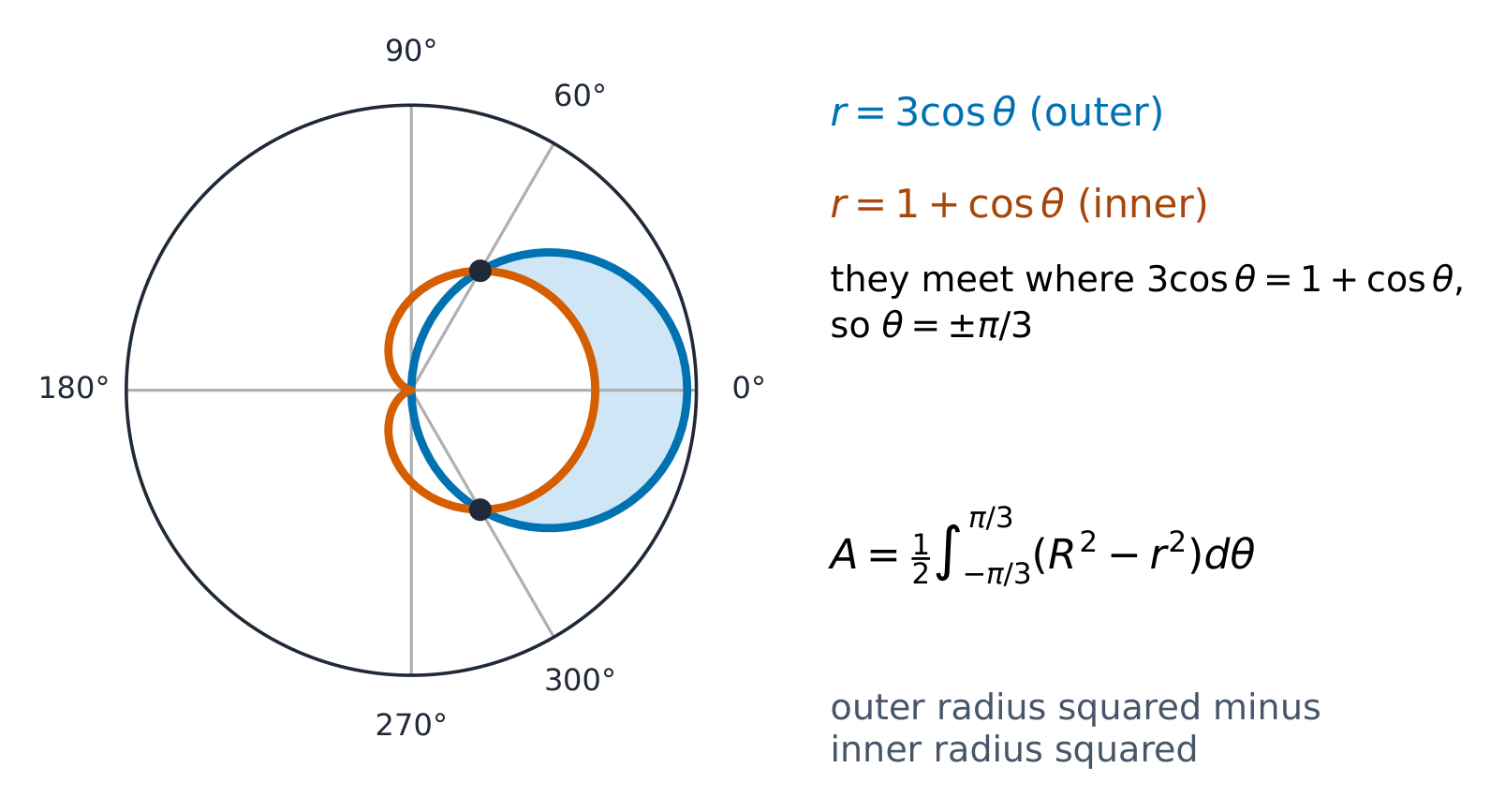
Solving $r_A(\theta)=r_B(\theta)$ finds same-angle ____ candidates. Also check the pole and other parameter representations.
الصعوبة 1/5 · 100 عملة + مكافأة صغيرة عند الإنجاز الأول اليوم
Equal radii at the same angle identify intersection candidates; they do not necessarily find every geometric intersection or every integration bound.
للدفاع $3\cos\theta=1+\cos\theta$, find $\cos\theta$.
الصعوبة 2/5 · 140 عملة + مكافأة صغيرة عند الإنجاز الأول اليوم
$2\cos\theta=1$, so $\cos\theta=1/2$.
للدفاع $r_A=3\cos\theta$ و $r_B=1+\cos\theta$, the positive same-ray crossing is $c\pi$ في $[0,\pi/2]$. Give c.
الصعوبة 2/5 · 140 عملة + مكافأة صغيرة عند الإنجاز الأول اليوم
$\cos\theta=1/2$ gives $\theta=\pi/3$.
للدفاع $r_A=3\cos\theta$ و $r_B=1+\cos\theta$, find the radius at their positive same-ray crossing $\theta=\pi/3$.
الصعوبة 2/5 · 140 عملة + مكافأة صغيرة عند الإنجاز الأول اليوم
$r=3(1/2)=3/2=1+1/2$.
Why must the origin be checked separately for the pictured circle/cardioid pair?
الصعوبة 1/5 · 100 عملة + مكافأة صغيرة عند الإنجاز الأول اليوم
A reaches r=0 at π/2, while B reaches r=0 at π; those are the same Cartesian point with different parameter values.
Keep only rays with the requested radial band
- For this circle A, choose $-\pi/2\le\theta\le\pi/2$ so its radius is nonnegative and the circle is traced once. The requirement inside A but outside B needs $3\cos\theta\ge1+\cos\theta$, so $-\pi/3\le\theta\le\pi/3$.
- At zero, the distances run from B's radius 2 to A's radius 3, confirming the intended right-hand band. Outside the selected angles, A has the smaller radial reach, so no points on those rays are inside A and outside B.
At θ=π/2, A has radial reach 0 and B has reach 1. What is the requested area density inside A but outside B?
الصعوبة 2/5 · 140 عملة + مكافأة صغيرة عند الإنجاز الأول اليوم
There is no radial interval that is simultaneously at most 0 and at least 1, so this ray contributes zero.
Evaluate the illustrated circle/cardioid region
- Its area is $\dfrac12\int_{-\pi/3}^{\pi/3}[9\cos^2\theta-(1+\cos\theta)^2]\,d\theta$. Expand the complete square to obtain the integrand $3/2+2\cos2\theta-\cos\theta$.
- An antiderivative is $3\theta/2+\sin2\theta-\sin\theta$. The sine terms cancel at each bound, leaving $\pi/2-(-\pi/2)=\pi$. This is the requested region, not the full area of either curve.
The area inside $r_A=3\cos\theta$ and outside $r_B=1+\cos\theta$ is cπ. Give c.
الصعوبة 2/5 · 140 عملة + مكافأة صغيرة عند الإنجاز الأول اليوم
The required rays satisfy $3\cos\theta\ge1+\cos\theta$, so $-\pi/3\le\theta\le\pi/3$. The half-difference of squares is $3/2+2\cos2\theta-\cos\theta$. Its integral is $[3\theta/2+\sin2\theta-\sin\theta]_{-\pi/3}^{\pi/3}=\pi$, so $c=1$.
Do not replace every negative difference by its absolute value
- Integrating the same raw difference over $[-\pi/2,\pi/2]$ gives $3\pi/2-2$, not the required $\pi$. The extra angles contribute a negative difference even though the requested inside-A/outside-B region is empty there.
- Taking its absolute value would add a different region: inside B but outside A on those rays. For the original request, omit those angles. Use an absolute difference only when the question asks for the band between the two radial boundaries regardless of their order.
Evaluate the raw integral $\frac12\int_{-\pi/2}^{\pi/2}[(3\cos\theta)^2-(1+\cos\theta)^2]\,d\theta$ to six decimal places.
الصعوبة 2/5 · 140 عملة + مكافأة صغيرة عند الإنجاز الأول اليوم
The raw value is $3\pi/2-2\approx2.712389$. It is not the requested cap area π.
Taking the absolute squared-radius difference always gives the area inside A but outside B.
الصعوبة 1/5 · 100 عملة + مكافأة صغيرة عند الإنجاز الأول اليوم
Where B is farther out, that absolute difference adds the opposite region: inside B and outside A.
Split when the outer boundary changes
- Now ask for the band between $r_A=1+\cos\theta$ and $r_B=1$ on a full turn. Both radii are nonnegative. They are equal at $\pi/2$ and $3\pi/2$, where $\cos\theta=0$.
- A is outer on $[0,\pi/2]$ and $[3\pi/2,2\pi]$; B is outer between those intervals. Split at the two crossing angles so each piece uses outer squared minus inner squared.
If the outer and inner curves swap over the interval, you should split the integral at the crossing.
الصعوبة 1/5 · 100 عملة + مكافأة صغيرة عند الإنجاز الأول اليوم
A split keeps outer-minus-inner correct on each piece.
للدفاع $r_A=1+\cos\theta$ و $r_B=1$, the first crossing in [0,2π] is cπ. Give c.
الصعوبة 2/5 · 140 عملة + مكافأة صغيرة عند الإنجاز الأول اليوم
$\cos\theta=0$ first gives π/2.
للدفاع $r_A=1+\cos\theta$ و $r_B=1$, the second crossing on $[0,2\pi]$ هي $c\pi$. Give c.
الصعوبة 2/5 · 140 عملة + مكافأة صغيرة عند الإنجاز الأول اليوم
The second zero of cosine on the interval is 3π/2.
Compare band area with signed cancellation
- Write the raw density as $f(\theta)=\dfrac12[(1+\cos\theta)^2-1]=\cos\theta+\dfrac12\cos^2\theta$. Its antiderivative is $F(\theta)=\sin\theta+\theta/4+\sin2\theta/8$.
- The two positive pieces total $2+\pi/4$, while the middle piece contributes area $2-\pi/4$ after reversing the subtraction. Thus the band area is 4. The unsplit signed integral is only $\pi/2$ because positive and negative contributions cancel.

Find the full band area between $r_A=1+\cos\theta$ و $r_B=1$.
الصعوبة 2/5 · 140 عملة + مكافأة صغيرة عند الإنجاز الأول اليوم
The raw density is $f=\cos\theta+\frac12\cos^2\theta$, with $F=\sin\theta+\theta/4+\sin2\theta/8$. Split at $\pi/2$ و $3\pi/2$: $A=[F]_0^{\pi/2}-[F]_{\pi/2}^{3\pi/2}+[F]_{3\pi/2}^{2\pi}=(2+\pi/4)+(2-\pi/4)=4$.
Evaluate $\frac12\int_0^{2\pi}[(1+\cos\theta)^2-1],d\theta=c\pi$. Give c.
الصعوبة 2/5 · 140 عملة + مكافأة صغيرة عند الإنجاز الأول اليوم
The integral of $\cos\theta+\frac12\cos^2\theta$ is π/2, including cancellation.
Match the radial rule to the wording
- For inside A and outside B, keep only rays where $r_A\ge r_B\ge0$. For the band between nonnegative radial boundaries, integrate $\dfrac12|r_A^2-r_B^2|$, splitting where the order changes.
- For inside both regions, use the smaller radial reach and integrate $\dfrac12\min(r_A,r_B)^2$. For the concentric circles 2 and 1, the common disk has area $\pi$, whereas the ring between their boundaries has area $3\pi$.
Two boundaries, one requested region
For A=3 cos θ and B=1+cos θ, bounds −π/3 to π/3 give area π. Compare omitted rays, a full annulus and a band whose outer boundary switches.
The area inside both concentric circles r=2 and r=1 is cπ. Give c.
الصعوبة 2/5 · 140 عملة + مكافأة صغيرة عند الإنجاز الأول اليوم
Their common region is the unit disk, not the ring between their boundaries.
Try fresh pairs and scales
- Find the area inside $r=3$ and outside $r=1$ between the rays $\pi/6$ and $5\pi/6$. Then scale the pictured circle/cardioid pair to $r_A=6\cos\theta$, $r_B=2+2\cos\theta$ and find the corresponding inside-A/outside-B area.
- For the band between $r_A=2+\cos\theta$ and $r_B=2$ on $[0,2\pi]$, find the switch angles, the band area and the unsplit signed integral. Explain why the last two values differ.
Find the area inside $r=3$, outside $r=1$, between the rays π/6 and 5π/6. Explain the bounds.
Compare your region, radius order and piecewise integral with the model.
للدفاع $r_A=6\cos\theta$ و $r_B=2+2\cos\theta$, find the inside-A/outside-B area and justify its limits.
Compare your region, radius order and piecewise integral with the model.
Find the full band area between $r_A=2+\cos\theta$ و $r_B=2$. Give the switch angles and compare the unsplit raw integral.
Compare your region, radius order and piecewise integral with the model.
Check the region before the arithmetic
- Between curves: $A=\dfrac12\displaystyle\int_\alpha^\beta\left(r_{\text{outer}}^2-r_{\text{inner}}^2\right)d\theta$, not $\dfrac12\displaystyle\int(r_{\text{outer}}-r_{\text{inner}})^2\,d\theta$.
- Use a common physical ray and nonnegative radial distances. Find relevant crossings, check the pole or other parameter representations, and include any given boundary rays. Test the radius order on each interval.
- Integrate the appropriate squared-radius difference, use ordered radian bounds and avoid repeated coverage. Finish with square units and confirm that your answer matches the requested region rather than an unintended signed difference.