مقياس درجات الحرارة
مُقدَّم| English | المعنى |
|---|---|
| thermometer/θɜːˈmɒmɪtə/ | مقياس حرارة |
| thermocouple/ˈθɜːməkʌpl/ | زوج حراري |
| thermodynamic/ˌθɜːməʊdaɪˈnæmɪk/ | ديناميكا حرارية |
| kelvin/ˈkelvɪn/ | كلفن |
| absolute zero/ˈæbsəluːt ˈzɪərəʊ/ | الصفر المطلق |
| Celsius/ˈselsɪəs/ | سيلزيوس |
How a thermometer 温度计 works
- A thermometer needs something that changes with temperature.
- A liquid expands, a metal's resistance rises, a gas swells.
- Read that change and you read the temperature.
مختبر مقياس درجة الحرارة
مؤشر كلفن = مؤشر السيلسيوس + 2.73
حرك مؤشر درجة الحرارة بالسيلزيوس لترى كيف يتغير مقياس كلفن بمقدار 273.
Kinds of thermometer
- Anything that changes repeatably with temperature works:
- expansion of a liquid, resistance of a metal, e.m.f. of a thermocouple 热电偶, volume of a gas.
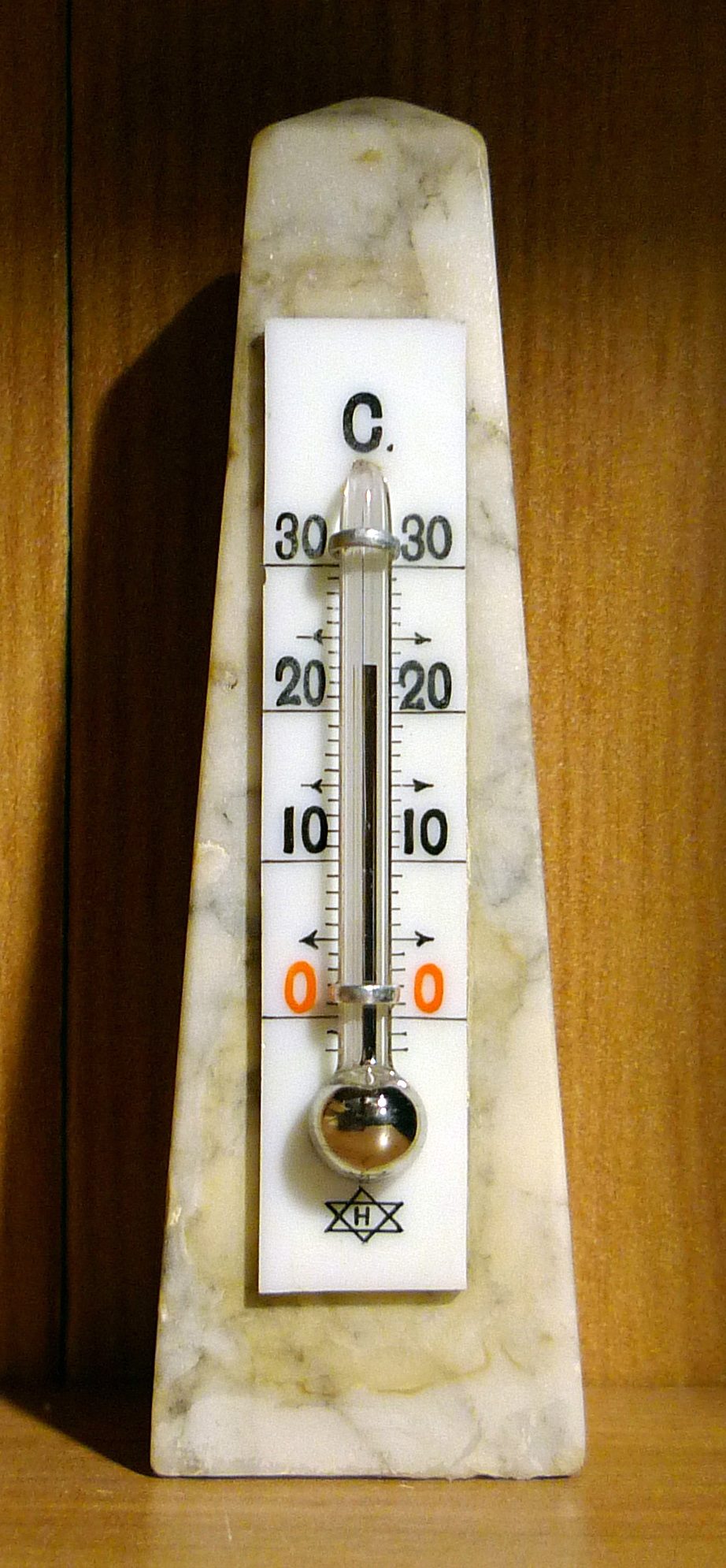
A thermometer measures temperature on a defined scale
حدد كل الخصائص التي يمكن استخدامها لقياس درجة الحرارة.
الصعوبة 2/5 · 140 عملة + مكافأة صغيرة عند الإنجاز الأول اليوم
أي خاصية تتغير بشكل قابل للتكرار مع درجة الحرارة تعمل. اللون الثابت للعلبة لا يعمل.
The absolute scale
- The thermodynamic 热力学 (absolute) scale uses the kelvin 开尔文 (K) and depends on no single substance.
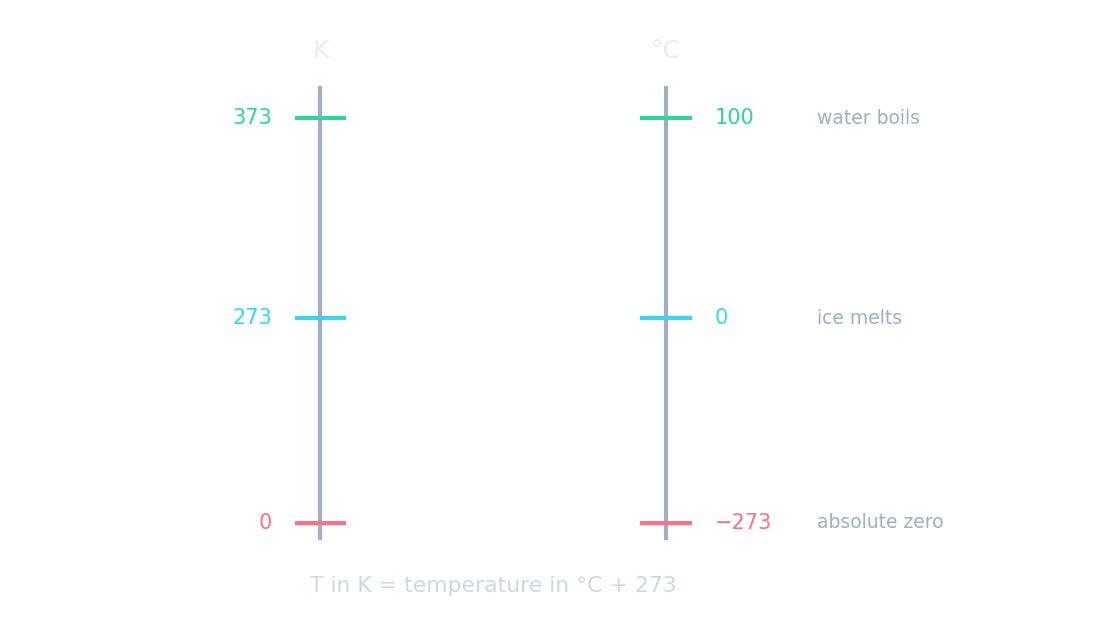
- Absolute zero 绝对零度 ($0\ \text{K}$) is the lowest possible temperature — least internal energy. Nothing is colder.
الصفر المطلق (0 K) هو:
الصعوبة 1/5 · 100 عملة + مكافأة صغيرة عند الإنجاز الأول اليوم
عند 0 K يكون للنظام أقل طاقة داخلية ممكنة؛ لا يمكن جعل شيء أبرد.
Kelvin and Celsius 摄氏度
- $T/\text{K} = \theta/°\text{C} + 273.15$. So $0\ °\text{C} = 273\ \text{K}$.
- A kelvin and a Celsius degree are the same size, so a change of $1\ \text{K} = 1\ °\text{C}$.
- Always use kelvin in gas-law calculations.
ما قيمة $27\ °\text{C}$ بوحدة كلفن؟
الصعوبة 2/5 · 140 عملة + مكافأة صغيرة عند الإنجاز الأول اليوم
$T/\text{K} = \theta/°\text{C} + 273 = 27 + 273 = 300\ \text{K}$.
ارتفاع درجة حرارة قدره 1 K يساوي ارتفاعاً قدره 1 °C.
الصعوبة 1/5 · 100 عملة + مكافأة صغيرة عند الإنجاز الأول اليوم
للمقياسين نفس حجم الدرجة — differing only in their zero points (by 273.15).
في حسابات قانون الغاز، يجب أن تكون درجة الحرارة بـ:
الصعوبة 1/5 · 100 عملة + مكافأة صغيرة عند الإنجاز الأول اليوم
تستخدم قوانين الغازات درجة الحرارة المطلقة — الكلفن. استخدام الدرجة المئوية (°C) يعطي إجابات خاطئة.
درجة حرارة تساوي 27 درجة مئوية. ما قيمتها بالكلفن؟
الصعوبة 2/5 · 140 عملة + مكافأة صغيرة عند الإنجاز الأول اليوم
T = 27 + 273 = 300 K. ومع ذلك، فإن فرق درجات الحرارة يكون نفس القيمة في كلا المقياسين: ارتفاع قدره 27 C هو نفسه ارتفاع قدره 27 K.
Why the thermodynamic scale is special
- It does not depend on the property of any particular substance — it is defined from the behaviour of an ideal gas, with absolute zero and the triple point of water as its fixed points.
- A liquid-in-glass thermometer assumes its liquid expands uniformly with temperature. That is only approximately true, so it agrees with the thermodynamic scale exactly only at the points where it was calibrated.
- That is the exam's "explain why a liquid-in-glass thermometer does not measure thermodynamic temperature".
ما الذي يجعل المقياس الديناميكي الحراري مميزاً؟ حدد كل الخيارات الصحيحة.
الصعوبة 2/5 · 140 عملة + مكافأة صغيرة عند الإنجاز الأول اليوم
الوحدة هي نتيجة وليس السمة التعريفية. يعتمد مقياس مقياس حرارة الزئبق على كيفية تمدد الزئبق؛ بينما هذا المقياس لا يعتمد على شيء من هذا القبيل.
Choosing a thermometer
- Platinum resistance: resistance varies linearly and repeatably with temperature over a wide range — very accurate. But it has a large thermal capacity, so it is slow and cannot follow a rapidly changing temperature.
- Thermocouple: two metal junctions give an e.m.f.; tiny, fast, wide range, measures at a point — ideal for a changing temperature.
- Liquid in glass: cheap and simple; limited range, slow, and reads only where the bulb is.
صل كل مقياس حرارة بميزته الرئيسية.
الصعوبة 2/5 · 140 عملة + مكافأة صغيرة عند الإنجاز الأول اليوم
السعة الحرارية الكبيرة تجعل مقياس المقاومة دقيقاً لكن بطيئاً؛ بينما يستجيب العقدة الصغيرة للكوبل الحراري بسرعة؛ والمقياس المطلق يُعرف من سلوك الغاز المثالي، وليس المادة.
صل كل مقياس حرارة بالخاصية التي يستخدمها.
الصعوبة 2/5 · 140 عملة + مكافأة صغيرة عند الإنجاز الأول اليوم
للكوبل الحراري سعة حرارية صغيرة ويستجيب بسرعة، ولهذا السبب يُختار لدرجات الحرارة المتغيرة بسرعة.
Worked example: finding absolute zero, then converting
A fixed volume of gas has pressure $100\ \text{kPa}$ at $0\ °\text{C}$ and $136.6\ \text{kPa}$ at $100\ °\text{C}$. Then: a gas is heated from $27\ °\text{C}$ to $742\ °\text{C}$.
- Gradient: $\dfrac{136.6 - 100}{100} = 0.366\ \dfrac{\text{kPa}}{°\text{C}}$; pressure is a straight line in temperature.
- Extrapolate to zero pressure: $\theta = -\dfrac{100}{0.366} = -273\ °\text{C}$ — absolute zero.
- Convert: $27\ °\text{C} = 300\ \text{K}$; $742\ °\text{C} = 1015\ \text{K}$.
- Temperature change: $742 - 27 = 715\ °\text{C} = 715\ \text{K}$ — a difference is the same number on both scales.
- Check: absolute zero is where the pressure of an ideal gas would fall to zero; the gas would liquefy long before, which is why the point is found by extrapolation, not by cooling.

Extrapolating the pressure-temperature line back to zero pressure gives absolute zero, about -273 degC
تم تسخين غاز من $20\ °\text{C}$ إلى $95\ °\text{C}$. ما مقدار تغير درجة الحرارة بـ K؟
الصعوبة 2/5 · 140 عملة + مكافأة صغيرة عند الإنجاز الأول اليوم
التغير هو نفس الرقم على كلا المقياسين: $95 - 20 = 75\ °\text{C} = 75\ \text{K}$. إضافة 273 ستكون خطأ هنا.
Add $273$ to convert a Celsius temperature to kelvin, but a temperature difference is the same number on both scales — do not add $273$ to a $\Delta T$. A kelvin temperature can never be negative. And absolute zero is the temperature of minimum internal energy, not zero energy — "the molecules stop moving" is not an accepted answer.
الصفر المطلق هو درجة الحرارة التي تمتلك فيها المادة ____ طاقتها الداخلية.
الصعوبة 1/5 · 100 عملة + مكافأة صغيرة عند الإنجاز الأول اليوم
ليس صفراً للطاقة — بل الحد الأدنى الممكن. ولهذا السبب لا يُقبل عبارة "تتوقف الجزيئات عن الحركة".
You've got it
- a thermometer uses any property that changes repeatably with temperature; the thermodynamic scale depends on no substance
- absolute zero $= 0\ \text{K} = -273.15\ °\text{C}$, the lowest possible temperature (minimum internal energy)
- $T/\text{K} = \theta/°\text{C} + 273$; a difference is the same in K and °C; use kelvin in gas laws