قانون نيوتن للجاذبية
| English | العربية |
|---|---|
| law of gravitation/lɔː ɒv ˌɡrævɪˈteɪʃn/ | قانون الجاذبية |
| attractive/əˈtræktɪv/ | جاذب |
| universal constant/ˌjuːnɪˈvɜːsl ˈkɒnstənt/ | ثابت عالمي |
| inverse-square law/ɪnˈvɜːs skweə lɔː/ | قانون التربيع العكسي |
| point mass/pɔɪnt mæs/ | كتلة نقطية |
Every mass pulls every other
- The Earth pulls you down — and you pull the Earth up, just as hard.
- Every pair of masses attracts, anywhere in the universe.
- Newton captured it in one equation.
The law of gravitation 万有引力定律
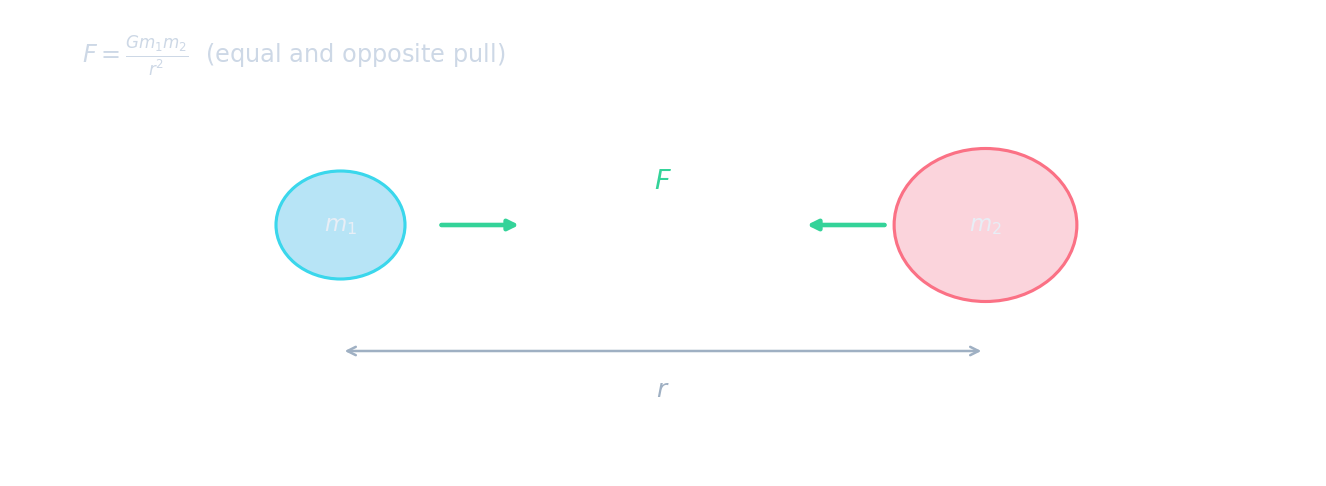
- $F = \dfrac{G m_1 m_2}{r^{2}}$ — an attractive 吸引 pull along the line joining the masses.
- $G = 6.67 \times 10^{-11}\ \dfrac{\text{N}\cdot\text{m}^2}{\text{kg}^2}$ is the universal constant 万有引力常数.
قانون نيوتن للجاذبية
F ∝ Mm / r²
الجاذبية تسحب للداخل وضعفها يتناسب مع مربع المسافة.
تعطي قانون نيوتن للجاذبية القوة بين كتلتين:
القوة تتناسب طردياً مع كل كتلة وعكسياً مع مربع المسافة.
الجاذبية دائماً تجاذبية.
نعم — الكتل تتجاذب معاً دائماً؛ لا يوجد تنافر جاذبي.
An inverse-square law 平方反比定律
- The force falls off as $\dfrac{1}{r^{2}}$.
- Double the separation → the force drops to a quarter.

The International Space Station orbits Earth, held in its path by gravity
كتلتان تتجاذبان بقوة $40\ \text{N}$ عند مسافة $r$. ما هي القوة عند مسافة $2r$؟
علاقة التربيع العكسي: $\dfrac{40}{2^{2}} = \dfrac{40}{4} = 10\ \text{N}$.
إذا تضاعفت كلتا الكتلتين (بنفس المسافة)، تصبح قوة الجاذبية:
$F \propto m_1 m_2$، لذا فإن مضاعفة كل منها يضاعف القوة بمقدار $2 \times 2 = 4$.
كتلتان تتجاذبان بقوة $F$. صل كل تغيير بالقوة الجديدة.
$F \propto \dfrac{m_1 m_2}{r^{2}}$: تتغير الكتلة القوة بشكل مباشر، بينما تتغير المسافة القوة按照 التربيع العكسي.
Spheres act as points
- A uniform sphere pulls (from outside) exactly like a point mass 质点 at its centre.
- So you can treat the Earth as a point mass at its centre, and $r$ is always measured centre to centre.

Two masses attract along the line joining them
الكرة المتجانسة تجذب الأجسام الخارجية وكأن كتلتها كلها متمركزة في مركزها.
نعم — من الخارج، تتصرف الكرة المتجانسة تماماً مثل كتلة نقطية في مركزها.
Worked example: the Earth and the Moon
Earth's mass is $5.97 \times 10^{24}\ \text{kg}$, the Moon's is $7.35 \times 10^{22}\ \text{kg}$, and their centres are $3.84 \times 10^{8}\ \text{m}$ apart.
- Force: $F = \dfrac{G m_1 m_2}{r^{2}} = \dfrac{6.67 \times 10^{-11} \times 5.97 \times 10^{24} \times 7.35 \times 10^{22}}{(3.84 \times 10^{8})^{2}} = 2.0 \times 10^{20}\ \text{N}$.
- On which body? On both: the Moon pulls the Earth with exactly the same $2.0 \times 10^{20}\ \text{N}$ — a Newton's third law pair.
- Halve the distance: the force would be $4 \times 2.0 \times 10^{20} = 8.0 \times 10^{20}\ \text{N}$.
- Check: square the separation before dividing, and keep it in metres. An answer near $10^{28}\ \text{N}$ means $r$ was not squared.
شخصان كتلتهما $50\ \text{kg}$ يقفان وبين مركزيهما مسافة $1.0\ \text{m}$. ما هي القوة الجاذبية بينهما، كنسبة من $10^{-7}\ \text{N}$؟
$F = \dfrac{6.67 \times 10^{-11} \times 50 \times 50}{1.0^{2}} = 1.67 \times 10^{-7}\ \text{N}$ — أقل من وزن حبة غبار، ولهذا يُطلق على $G$ اسم صغير جداً.
Weighing a planet
- You cannot put a planet on a balance, but its surface field gives its mass: $g = \dfrac{GM}{R^{2}}$, so $M = \dfrac{gR^{2}}{G}$.
- A moon's orbit works too: gravity supplies the centripetal force, $\dfrac{GMm}{r^{2}} = mr\omega^{2}$, so $M = \dfrac{4\pi^{2}r^{3}}{GT^{2}}$ — only the orbit's radius and period are needed.
Worked example: the mass of Mars
At the surface of Mars the field strength is $3.7\ \dfrac{\text{N}}{\text{kg}}$ and the radius is $3.4 \times 10^{6}\ \text{m}$. Show that the mass of Mars is about $6.4 \times 10^{23}\ \text{kg}$.
- Start from the field of a sphere: $g = \dfrac{GM}{R^{2}}$.
- Rearrange: $M = \dfrac{gR^{2}}{G} = \dfrac{3.7 \times (3.4 \times 10^{6})^{2}}{6.67 \times 10^{-11}}$.
- Answer: $M = 6.4 \times 10^{23}\ \text{kg}$, as required — about a tenth of the Earth's mass.
- Check: a "show that" is marked on the working, so write the equation, the rearrangement and the substitution, and let the number fall out.
كوكب له شدة حقل سطحي $25\ \dfrac{\text{N}}{\text{kg}}$ ونصف قطر $7.0 \times 10^{7}\ \text{m}$. ما هي كتلته، كنسبة من $10^{27}\ \text{kg}$؟
$M = \dfrac{gR^{2}}{G} = \dfrac{25 \times (7.0 \times 10^{7})^{2}}{6.67 \times 10^{-11}} = 1.84 \times 10^{27}\ \text{kg}$ — قريب من كتلة المشتري.
$r$ is the distance between the centres — never the gap between the surfaces, and never a height above the ground on its own. $G$ is tiny, which is why gravity between everyday objects is negligible; only a planet-sized mass makes it noticeable. And the two forces in the pair are equal, however different the masses — the apple pulls the Earth as hard as the Earth pulls the apple.
في $F = \dfrac{G m_1 m_2}{r^{2}}$، تُقاس المسافة $r$ بين ____ للكتلتين.
تعمل الكرة المتجانسة كتلة نقطية في مركزها، لذا بالنسبة لقمر صناعي $r$ هو نصف قطر الكوكب زائد الارتفاع فوق السطح.
You've got it
- $F = \dfrac{G m_1 m_2}{r^{2}}$ — always attractive, along the joining line, equal on both masses
- it is an inverse-square law: double $r$ → quarter the force
- a uniform sphere acts as a point mass at its centre, so $r$ is centre-to-centre; $M = \dfrac{gR^{2}}{G}$ weighs a planet