الطاقة الحركية والطاقة الكامنة
| English | العربية |
|---|---|
| kinetic energy/kɪˈnetɪk ˈenədʒi/ | الطاقة الحركية |
| gravitational potential energy/ˌɡrævɪˈteɪʃənl pəˈtenʃl ˈenədʒi/ | الطاقة الكامنة الجاذبية |
| thermal energy/ˈθɜːml ˈenədʒi/ | طاقة حرارية |
| momentum/məʊˈmentəm/ | العزم |
| elastic potential energy/ɪˈlæstɪk pəˈtenʃl ˈenədʒi/ | الطاقة الكامنة المرنة |
| compression/kəmˈpreʃn/ | ضغط |
The roller-coaster swap
- At the top of a drop a coaster crawls; at the bottom it races.
- Height has turned into speed — potential energy into kinetic energy 动能.
- Energy is just moving between two stores.
Gravitational potential energy 重力势能
- Lifting a mass $m$ through a height $\Delta h$ stores $\Delta E_{\text{P}} = mg\Delta h$.
- It comes from the work done against gravity: $W = mg \times \Delta h$.

Gravitational PE depends only on the change in height Δh, not on the path taken

Wind turbines transfer the kinetic energy of the wind into electrical energy
الطاقة الحركية والطاقة الكامنة
PE + KE = ثابت
الطاقة الكامنة تتحول إلى طاقة حركية — ولا يتغير المجموع الكلي أبداً.
كتاب كتلته $2.0\ \text{kg}$ يُرفعه ارتفاع $5.0\ \text{m}$. كم مقدار الطاقة الكامنة الجاذبية التي يكتسبها؟ (استخدم $g = 9.81\ \dfrac{\text{m}}{\text{s}^2}$.)
$\Delta E_{\text{P}} = mg\Delta h = 2.0 \times 9.81 \times 5.0 \approx 98\ \text{J}$.
Kinetic energy
- A mass $m$ moving at speed $v$ has $E_{\text{K}} = \tfrac{1}{2}mv^{2}$.
- It comes from the work done to speed it up: $W = Fs = \tfrac{1}{2}mv^{2}$.
عربة كتلتها $4.0\ \text{kg}$ تتحرك بسرعة $3.0\ \dfrac{\text{m}}{\text{s}}$. ما طاقتها الحركية؟
$E_{\text{K}} = \tfrac{1}{2}mv^{2} = \tfrac{1}{2} \times 4.0 \times 3.0^{2} = 18\ \text{J}$.
صافِ كل مخزن طاقة بما يعتمد عليه.
اثنان من الثلاثة يتناسبان مع مربع، ولهذا عند مضاعفة السرعة أو الاستطالة تتضاعف الطاقة أربعة أضعاف، بينما مضاعفة الارتفاع تضاعفه فقط.
Two traps. Squaring: doubling the speed gives four times the kinetic energy, not two. Height: $\Delta h$ is the vertical change in height, never the distance along a slope — a ramp of length $3\ \text{m}$ that drops $1.5\ \text{m}$ uses $1.5\ \text{m}$.
The energy swap
- On a frictionless ramp, GPE becomes KE: $mgh = \tfrac{1}{2}mv^{2}$, so $v = \sqrt{2gh}$.
- The mass cancels — every object reaches the same speed from the same height.
- With friction, some of it becomes thermal energy 热能 instead.
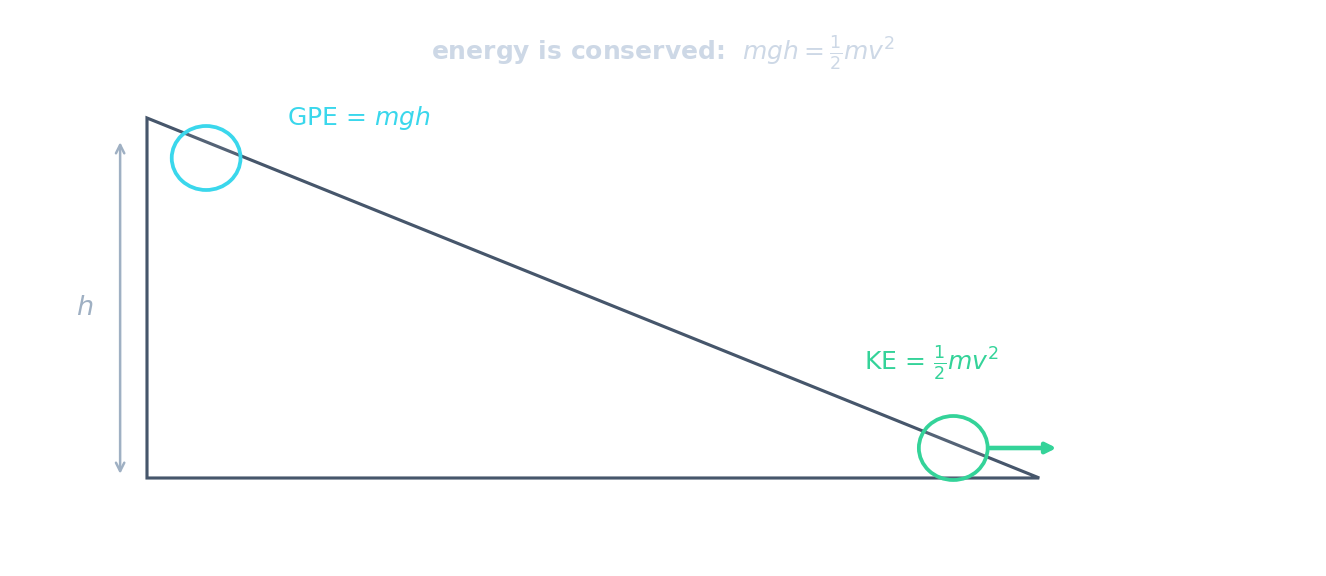
عندما تدحرج كرة منحدرًا بلا احتكاك، تتحول طاقتها الكامنة الجاذبية بشكل رئيسي إلى:
بدون احتكاك، تتحول جميع الطاقة الكامنة الجاذبية المفقودة إلى طاقة حركية: $mgh = \tfrac{1}{2}mv^{2}$.
كتلة كتلتها 2.0 كجم تنزلق من السكون على منحدر أملس، بانخفاض ارتفاع 1.5 متر. ما سرعتها في الأسفل، بوحدة م/ث؟ (g = 9.81 م/ث^2)
mgh = mv^2/2، وتختصر الكتلة: v = sqrt(2 x 9.81 x 1.5) = 5.4 م/ث. استخدم الهبوط الرأسي، لا المسافة على طول المنحدر.
في $mg\Delta h$ الارتفاع هو المسافة المقطوعة على طول الميلان.
إنه الارتفاع الرأسي المكتسب أو المفقود. استخدام مسافة الميلان يؤدي دائمًا إلى مبالغة في حساب التغير في الطاقة، بمعامل 1/sin(theta).
Worked example: a ramp with friction
A $2.0\ \text{kg}$ trolley is released from rest at the top of a ramp $3.0\ \text{m}$ long that drops $1.5\ \text{m}$. It reaches the bottom at $4.0\ \dfrac{\text{m}}{\text{s}}$. Find the work done against friction and the average friction force.
- GPE lost: $mg\Delta h = 2.0 \times 9.81 \times 1.5 = 29\ \text{J}$.
- KE gained: $\tfrac{1}{2}mv^{2} = \tfrac{1}{2} \times 2.0 \times 4.0^{2} = 16\ \text{J}$.
- The difference is the work done against friction: $29 - 16 = 13\ \text{J}$.
- Friction force: work = force × distance along the ramp, so $F = \dfrac{13}{3.0} = 4.5\ \text{N}$.
- Check: without friction the speed would have been $\sqrt{2 \times 9.81 \times 1.5} = 5.4\ \dfrac{\text{m}}{\text{s}}$ — larger than $4.0$, as it must be.
عربة تدحرج منحدرًا خشنًا. بالمقارنة بمنحدر بلا احتكاك، أي العبارات صحيحة؟ حدد كل ما ينطبق.
الطاقة الكامنة الجاذبية المفقودة ثابتة بسبب هبوط الارتفاع وهي نفسها على كلا المنحدرين. يأخذ الاحتكاك جزءًا منها كطاقة حرارية، لذا فإن الطاقة الحركية في الأسفل تكون أصغر بمقدار الشغل المبذول ضد الاحتكاك تمامًا.
Energy and momentum 动量
- Combining $p = mv$ with $E_{\text{K}} = \tfrac{1}{2}mv^{2}$ gives $E_{\text{K}} = \dfrac{p^{2}}{2m}$.
- Handy when you know the momentum but not the speed.
الطاقة الحركية مكتوبة بدلالة الزخم $p$ هي:
من $p = mv$ و $E_{\text{K}} = \tfrac{1}{2}mv^{2}$، بالتعويض $v = p/m$ نحصل على $E_{\text{K}} = \dfrac{p^{2}}{2m}$.
Energy methods
- Write the energy at the start and end, then balance the books.
- Spring: a block's KE becomes elastic potential energy 弹性势能 $\tfrac{1}{2}kx^{2}$ at greatest compression 压缩.
- Bounce: the height ratio $\dfrac{h_2}{h_1}$ is the fraction of energy kept.

A stretched or compressed spring stores elastic PE ½kx², ready to become kinetic energy
كتلة تنزلق داخل زنبرك على سطح بلا احتكاك. عند أقصى انضغاط، تتحول طاقتها الحركية بالكامل إلى طاقة ____ كامنة.
KE → PE مرنة $= \tfrac{1}{2}kx^{2}$ عند نقطة أقصى انضغاط، ثم تعود إلى KE عندما يدفعها الزنبرك للخارج.
عندما تعمل الاحتكاك، تتحول بعض الطاقة الميكانيكية إلى طاقة حرارية.
نعم — تلك الطاقة "المفقودة" لم تُدمر؛ بل أسخنت الأسطح والمحيط.
Worked example: a block meets a spring
A block slides down a slope and hits a spring with $60\ \text{J}$ of kinetic energy. While the spring compresses to its maximum, the block's gravitational PE falls by a further $10\ \text{J}$. All the energy the block loses becomes elastic PE in the spring, whose constant is $k = 3500\ \dfrac{\text{N}}{\text{m}}$. Find the maximum compression and the force on the block there.
- Energy into the spring: $60 + 10 = 70\ \text{J}$ (the block loses both its KE and some GPE).
- Compression: $\tfrac{1}{2}kx^{2} = 70$, so $x^{2} = \dfrac{140}{3500} = 0.040$ and $x = 0.20\ \text{m}$.
- Force at maximum compression: $F = kx = 3500 \times 0.20 = 700\ \text{N}$.
- Check: on a force–compression graph the area under the line to $x = 0.20\ \text{m}$ is $\tfrac{1}{2} \times 700 \times 0.20 = 70\ \text{J}$ — the same energy, found the other way.
كتلة طاقتها الحركية $40\ \text{J}$ تصطدم بزنبرك ثابت زنه $k = 2000\ \dfrac{\text{N}}{\text{m}}$ على سطح أفقي. تتحول كل طاقتها الحركية إلى طاقة كامنة مرنة. ما أقصى انضغاط، بوحدة المتر؟
$\tfrac{1}{2}kx^{2} = 40$، لذا $x^{2} = \dfrac{80}{2000} = 0.040$ و $x = 0.20\ \text{m}$.
You've got it
- gravitational PE $\Delta E_{\text{P}} = mg\Delta h$ (vertical height!); kinetic energy $E_{\text{K}} = \tfrac{1}{2}mv^{2}$
- on a frictionless ramp $mgh = \tfrac{1}{2}mv^{2}$, so $v = \sqrt{2gh}$; with friction the missing energy is the work done against it
- in momentum terms, $E_{\text{K}} = \dfrac{p^{2}}{2m}$; a spring stores $\tfrac{1}{2}kx^{2}$