قوانين نيوتن، القوة والزخم
مُقدَّم| English | المعنى |
|---|---|
| momentum/məʊˈmentəm/ | زخم |
| impulse/ˈɪmpʌls/ | اندفاع |
| collision/kəˈlɪʒn/ | اصطدام |
| resultant force/rɪˈzʌltənt fɔːs/ | قوة محصلة |
| inertia/ɪˈnɜːʃə/ | خمول (قصور ذاتي) |
| weight/weɪt/ | وزن |
Why soft hands catch an egg
- Catch a thrown egg with stiff hands and it breaks; with soft, giving hands it survives.
- Both stop the same egg — but soft hands take more time, so the force is smaller.
- That link between force, momentum 动量 and time is the heart of dynamics.
Momentum
- Momentum $p = mv$ — mass times velocity. It is a vector (same direction as $v$).
- Unit: $\dfrac{\text{kg}\cdot\text{m}}{\text{s}}$, the same as $\text{N}\cdot\text{s}$.
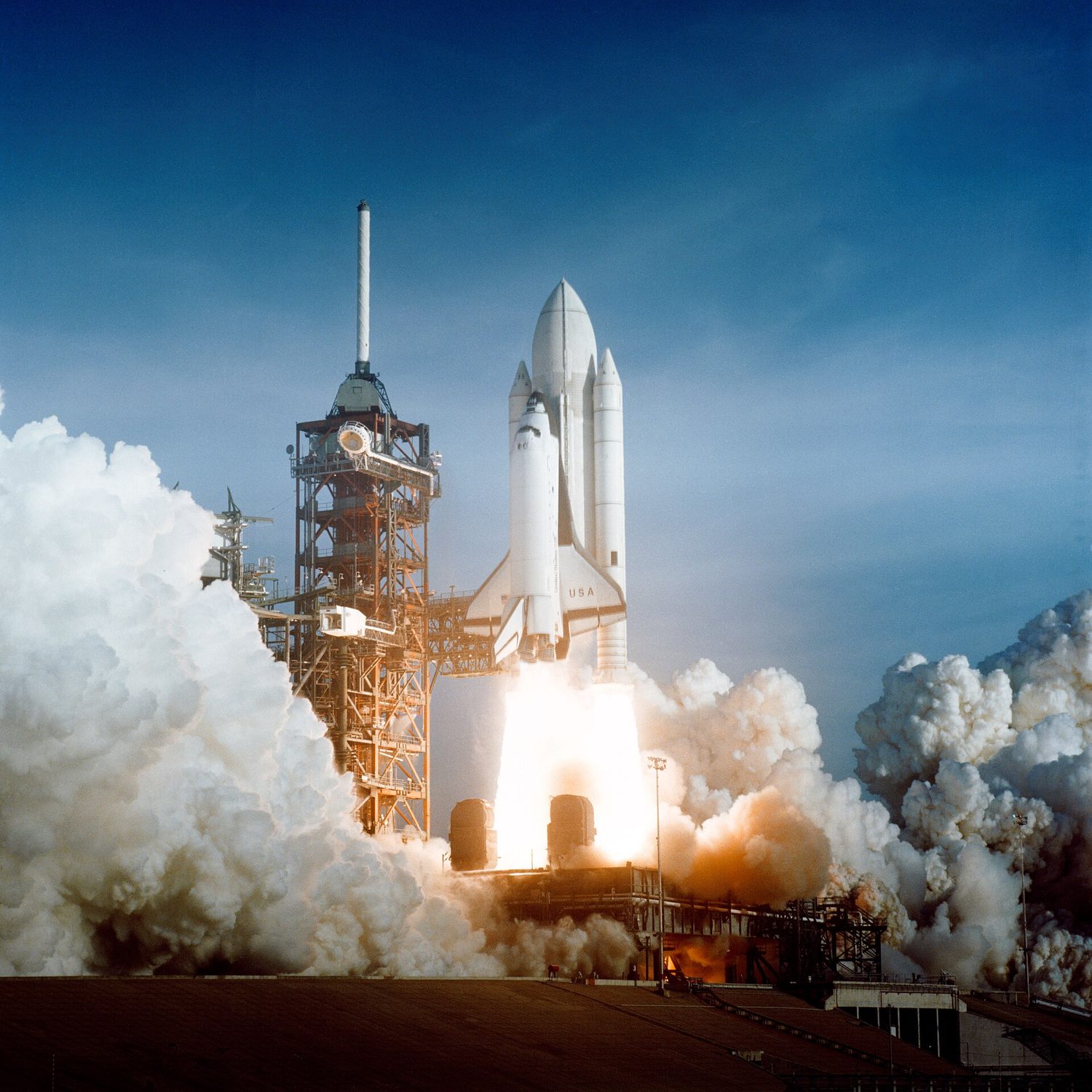
The rocket gains upward momentum because its exhaust gas gains the same amount of momentum downward
مخطط الجسم الحر (F = ma)
حاصل القوى مقسوماً على الكتلة يعطي التسارع.
القانون الثاني لنيوتن
F = ma (الحاصل)
القوة المحصلة تحدد التسارع؛ القوى المتوازنة ⇒ لا يوجد تسارع.
كرة كتلتها $2.0\ \text{kg}$ تتحرك بسرعة $3.0\ \dfrac{\text{m}}{\text{s}}$. ما زخمها؟
الصعوبة 2/5 · 140 عملة + مكافأة صغيرة عند الإنجاز الأول اليوم
$p = mv = 2.0 \times 3.0 = 6.0\ \dfrac{\text{kg}\cdot\text{m}}{\text{s}}$.
الزخم كمية متجهة.
الصعوبة 1/5 · 100 عملة + مكافأة صغيرة عند الإنجاز الأول اليوم
نعم — $p = mv$ يشير في نفس اتجاه السرعة، لذا له اتجاه.
Force = rate of change of momentum
- Newton's second law, in full: $F = \dfrac{\Delta p}{\Delta t}$.
- When the mass is constant this becomes the familiar $F = ma$.
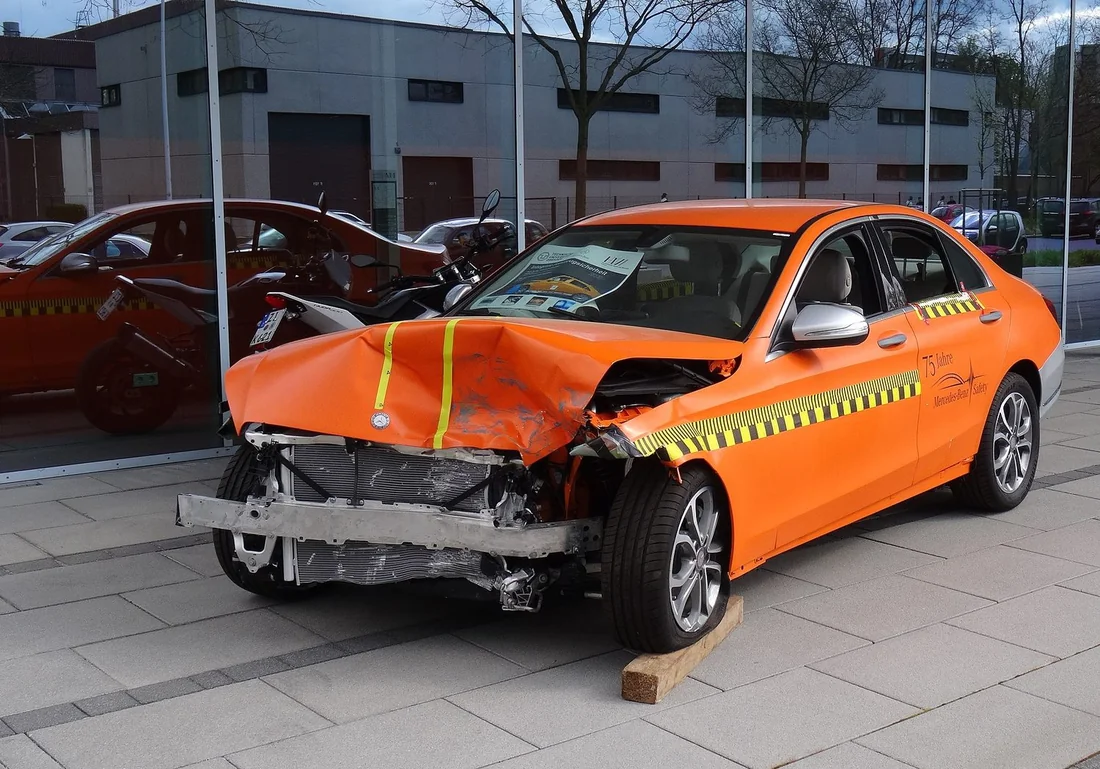
In a crash, a large force acts over a very short time to change momentum
الصيغة العامة لقانون نيوتن الثاني تنص على أن القوة المحصلة تساوي:
الصعوبة 1/5 · 100 عملة + مكافأة صغيرة عند الإنجاز الأول اليوم
$F = \dfrac{\Delta p}{\Delta t}$ — معدل تغير الزخم. للكتلة الثابتة هذا هو $F = ma$.
صل كل قانون من قوانين نيوتن بعبارته.
الصعوبة 2/5 · 140 عملة + مكافأة صغيرة عند الإنجاز الأول اليوم
صيغة القانون الثاني تتعلق بمعدل تغير الزَخم. F = ma حالة خاصة، صالحة فقط عندما تكون الكتلة ثابتة.
Impulse 冲量 and collisions 碰撞
- The average force in a hit is $F = \dfrac{\Delta p}{\Delta t}$ — change in momentum over contact time.
- A longer contact time means a smaller force (the egg, a crumple zone, a bent knee on landing).
- Energy link: $E_{\text{k}} = \dfrac{p^{2}}{2m}$.
التقاط بيضة بأيدين لينتين يزيد وقت التلامس، مما يجعل القوة المتوسطة ____.
الصعوبة 1/5 · 100 عملة + مكافأة صغيرة عند الإنجاز الأول اليوم
نفس التغير في الزخم عبر زمن أطول يعني قوة أقل: $F = \dfrac{\Delta p}{\Delta t}$.
صدمت كرة كتلتها $0.15\ \text{kg}$ جداراً بسرعة $12\ \dfrac{\text{m}}{\text{s}}$ وتردّت بسرعة $8.0\ \dfrac{\text{m}}{\text{s}}$ على نفس الخط. ما مقدار الدفع المؤثر عليها؟
الصعوبة 2/5 · 140 عملة + مكافأة صغيرة عند الإنجاز الأول اليوم
اعتمد اتجاه الرد كاتجاه موجب: $\Delta p = 0.15 \times (8.0 - (-12)) = 3.0\ \text{N}\cdot\text{s}$. طرح السرعات بدون إشارتها ($0.15 \times 4.0$) هو خطأ شائع؛ فالكرة تعكس اتجاهها، لذا يتغير زخمها بمقدار أكبر من أي قيمة فردية.
Worked example: the egg, then a tennis ball
- A $0.060\ \text{kg}$ egg moving at $5.0\ \dfrac{\text{m}}{\text{s}}$ is stopped. Its change in momentum is $0.060 \times 5.0 = 0.30\ \text{N}\cdot\text{s}$ either way. Stiff hands stop it in $0.010\ \text{s}$: $F = \dfrac{0.30}{0.010} = 30\ \text{N}$. Soft hands take $0.20\ \text{s}$: $F = \dfrac{0.30}{0.20} = 1.5\ \text{N}$.
- A $0.060\ \text{kg}$ tennis ball arrives at $20\ \dfrac{\text{m}}{\text{s}}$ and leaves the racket at $30\ \dfrac{\text{m}}{\text{s}}$ the other way. With the outgoing direction positive, $\Delta p = 0.060 \times (30 - (-20)) = 3.0\ \text{N}\cdot\text{s}$. In $5.0\ \text{ms}$ of contact, $F = \dfrac{3.0}{5.0 \times 10^{-3}} = 600\ \text{N}$.
تم التقاط كرة قدم كتلتها $0.40\ \text{kg}$ وهي تتحرك بسرعة $15\ \dfrac{\text{m}}{\text{s}}$ وأُوقف تيارها خلال $0.12\ \text{s}$. ما متوسط القوة المؤثرة عليها؟
الصعوبة 2/5 · 140 عملة + مكافأة صغيرة عند الإنجاز الأول اليوم
$\Delta p = 0.40 \times 15 = 6.0\ \text{N}\cdot\text{s}$، إذن $F = \dfrac{\Delta p}{\Delta t} = \dfrac{6.0}{0.12} = 50\ \text{N}$.
Newton's first law
- With zero resultant force 合力, an object stays at rest or moves at constant velocity.
- You lurch forward when a bus brakes because your body "wants" to keep moving — inertia 惯性.
Newton's second law
- A resultant force gives an acceleration: $F = ma$.
- The acceleration always points the same way as the resultant force.
Newton's third law
- If A pushes B, then B pushes A back — equal in size, opposite in direction.
- The two forces act on different objects and are the same type of force.
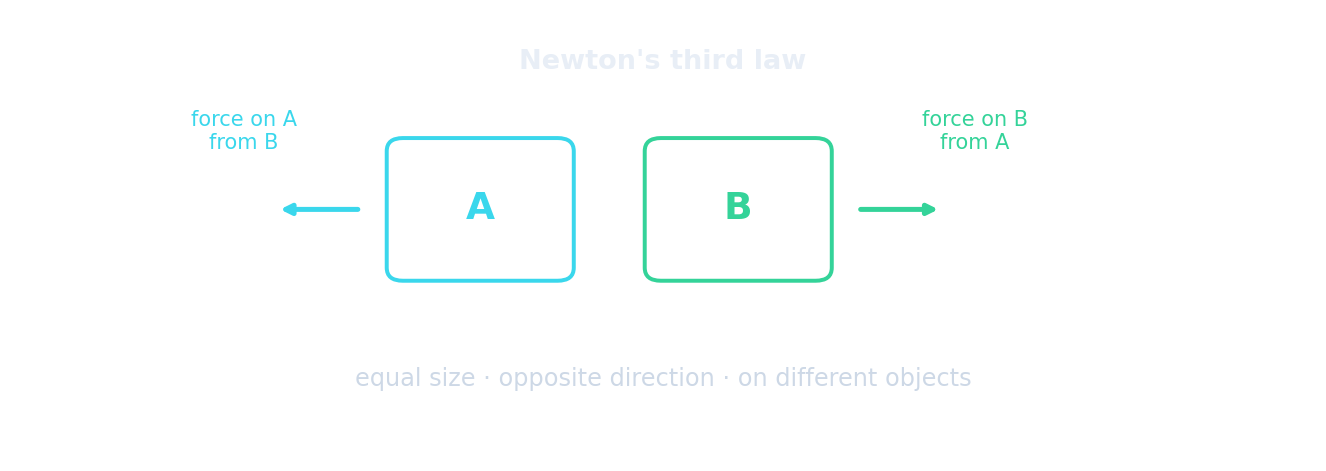
A book's weight and the table's upward push are not a third-law pair — they act on the same object (the book) and are different types of force.
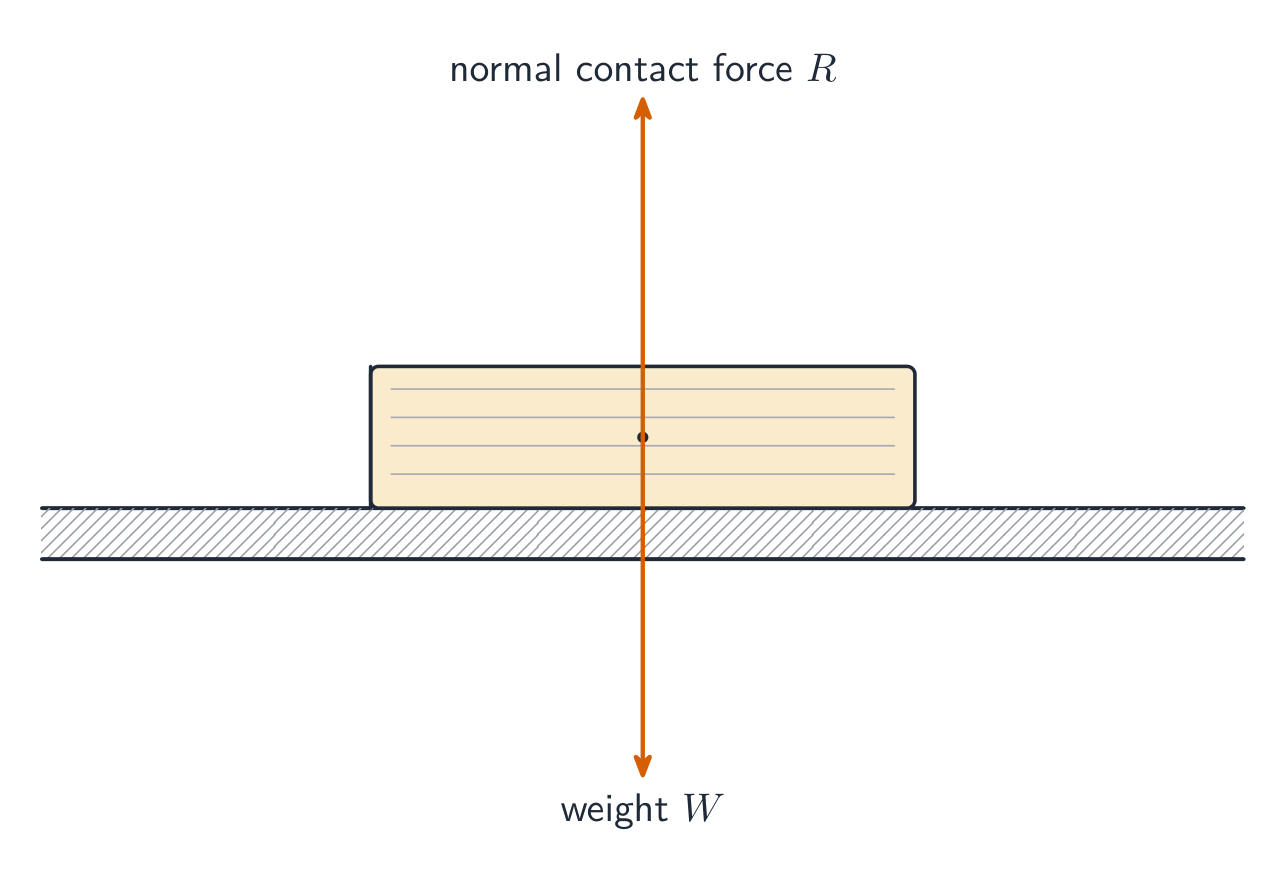
Both forces act on the book: the weight 重力 is gravitational, the table's push is a contact force
أي زوج من القوى يمثلان شريكين حقيقيين في قانون نيوتن الثالث؟
الصعوبة 1/5 · 100 عملة + مكافأة صغيرة عند الإنجاز الأول اليوم
قوى التلامس "كتاب على طاولة" و"طاولة على كتاب" متساوية، معاكسة، من نفس النوع، وتؤثر على أجسام مختلفة. وزن الكتاب ودفع الطاولة يؤثران على نفس الجسم، لذا فهما ليسا زوجًا.
حدد جميع العبارات الصحيحة حول زوج قوى قانون نيوتن الثالث.
الصعوبة 2/5 · 140 عملة + مكافأة صغيرة عند الإنجاز الأول اليوم
زوج قانون نيوتن الثالث يكون متساويًا، معاكسًا، من نفس النوع، ويؤثر على جسمين مختلفين — لا يمكن أن يؤثر على نفس الجسم أبدًا.
Weight
- Weight is the gravitational force on a mass: $W = mg$.
- Mass is the same everywhere; weight changes with $g$ (less on the Moon).
ما وزن حقيبة كتلتها $5.0\ \text{kg}$ بالقرب من سطح الأرض؟ (استخدم $g = 9.81\ \dfrac{\text{m}}{\text{s}^2}$.)
الصعوبة 2/5 · 140 عملة + مكافأة صغيرة عند الإنجاز الأول اليوم
$W = mg = 5.0 \times 9.81 \approx 49\ \text{N}$.
لجسم في حالة توازن، لا تقل إن القوى تلغي بعضها. قل إن محصلة ____ المؤثرة عليه تساوي صفرًا.
الصعوبة 1/5 · 100 عملة + مكافأة صغيرة عند الإنجاز الأول اليوم
"متوازنة" و"تلغي بعضها" كلاهما مرفوض. المصحح يتحقق مما إذا كنت تستطيع تسمية المحصلة المتجهة الواحدة لجميع القوى.
رتب اختبار زوج قانون نيوتن الثالث بشكل صحيح.
الصعوبة 3/5 · 200 عملة + مكافأة صغيرة عند الإنجاز الأول اليوم
الأخيران هما ما ينفيان الإجابة الخاطئة الكلاسيكية. وزن كتاب (جاذبية) ودفع الطاولة له (تلامس) يفشلان في الحالتين: نفس الجسم، أنواع مختلفة.
Marks that slip away
- Never write "the forces are balanced" or "the forces cancel out". The marked phrase is the resultant force on the object is zero.
- Newton's second law is about the rate of change of momentum, not simply $F = ma$. That form assumes a constant mass.
- A third-law pair acts on two different objects and is one type of force. The weight of a book and the table's push on it are not a pair: both act on the book.
- Conservation of momentum needs its condition stated: provided no resultant external force acts on the system.
- Mass resists a change in motion and is in kilograms; weight is a force in newtons, equal to $mg$. A question that says "mass" wants kilograms.
You've got it
- momentum $p = mv$ (a vector); force $F = \dfrac{\Delta p}{\Delta t} = ma$
- a longer contact time gives a smaller force (impulse)
- third-law pairs are equal, opposite, same type, different objects; $W = mg$