Why complexes are coloured
مُقدَّم| English | المعنى |
|---|---|
| degenerate/dɪˈdʒenəreɪt/ | متساوي الطاقة |
| octahedral/ˌɒktəˈhiːdrəl/ | ثماني الأوجه |
| tetrahedral/ˌtetrəˈhiːdrəl/ | رباعي السطوح |
| complementary colour/ˌkɒmplɪˈmentəri ˈkʌlə/ | لون مكمل |
| spectrochemical series/ˌspektrəʊˈkemɪkl ˈsɪəriːz/ | السلسلة الطيفية الكيميائية |
Where the colour comes from
- Copper sulfate solution is blue, iron(III) solutions are yellow-brown, and zinc sulfate is colourless. The colour comes from the d electrons.
- In a free ion the five d orbitals are degenerate 简并 (same energy). Ligands split them into two sets, and absorbing light across the gap gives the colour we see.
Complex colour route
Follow light absorption from d-orbital splitting to observed colour.
In a free transition-metal ion, the five d orbitals are:
الصعوبة 1/5 · 100 عملة + مكافأة صغيرة عند الإنجاز الأول اليوم
They are degenerate until ligands approach and split them into two sets.
Transition-metal complexes are coloured because d-electrons absorb part of the ______ spectrum.
الصعوبة 1/5 · 100 عملة + مكافأة صغيرة عند الإنجاز الأول اليوم
The complementary colour is transmitted.
Splitting the d orbitals
- Ligands split the d orbitals into two sets separated by an energy gap $\Delta E$. In an octahedral 八面体形 complex there are three lower and two higher orbitals.
- In a tetrahedral 四面体形 complex it is the reverse: two lower and three higher, with a smaller gap.
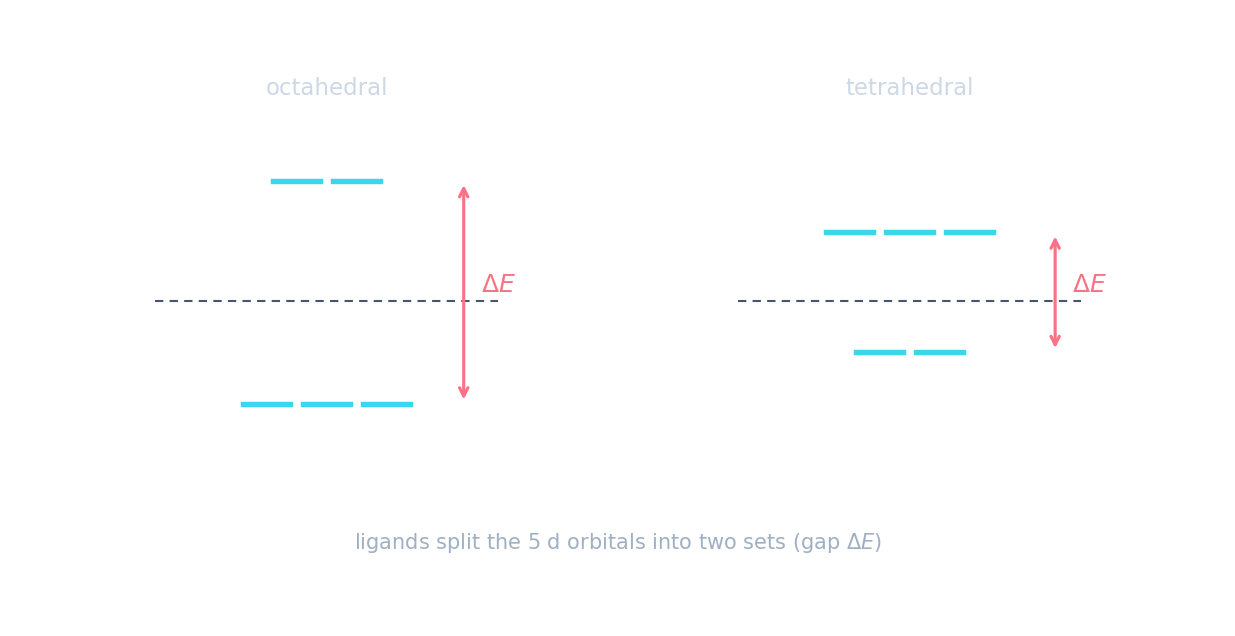
In an octahedral complex, the d orbitals split into:
الصعوبة 1/5 · 100 عملة + مكافأة صغيرة عند الإنجاز الأول اليوم
Octahedral: 3 lower + 2 upper; tetrahedral is the reverse (2 lower + 3 upper).
Match each colour-theory idea.
الصعوبة 2/5 · 140 عملة + مكافأة صغيرة عند الإنجاز الأول اليوم
Each item links the term to its correct meaning.
The colour we see
- A complex absorbs visible light whose energy matches $\Delta E=hf$, promoting a d electron to the upper set. The rest of the light passes through.
- We see the complementary colour 互补色 of the light absorbed: the colour opposite it on the colour wheel. A d⁰ or d¹⁰ ion (Sc³⁺, Zn²⁺, Cu⁺) has no possible jump, so it is colourless.

The colour we see for a complex is:
الصعوبة 1/5 · 100 عملة + مكافأة صغيرة عند الإنجاز الأول اليوم
The complex absorbs light of energy ΔE; we see the complementary colour of what was absorbed.
What changes the colour
- Change $\Delta E$ and you change the colour. $\Delta E$ depends on the ligand (a spectrochemical series 光谱化学序列: CN⁻ > NH₃ > H₂O > Cl⁻), the metal's oxidation state (higher charge, bigger $\Delta E$) and the geometry.
- A bigger $\Delta E$ means higher-energy light is absorbed: a shorter wavelength, nearer the blue end of the spectrum.
Ligand exchange changes the colour because different ligands:
الصعوبة 1/5 · 100 عملة + مكافأة صغيرة عند الإنجاز الأول اليوم
A different ligand changes the size of the d-orbital splitting (ΔE), so a different colour is seen.
Ligand exchange. Add ammonia to pale-blue [Cu(H₂O)₆]²⁺ to make deep-blue [Cu(NH₃)₄(H₂O)₂]²⁺.
- NH₃ is a stronger-field ligand than H₂O, so $\Delta E$ gets larger.
- The complex now absorbs shorter-wavelength (higher-energy) light, so the colour we see changes to a deeper blue-violet.
Calculating $\Delta E$. [Ti(H₂O)₆]³⁺ absorbs most strongly at 500 nm. Find $\Delta E$ in J and in kJ mol⁻¹. ($h=6.63\times10^{-34}$ J s, $c=3.00\times10^{8}$ m s⁻¹, $L=6.02\times10^{23}$ mol⁻¹.)
- $\Delta E=hf=\dfrac{hc}{\lambda}=\dfrac{6.63\times10^{-34}\times3.00\times10^{8}}{500\times10^{-9}}=3.98\times10^{-19}$ J.
- Per mole: $3.98\times10^{-19}\times6.02\times10^{23}=2.39\times10^{5}$ J mol⁻¹ $=239$ kJ mol⁻¹. Absorbing green-yellow light makes it look purple.
A complex absorbs most strongly at 600 nm. Calculate $\Delta E$ in kJ mol⁻¹. ($h=6.63\times10^{-34}$ J s, $c=3.00\times10^{8}$ m s⁻¹, $L=6.02\times10^{23}$ mol⁻¹)
الصعوبة 2/5 · 140 عملة + مكافأة صغيرة عند الإنجاز الأول اليوم
$\dfrac{hc}{\lambda}=\dfrac{6.63\times10^{-34}\times3.00\times10^{8}}{600\times10^{-9}}=3.32\times10^{-19}$ J; $\times6.02\times10^{23}=2.00\times10^{5}$ J mol⁻¹ $=200$ kJ mol⁻¹.
Coloured or not? Which of Sc³⁺, Ti³⁺, Cu⁺ and Cu²⁺ form coloured aqueous ions?
- Sc³⁺ is 3d⁰ and Cu⁺ is 3d¹⁰: no d–d jump is possible, so they are colourless.
- Ti³⁺ (3d¹) and Cu²⁺ (3d⁹) have a partly filled d subshell, so they are coloured.
Select جميعها the aqueous ions that are coloured.
الصعوبة 2/5 · 140 عملة + مكافأة صغيرة عند الإنجاز الأول اليوم
Only a partly filled d subshell allows a d–d transition. 3d⁰ and 3d¹⁰ ions are colourless.
- The colour you see is not the colour absorbed. A blue solution absorbs orange-red light.
- Colour needs a partly filled d subshell. Being a d-block ion is not enough: Zn²⁺ and Cu⁺ are colourless.
- A larger $\Delta E$ means a shorter wavelength absorbed, not a longer one: $E=\dfrac{hc}{\lambda}$.
A larger $\Delta E$ means the complex absorbs light of a longer wavelength.
الصعوبة 1/5 · 100 عملة + مكافأة صغيرة عند الإنجاز الأول اليوم
$E=\dfrac{hc}{\lambda}$: larger energy means a shorter wavelength.
- a free ion's five d orbitals are degenerate; ligands split them by a gap $\Delta E$ (octahedral 3 lower + 2 upper; tetrahedral 2 lower + 3 upper)
- the complex absorbs light with $\Delta E=hf=\frac{hc}{\lambda}$, and we see the complementary colour; d⁰ and d¹⁰ ions are colourless
- $\Delta E$, and so the colour, changes with the ligand, the oxidation state and the geometry