Stereoisomerism in complexes
مُقدَّم| English | المعنى |
|---|---|
| cisplatin | cisplatin |
| stereoisomerism/ˈsterɪəʊɪsəmərɪzəm/ | تصاوغ فراغي |
| square planar/skweə ˈpleɪnə/ | مستوٍ مربع |
| octahedral/ˌɒktəˈhiːdrəl/ | ثماني الأوجه |
| optical isomerism/ˈɒptɪkl ˈaɪsəmərɪzəm/ | تصاوغ ضوئي |
| bidentate/baɪˈdenteɪt/ | ثنائي السن |
Same formula, different medicine
- cis-$[\text{Pt}(\text{NH}_3)_2\text{Cl}_2]$ is cisplatin 顺铂, an anticancer drug. The trans isomer has exactly the same atoms and bonds, but it does not work, because its shape cannot bind to DNA in the same way.
- Complexes like these show stereoisomerism 立体异构: the same bonds with a different 3-D arrangement. There are two kinds, geometrical and optical, and they can also change a complex's polarity.
Complex stereoisomer lab
Classify complex isomers by ligand arrangement.
Transition-metal complexes can show both geometrical and optical isomerism.
الصعوبة 1/5 · 100 عملة + مكافأة صغيرة عند الإنجاز الأول اليوم
Square planar/octahedral complexes show cis/trans; octahedral ones with bidentate ligands show optical isomerism.
Octahedral complexes cannot show cis-trans isomerism.
الصعوبة 1/5 · 100 عملة + مكافأة صغيرة عند الإنجاز الأول اليوم
False. Octahedral complexes with two types of ligand, such as [Co(NH₃)₄Cl₂]⁺, can show cis-trans isomerism.
Geometrical (cis/trans)
- Appears in square planar 平面正方形 complexes (e.g. $[\text{Pt}(\text{NH}_3)_2\text{Cl}_2]$) and octahedral 八面体形 ones.
- The two identical ligands are adjacent (cis) or opposite (trans).
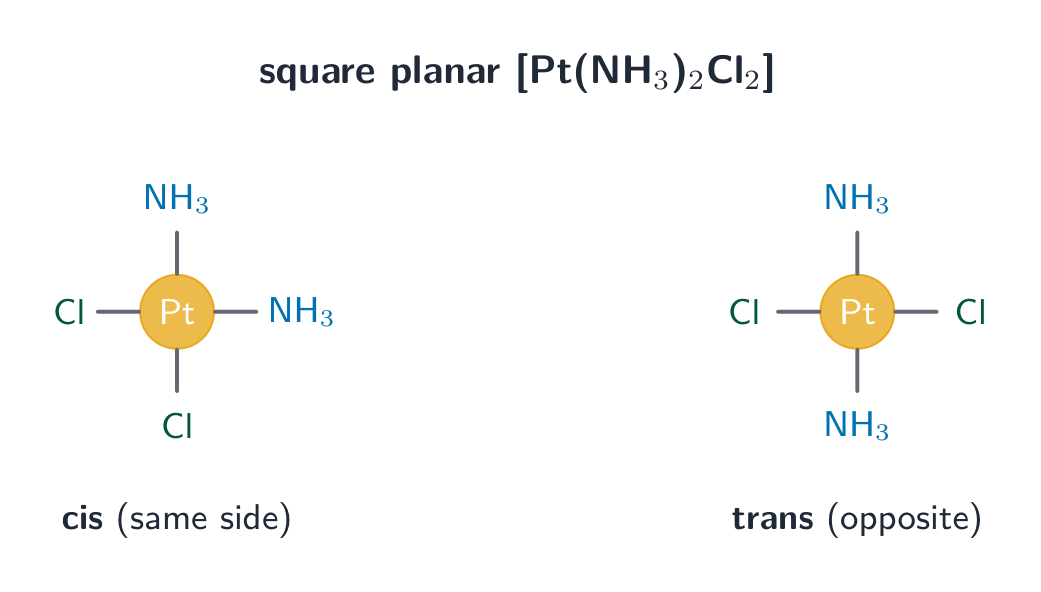
Cis and trans isomers of a square planar complex
Geometrical (cis/trans) isomerism in [Pt(NH₃)₂Cl₂] means the two identical ligands are:
الصعوبة 1/5 · 100 عملة + مكافأة صغيرة عند الإنجاز الأول اليوم
In a square planar complex the matching ligands sit next to each other (cis) or across (trans).
Match each isomerism idea in complexes.
الصعوبة 2/5 · 140 عملة + مكافأة صغيرة عند الإنجاز الأول اليوم
Each item links the term to its correct meaning.
Optical isomerism 旋光异构
- Appears in octahedral complexes with bidentate 双齿 ligands, e.g. $[\text{Ni}(\text{en})_3]^{2+}$.
- It has two non-superimposable mirror images.
- Polarity: a cis form may be polar, while the trans form is often non-polar (its dipoles cancel).
Optical isomerism appears in octahedral complexes that have:
الصعوبة 1/5 · 100 عملة + مكافأة صغيرة عند الإنجاز الأول اليوم
Octahedral complexes with bidentate ligands can exist as two non-superimposable mirror images.
Compared with a cis complex, the matching trans complex is often:
الصعوبة 1/5 · 100 عملة + مكافأة صغيرة عند الإنجاز الأول اليوم
In the trans form the opposite ligands' dipoles cancel, so it is often non-polar.
Worked example: which isomerism, if any?
Decide the stereoisomerism in three octahedral complexes.
- $[\text{Co}(\text{NH}_3)_4(\text{H}_2\text{O})_2]^{2+}$: the two water ligands can be adjacent or opposite, so cis/trans. The cis form is polar; the trans form is non-polar.
- $[\text{Ni}(\text{en})_3]^{2+}$: three bidentate ligands wrap round the metal like a propeller, so optical isomers. $[\text{Cu}(\text{H}_2\text{O})_6]^{2+}$ has six identical ligands, so no stereoisomers.
Which stereoisomerism does octahedral $[\text{Co}(\text{NH}_3)_5\text{Cl}]^{2+}$ show?
الصعوبة 1/5 · 100 عملة + مكافأة صغيرة عند الإنجاز الأول اليوم
cis/trans needs two of the same ligand that can be adjacent or opposite. One chloride among five ammonia ligands has only one arrangement, and with no bidentate ligands there is no optical isomer.
Cisplatin is polar, but its trans isomer is non-polar.
الصعوبة 1/5 · 100 عملة + مكافأة صغيرة عند الإنجاز الأول اليوم
In the trans isomer the two Pt–Cl dipoles point in opposite directions and cancel; in cisplatin they do not.
Octahedral [Co(en)₂Cl₂]⁺ has two Cl ligands and two bidentate en ligands. Which isomerism can it show?
الصعوبة 1/5 · 100 عملة + مكافأة صغيرة عند الإنجاز الأول اليوم
The Cl ligands can be adjacent or opposite. The cis form has no mirror plane, so it also exists as two optical isomers.
- Cis/trans needs two different kinds of ligand. Six identical ligands give no stereoisomers.
- Tetrahedral complexes do not show cis/trans: every position is next to every other.
- Optical isomers in complexes come from bidentate ligands wrapped round an octahedral centre; you need not find a chiral carbon.
Tetrahedral [CoCl₂Br₂]²⁻ has cis and trans isomers.
الصعوبة 1/5 · 100 عملة + مكافأة صغيرة عند الإنجاز الأول اليوم
In a tetrahedron every corner is next to every other corner, so two ligands cannot be "opposite". There is only one form.
You've got it
- geometrical (cis/trans): in square planar ([Pt(NH₃)₂Cl₂]) and octahedral complexes — ligands adjacent (cis) or opposite (trans)
- optical: in octahedral complexes with bidentate ligands (e.g. [Ni(en)₃]²⁺) — mirror images
- a cis complex may be polar; the trans form is often non-polar