محاليل المحار
| English | العربية |
|---|---|
| buffer/ˈbʌfə/ | منظم |
| weak acid/wiːk ˈæsɪd/ | القاعدة المرافقة |
| conjugate base/ˈkɒndʒuːɡeɪt beɪs/ | قاعدته المرافقة |
Solutions that resist change
- A buffer 缓冲溶液 resists a change in pH when a little acid or alkali is added.
- It is made from a weak acid 弱酸 and its conjugate base 共轭碱.
- It is vital in living things — like your blood.
تُجهز محلول المحار من:
يُكوّن حمض ضعيل وقاعدته المرافقة (مثل: حمض الإيثانويك + إيثانوات الصوديوم) محلولاً منظمًا.
يحافظ المحلول المنظم على الرقم الهيدروجيني ثابتاً تقريباً عند إضافة كمية صغيرة من الحمض أو القلوي.
هذا بالضبط ما يفعله المحلول المنظم — حيث يقاوم التغيرات في الرقم الهيدروجيني.
يقاوم المحلول المنظم التغيرات في الرقم الهيدروجيني عند إضافة كميات صغيرة من الحمض أو القاعدة.
يحتوي على حمض ضعيل وقاعدته المرافقة.
How a buffer works
It holds a store of both partners:
- added $\text{H}^+$ is removed by the conjugate base: $\text{CH}_3\text{COO}^- + \text{H}^+ \rightarrow \text{CH}_3\text{COOH}$.
- added $\text{OH}^-$ is removed by the weak acid: $\text{CH}_3\text{COOH} + \text{OH}^- \rightarrow \text{CH}_3\text{COO}^- + \text{H}_2\text{O}$.
So the pH barely changes.
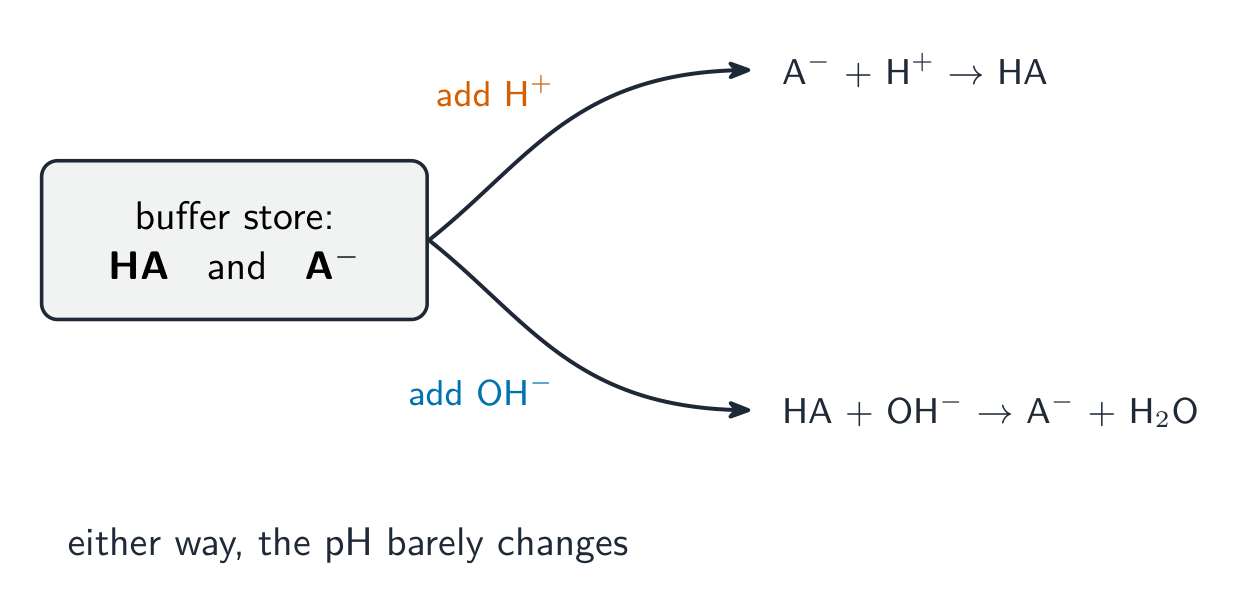
A buffer mops up added acid or alkali
منطقة المحار
على المنحنى، يكون المحار هو الجزء المسطح حيث لا يتغير الرقم الهيدروجيني (pH) تقريبًا عند إضافة حمض أو قاعدة — ثم يقفز عند نقطة التكافؤ.
عند إضافة القليل من الحمض (H⁺)، يتم إزالته بواسطة:
تقوم القاعدة المرافقة بامتصاص الـ H⁺ المضاف، بينما يمتص الحمض الضعيف الـ OH⁻ المضاف، لذا لا يتغير الرقم الهيدروجيني تقريباً.
طابق كل فكرة عن المحلول المنظم.
يربط كل بند المصطلح بمعناه الصحيح.
Finding the pH and uses
- Put the concentrations of the acid and its salt into the $K_a$ expression: $[\text{H}^+] = K_a \times \dfrac{[\text{acid}]}{[\text{salt}]}$.
- Buffers matter in life: $\text{HCO}_3^-$ keeps the pH of blood close to 7.4.
في الدم، يُحافظ على الرقم الهيدروجيني قريباً من 7.4 بواسطة الأيون المنظم:
أيون البيكربونات يُنظّم الدم، مما يحافظ على رقمه الهيدروجيني حول 7.4.
Working out the pH
A buffer is 0.10 mol/dm³ ethanoic acid ($K_a = 1.8 \times 10^{-5}$) + 0.10 mol/dm³ sodium ethanoate.
- $[\text{H}^+] = K_a \times \dfrac{[\text{acid}]}{[\text{salt}]} = 1.8 \times 10^{-5} \times \dfrac{0.10}{0.10} = 1.8 \times 10^{-5}$
- $\text{pH} = -\log(1.8 \times 10^{-5}) = \mathbf{4.74}$
When acid and salt concentrations are equal, $[\text{H}^+] = K_a$, so the pH equals $\text{p}K_a$.
You've got it
- a buffer = weak acid + its conjugate base; it resists pH change
- added $\text{H}^+$ is mopped up by A⁻; added $\text{OH}^-$ by HA
- find its pH from $[\text{H}^+] = K_a \times \frac{[\text{acid}]}{[\text{salt}]}$ (equal concentrations ⇒ pH = p$K_a$)
- blood is buffered by $\text{HCO}_3^-$ near pH 7.4