Stereoisomerism
مُقدَّم| English | المعنى |
|---|---|
| stereoisomerism/ˈsterɪəʊɪsəmərɪzəm/ | تصاوغ فراغي |
| geometrical/ˌdʒiːəʊˈmetrɪkl/ | هندسي |
| restricted rotation/rɪˈstrɪktɪd rəʊˈteɪʃn/ | دوران مقيد |
| optical isomerism/ˈɒptɪkl ˈaɪsəmərɪzəm/ | تصاوغ ضوئي |
| chiral centre/ˈkaɪrəl ˈsentə/ | مركز كيرالي |
| enantiomer/eˈnæntɪəmə/ | متناظر عكسي |
| racemic mixture/rəˈsiːmɪk ˈmɪkstʃə/ | racemic mixture |
Mirror images and rigid bonds
- Your left and right hands have the same parts in the same order, but you cannot lay one exactly on top of the other. Many molecules are like that, and the body can tell the two forms apart: one form of a drug may heal while its mirror image does nothing, or harms.
- In stereoisomerism 立体异构 atoms are joined in the same order but point in different directions in space. There are two kinds: geometrical 几何 and optical.
Stereoisomerism lab
Sort stereoisomer examples by the 3D feature that creates them.
In stereoisomerism, the atoms are:
الصعوبة 1/5 · 100 عملة + مكافأة صغيرة عند الإنجاز الأول اليوم
Stereoisomers share the same connectivity but differ in 3-D arrangement.
E/Z (cis-trans) isomerism arises because there is no rotation about a C=C double bond.
الصعوبة 1/5 · 100 عملة + مكافأة صغيرة عند الإنجاز الأول اليوم
The restricted rotation fixes the groups' positions.
Geometrical (cis/trans)
- Happens at a C=C double bond. The π bond stops the carbons rotating (restricted rotation 受限旋转), so the groups are fixed in place.
- cis: the matching groups are on the same side. trans: they are on opposite sides. Each C of the C=C must carry two different groups.
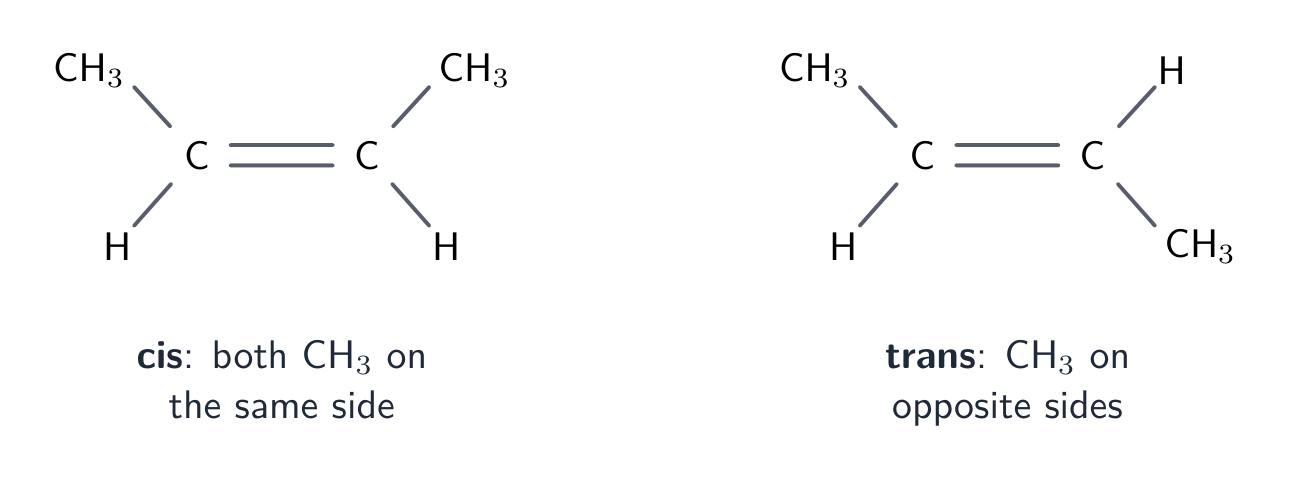
Geometrical (cis/trans) isomerism happens at a C=C bond because:
الصعوبة 1/5 · 100 عملة + مكافأة صغيرة عند الإنجاز الأول اليوم
Restricted rotation about the C=C bond fixes groups cis (same side) or trans (opposite sides).
Match each stereochemistry term.
الصعوبة 2/5 · 140 عملة + مكافأة صغيرة عند الإنجاز الأول اليوم
Each item links the term to its correct meaning.
Optical isomerism 旋光异构
- Happens at a chiral centre 手性中心: a carbon with four different groups. It gives two mirror-image forms, enantiomers 对映体, that cannot be superimposed.
- Draw them in 3-D with wedge and dash bonds, reflected in a mirror. Enantiomers rotate plane-polarised light by equal amounts in opposite directions; a 50 : 50 racemic mixture 外消旋混合物 has no overall effect.
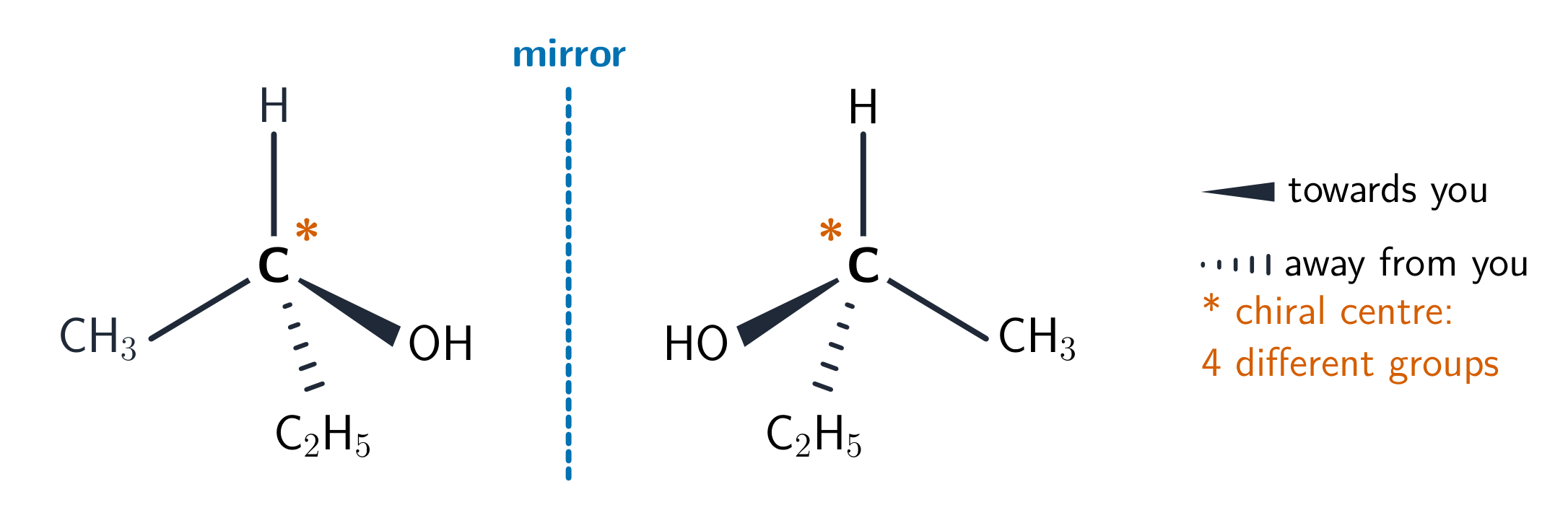
A chiral centre is a carbon with:
الصعوبة 1/5 · 100 عملة + مكافأة صغيرة عند الإنجاز الأول اليوم
A carbon bonded to four different groups is chiral and gives two mirror-image forms.
Enantiomers are:
الصعوبة 1/5 · 100 عملة + مكافأة صغيرة عند الإنجاز الأول اليوم
Optical isomers (enantiomers) are mirror images that cannot be superimposed on each other.
A racemic mixture:
الصعوبة 1/5 · 100 عملة + مكافأة صغيرة عند الإنجاز الأول اليوم
The two enantiomers rotate the light equally in opposite directions, so the effects cancel.
Worked example: which alkenes show cis/trans?
Check each carbon of the C=C: it needs two different groups.
- But-2-ene, $\text{CH}_3\text{CH}{=}\text{CHCH}_3$: each carbon has H and $\text{CH}_3$, so yes, cis and trans. 1,2-Dichloroethene, $\text{ClCH}{=}\text{CHCl}$: each carbon has H and Cl, so yes.
- But-1-ene, $\text{CH}_2{=}\text{CHCH}_2\text{CH}_3$: carbon 1 carries two H atoms, so no. 2-Methylbut-2-ene, $(\text{CH}_3)_2\text{C}{=}\text{CHCH}_3$: carbon 2 carries two $\text{CH}_3$ groups, so no.
Which alkene has cis/trans isomers?
الصعوبة 1/5 · 100 عملة + مكافأة صغيرة عند الإنجاز الأول اليوم
In pent-2-ene one carbon has H and $\text{CH}_3$, the other H and $\text{C}_2\text{H}_5$. Each of the others has a carbon carrying two identical groups.
Finding chiral centres. Which of these have a chiral centre: butan-2-ol CH₃CH(OH)CH₂CH₃, propan-2-ol CH₃CH(OH)CH₃, and lactic acid CH₃CH(OH)COOH?
- Butan-2-ol: C2 carries H, OH, CH₃ and C₂H₅, four different groups, so yes. Lactic acid: C2 carries H, OH, CH₃ and COOH, so yes.
- Propan-2-ol: C2 carries two CH₃ groups, so no. A carbon with two identical groups, or with a double bond, is never a chiral centre.
Select جميعها the molecules that have a chiral centre.
الصعوبة 2/5 · 140 عملة + مكافأة صغيرة عند الإنجاز الأول اليوم
2-Chlorobutane C2: H, Cl, CH₃, C₂H₅. Alanine C2: H, NH₂, CH₃, COOH. The others have a carbon with two identical groups.
Counting stereoisomers. How many stereoisomers does pent-3-en-2-ol, CH₃CH=CHCH(OH)CH₃, have?
- The C=C has H and CH₃ on one carbon, H and CH(OH)CH₃ on the other: cis/trans is possible (2 forms).
- C2 carries H, OH, CH₃ and CH=CHCH₃: a chiral centre (2 forms). Together: $2\times2=$ 4 stereoisomers.
A molecule has one C=C that shows cis/trans isomerism and one chiral centre. How many stereoisomers does it have?
الصعوبة 2/5 · 140 عملة + مكافأة صغيرة عند الإنجاز الأول اليوم
2 geometrical forms × 2 optical forms = 4.
- A chiral centre needs four different groups attached to that carbon, not just four atoms. Look along each whole group: CH₂CH₃ and CH₃ are different.
- Cis/trans needs two different groups on each C of the C=C. One carbon with two identical groups rules it out.
- Enantiomers have identical physical properties (boiling point, density) except their effect on plane-polarised light.
You've got it
- stereoisomers = same order of atoms, different directions in space
- geometrical (cis/trans): at a C=C bond, restricted rotation fixes groups on the same (cis) or opposite (trans) sides
- optical: at a chiral centre (carbon with 4 different groups) → non-superimposable mirror images (enantiomers)