Shapes of organic molecules
مُقدَّم| English | المعنى |
|---|---|
| hybridisation/ˌhaɪbrɪdaɪˈzeɪʃn/ | تهجين |
| sigma/ˈsɪɡmə/ | سيجما |
| pi/paɪ/ | باي |
| tetrahedral/ˌtetrəˈhiːdrəl/ | رباعي السطوح |
| planar/ˈpleɪnə/ | مستوٍ |
The 3-D shape of carbon
- Ethene is completely flat, and a C=C bond cannot twist, yet ethane spins freely about its C–C bond. Both facts come from how carbon's orbitals overlap.
- The shape around a carbon depends on its hybridisation 杂化. Single bonds are sigma σ键 bonds; double and triple bonds add pi π键 bonds.
A carbon atom forming four single bonds is trigonal planar with bond angles of 120°.
الصعوبة 1/5 · 100 عملة + مكافأة صغيرة عند الإنجاز الأول اليوم
False. Four bonding pairs repel equally and point to the corners of a tetrahedron, giving bond angles of about 109.5°. Trigonal planar (120°) needs three electron pairs.
Hybridisation and shape
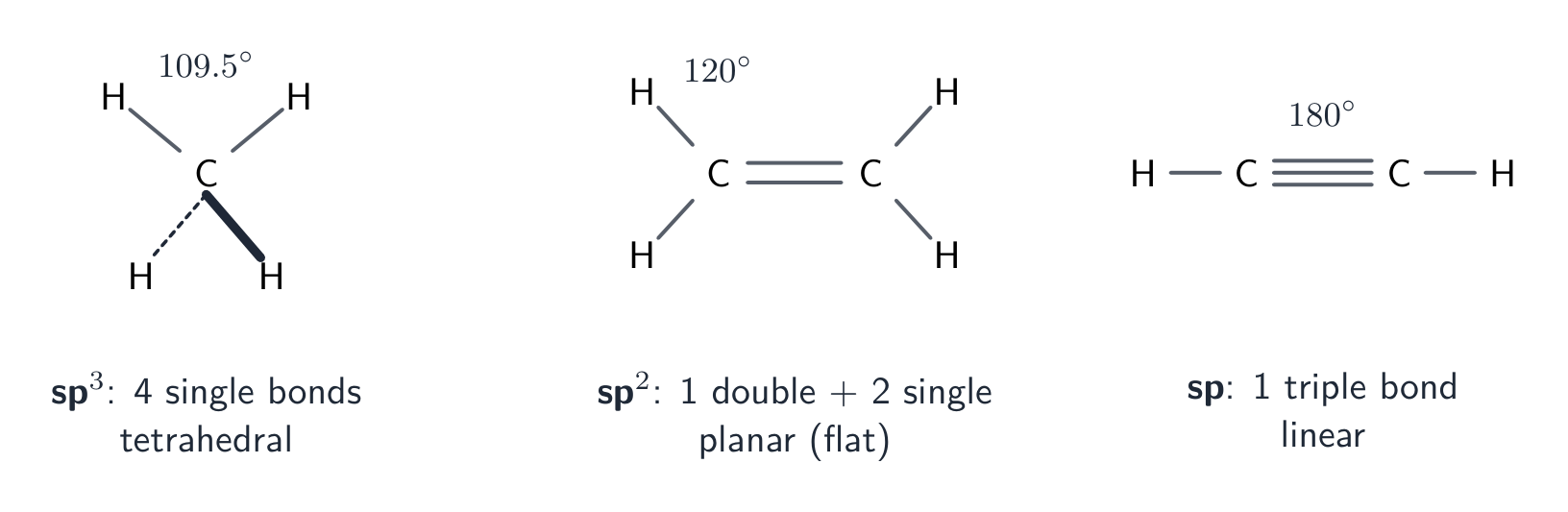
| Hybridisation | Bonds | Shape | Angle |
|---|---|---|---|
| $\text{sp}^3$ | 4 single | tetrahedral 四面体形 | $109.5°$ |
| $\text{sp}^2$ | 1 double + 2 single | planar 平面 (flat) | $120°$ |
| $\text{sp}$ | 1 triple + 1 single, or 2 double | linear | $180°$ |
Shapes of organic molecules
VSEPR حول كل كربون
Around a single-bonded carbon the four pairs are رباعي السطوح (109.5°).
An sp³ carbon (four single bonds) is:
الصعوبة 1/5 · 100 عملة + مكافأة صغيرة عند الإنجاز الأول اليوم
Four single bonds (sp³) give a tetrahedral shape at 109.5°.
An sp² carbon (one double + two single bonds), as in ethene, is:
الصعوبة 1/5 · 100 عملة + مكافأة صغيرة عند الإنجاز الأول اليوم
sp² hybridisation gives a flat (planar) arrangement at 120°, so ethene is planar.
An sp carbon (a triple bond) is:
الصعوبة 1/5 · 100 عملة + مكافأة صغيرة عند الإنجاز الأول اليوم
sp hybridisation gives a linear shape at 180° (e.g. ethyne).
Match each bonding feature to its geometry.
الصعوبة 2/5 · 140 عملة + مكافأة صغيرة عند الإنجاز الأول اليوم
Each item links the term to its correct meaning.
Sigma and pi bonds
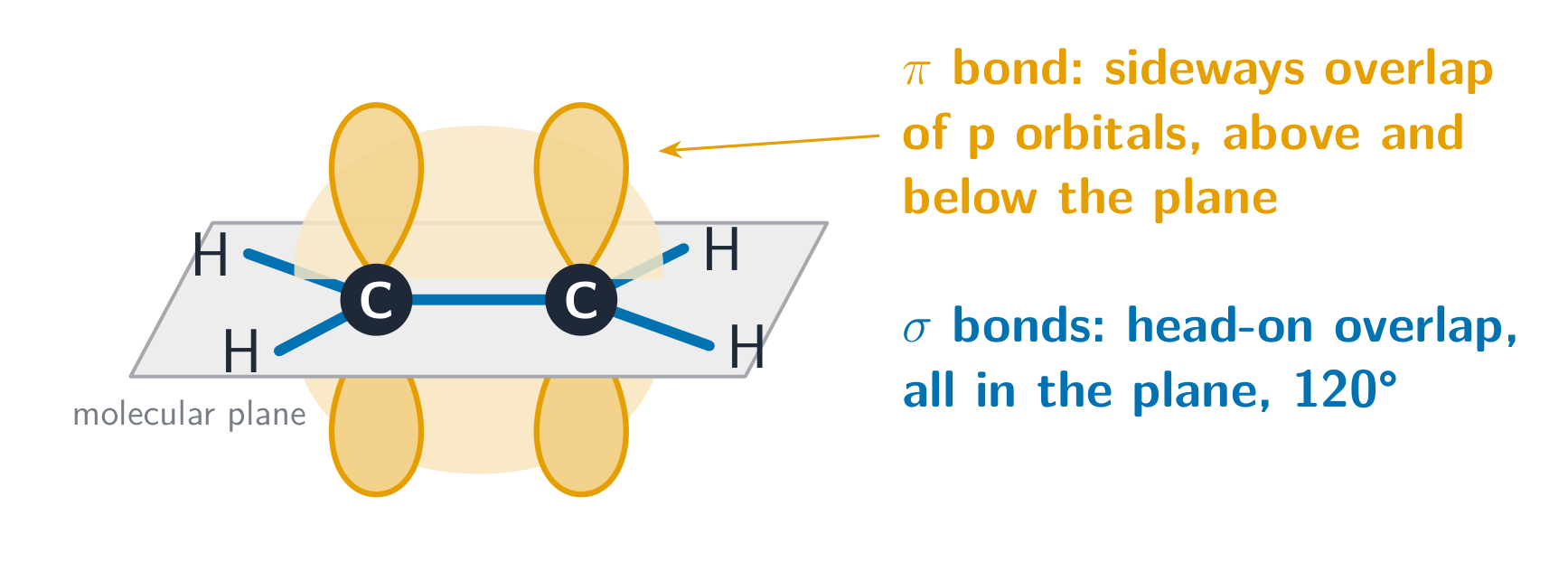
- Every single bond is a σ bond: head-on overlap along the line between the nuclei. A double bond is one σ + one π; a triple bond is one σ + two π.
- A π bond comes from sideways overlap of p orbitals, above and below the plane. To keep that overlap, the p orbitals must stay parallel, so all six atoms of ethene lie in one plane and the C=C cannot rotate.
A C=C double bond consists of:
الصعوبة 1/5 · 100 عملة + مكافأة صغيرة عند الإنجاز الأول اليوم
A single bond is one σ; a double bond is one σ plus one π (sideways p-orbital overlap).
Worked example: shapes and bonds in propene
For propene, $\text{CH}_3\text{CH}{=}\text{CH}_2$, give the hybridisation and bond angle at each carbon, and count the σ and π bonds.
- C1 ($\text{CH}_3$) has four single bonds: $\text{sp}^3$, tetrahedral, about 109.5°. C2 and C3 share the C=C: each is $\text{sp}^2$, trigonal planar, about 120°.
- Bonds: 6 C–H, 1 C–C and 1 C=C. Every bond has one σ, and the double bond adds one π: 8 σ and 1 π.
How many σ bonds are there in ethyne, $\text{HC}{\equiv}\text{CH}$?
الصعوبة 2/5 · 140 عملة + مكافأة صغيرة عند الإنجاز الأول اليوم
Two C–H σ bonds plus one σ in the triple bond make 3 σ; the triple bond also has 2 π bonds.
A triple bond. For propyne, $\text{CH}_3\text{C}{\equiv}\text{CH}$, give the shape at each carbon and count σ and π bonds.
- C1 ($\text{CH}_3$): sp³, tetrahedral, 109.5°. C2 and C3 share the triple bond: sp, linear, 180°, so C1, C2, C3 and the end H lie in a straight line.
- Bonds: 4 C–H, 1 C–C, 1 C≡C. The triple bond is 1 σ + 2 π: 6 σ and 2 π.
How many π bonds are there in buta-1,3-diene, CH₂=CH–CH=CH₂?
الصعوبة 2/5 · 140 عملة + مكافأة صغيرة عند الإنجاز الأول اليوم
Each C=C has one π bond, and there are two C=C bonds.
How many σ bonds are there in ethyne, HC≡CH?
الصعوبة 2/5 · 140 عملة + مكافأة صغيرة عند الإنجاز الأول اليوم
2 C–H (σ) plus the C≡C, which has 1 σ and 2 π: 3 σ in total.
Why can't a C=C rotate? But-2-ene exists as two separate isomers (cis and trans). Explain using orbitals.
- Twisting one end of the C=C would turn its p orbital away from the other, so the sideways overlap would be lost and the π bond would break.
- That costs a lot of energy, so at room temperature there is no rotation: the two arrangements cannot turn into each other.
Rotation about a C=C bond is restricted because:
الصعوبة 1/5 · 100 عملة + مكافأة صغيرة عند الإنجاز الأول اليوم
The π bond needs the p orbitals parallel. Rotation would destroy the overlap.
- Count every bond as one σ first, then add π for double (1) and triple (2) bonds. Don't forget C–H bonds.
- A π bond is not a second bond along the same line. It sits above and below the σ bond.
- Shape at one carbon depends only on that carbon's bonds: in propene, C1 is tetrahedral even though C2 is planar.
You've got it
- shape follows hybridisation: sp³ tetrahedral ($109.5°$), sp² planar ($120°$), sp linear ($180°$)
- single bond = σ; double bond = σ + π (π from sideways p-orbital overlap)
- ethene is planar (sp² carbons)