Physical properties across Period 3
مُقدَّم| English | المعنى |
|---|---|
| periodicity/ˌpɪərɪˌɒˈdɪsɪti/ | الدورية |
| nuclear charge/ˈnjuːklɪə tʃɑːdʒ/ | شحنة النواة |
| atomic radius/əˈtɒmɪk ˈreɪdɪəs/ | نصف قطر الذرة |
| melting point/ˈmeltɪŋ pɔɪnt/ | درجة انصهار |
| giant covalent/ˈdʒaɪənt ˈkəʊvələnt/ | شبكة تساهمية ضخمة |
| simple molecular/ˈsɪmpl məˈlekjʊlə/ | جزيئي بسيط |
A trip across Period 3
- Period 3 runs from sodium, a soft metal you can cut with a knife, to argon, a gas that reacts with nothing. In between, silicon is hard enough to make computer chips.
- Periodicity 周期性 means these properties change in a pattern that repeats in every period. Each trend follows from nuclear charge, shielding and bonding.
Periodicity means that properties:
الصعوبة 1/5 · 100 عملة + مكافأة صغيرة عند الإنجاز الأول اليوم
Periodicity is the repeating pattern of properties across the periods of the table.
Across Period 3, atomic radius increases.
الصعوبة 1/5 · 100 عملة + مكافأة صغيرة عند الإنجاز الأول اليوم
False. Atomic radius decreases across Period 3: nuclear charge rises while shielding stays similar, so electrons are pulled closer.
Atomic radius 原子半径
- Across Period 3 the atomic radius gets smaller. The nuclear charge 核电荷 rises by one each step, but the new electrons go into the same shell with about the same shielding, so the stronger pull draws the shell in.
- Ionic radius is different. Na⁺, Mg²⁺, Al³⁺ have lost the whole third shell, so they are small (102, 72, 53 pm). P³⁻, S²⁻, Cl⁻ keep it and have extra electrons, so they are large (212, 184, 181 pm). Within each set, size falls as nuclear charge rises.

Across Period 3, the atomic radius:
الصعوبة 1/5 · 100 عملة + مكافأة صغيرة عند الإنجاز الأول اليوم
More protons pull the outer shell in more strongly, while shielding stays about the same.
First ionisation energy
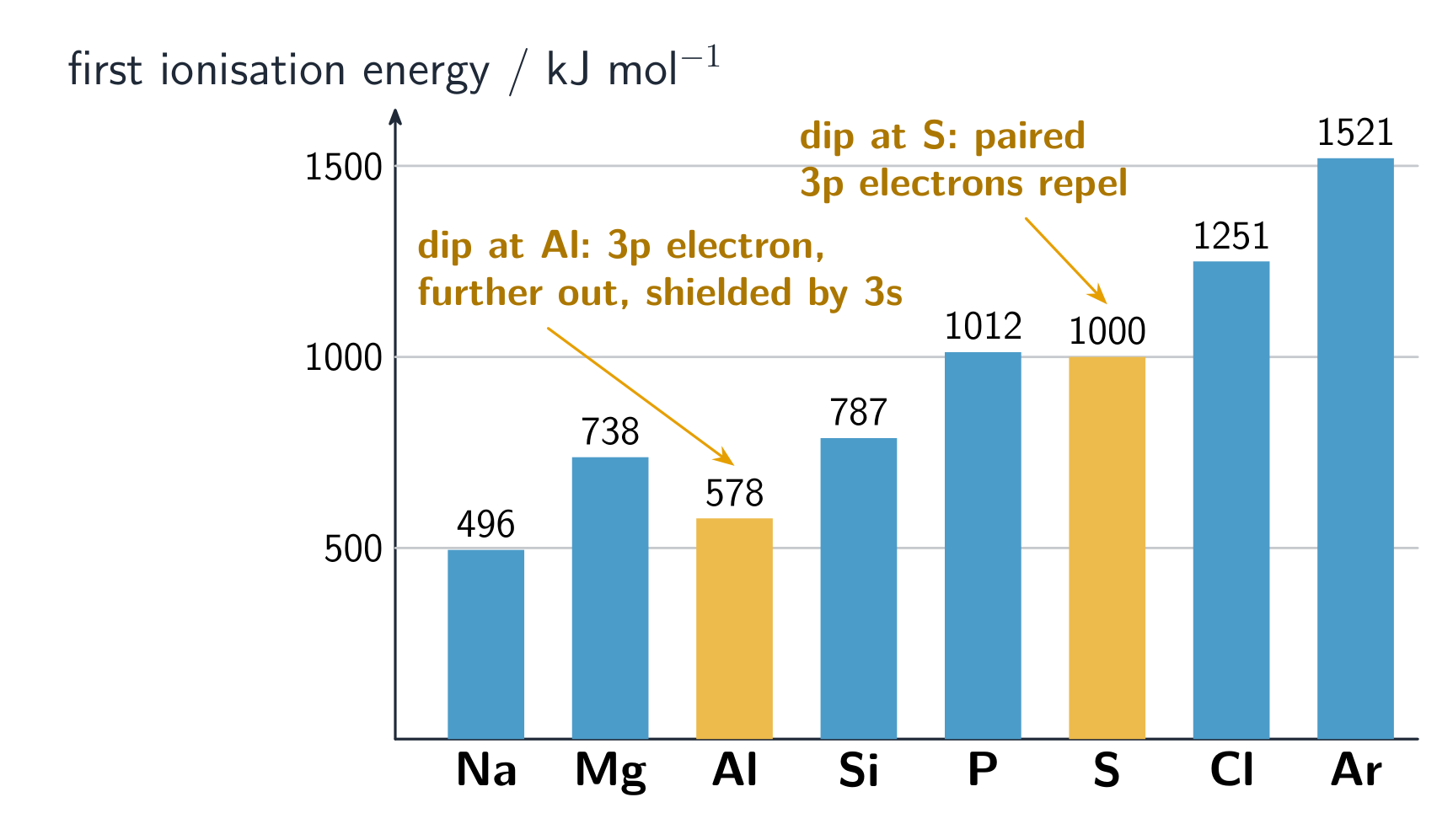
- The general trend is up across the period: more nuclear charge, similar shielding, smaller radius, so the outer electron is held more tightly.
- There are two dips. Al is lower than Mg because its electron comes from 3p, which is higher in energy and shielded by 3s. S is lower than P because its 3p has one paired electron, and pair repulsion makes it easier to remove.
Why is the first ionisation energy of Al lower than that of Mg?
الصعوبة 1/5 · 100 عملة + مكافأة صغيرة عند الإنجاز الأول اليوم
Mg loses a 3s electron; Al loses a 3p electron, which is further from the nucleus on average and partly shielded by the 3s pair.
Sulfur has a lower first ionisation energy than phosphorus.
الصعوبة 1/5 · 100 عملة + مكافأة صغيرة عند الإنجاز الأول اليوم
S has a pair of electrons in one 3p orbital; their repulsion makes one easier to remove (1000 vs 1012 kJ mol⁻¹).
Melting point 熔点 and conductivity

- Na, Mg, Al are giant metallic — melting points rise, and they conduct well.
- Si is giant covalent 巨型共价 — the highest melting point; it barely conducts.
- P, S, Cl, Ar are simple molecular 分子晶体 — low melting points (weak forces); they don't conduct.
Melting point across Period 3
Melting point peaks at giant-covalent silicon, then collapses at the simple-molecular and atomic non-metals. Step across to see the giant-to-simple switch.
Which element has the highest melting point in Period 3?
الصعوبة 1/5 · 100 عملة + مكافأة صغيرة عند الإنجاز الأول اليوم
Silicon's giant covalent network needs strong covalent bonds broken, giving the highest melting point.
Which Period 3 elements conduct electricity well?
الصعوبة 1/5 · 100 عملة + مكافأة صغيرة عند الإنجاز الأول اليوم
The metals Na, Mg, Al conduct well; from silicon onwards conductivity is almost zero.
Match each Period 3 fact to the right item.
الصعوبة 2/5 · 140 عملة + مكافأة صغيرة عند الإنجاز الأول اليوم
Each item links the term to its correct meaning.
Worked example: explain two melting points
Explain why Al (660 °C) melts higher than Na (98 °C), and why sulfur (115 °C) melts higher than phosphorus (44 °C).
- Na and Al are both giant metallic. Al gives three delocalised electrons per atom and forms a smaller, $3+$ ion, so the attraction between ions and the electron sea is much stronger than for $\text{Na}^+$ with one electron.
- Sulfur and phosphorus are both simple molecular, so only weak intermolecular forces break. $\text{S}_8$ molecules have more electrons than $\text{P}_4$, so their instantaneous dipole–induced dipole forces are stronger. No covalent bonds break in either.
Why does chlorine have a lower melting point than sulfur?
الصعوبة 1/5 · 100 عملة + مكافأة صغيرة عند الإنجاز الأول اليوم
Melting a simple molecular solid overcomes only intermolecular forces; the smaller $\text{Cl}_2$ molecule has weaker ones. No covalent bonds break.
Ionic radius. Explain why Mg²⁺ (72 pm) is much smaller than Na⁺ (102 pm), and why S²⁻ (184 pm) is much bigger than Mg²⁺.
- Na⁺ and Mg²⁺ both have the electron arrangement 2,8, but Mg has 12 protons, not 11. The same electrons feel more pull, so Mg²⁺ is smaller.
- S²⁻ has the arrangement 2,8,8: it still has the third shell. One more occupied shell makes it far bigger than any of the cations.
Which ion is the largest?
الصعوبة 1/5 · 100 عملة + مكافأة صغيرة عند الإنجاز الأول اليوم
P³⁻ and Cl⁻ both have the arrangement 2,8,8, but P has only 15 protons to hold 18 electrons, so P³⁻ is larger. The cations have lost their third shell.
- Atomic radius falls across the period, but ionic radius jumps up between Si and P because the anions keep the third shell.
- Explain the Al and S dips with sub-shells and pairing, not with "more shielding" alone.
- Argon exists as single atoms with only very weak forces between them, so it has the lowest melting point in the period. There are no bonds to break.
You've got it
- periodicity = properties repeat across each period
- atomic radius decreases across (more nuclear charge, same shell); cations small, anions large
- first ionisation energy rises across, with dips at Al (3p) and S (paired 3p)
- melting point peaks at silicon (giant covalent); high for metals, low for molecular
- Na/Mg/Al conduct (metallic); from Si onwards they barely conduct