الانتقال إلى المحتوى
المواد

OxfordAQA · International GCSE · Physics

  • 1

    3.1 · Forces and their effects

    برنامج تعليمي قادم قريبًا

    ورقة عمل

    القوى وآثارها

    كل دفع وسحب وإمساك في العالم هو قوة — ويُنظّم موضوع OxfordAQA الأول هذه القوى: التفاعلات الملموسة وغير الملموسة، والكميات القياسية مقابل المتجهات، وقوانين نيوتن الثلاثة، وأمان المركبات، ومفاهيم امتداد P الخاصة بالعزم، والسرعة النهائية، ومركز الثقل، والعزوم.

    فيزياء OxfordAQA الدولية GCSE 9203، الموضوع 3.1 (الإصدار 5.1، الامتحانات 2018 وما بعدها). العبارات المرموز لها بـ(P) تخص الورقة 2 فقط؛ تفاصيل الورقة موجودة في مخطط التقييم في المواصفة. المكونات النموذجية المسجلة هي 9203-92031 و9203-92032 — والممارسة النموذجية في هذه الحزمة يُشار إليها دائمًا بهذا الوصف.

    القوى وتفاعلاتها

    تتفاعل الأجسام عبر قوى مجال غير ملموسة (الجاذبية، الكهروستاتيكية، المغناطيسية) وقوى تلامسية (الاحتكاك، مقاومة الهواء، الشد، قوة التلامس العادية). الاحتكاك يعمل بين سطحين، يعيق الحركة وقد يسخنهما؛ ومقاومة الهواء هي احتكاك مع مائع.
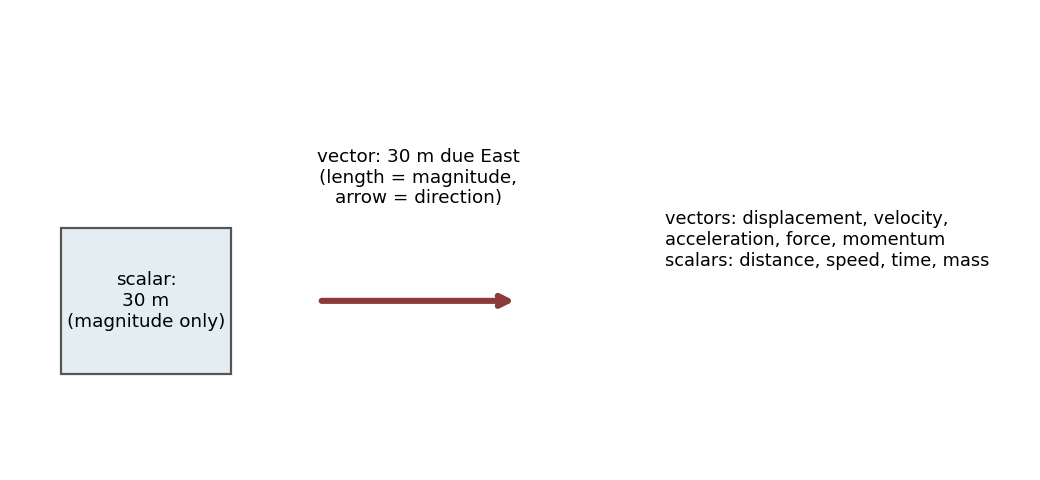
    الكمية القياسية لها حجم فقط؛ والمتجه هو سهم طول طوله المقدار واتجاهه اتجاه السهم.

    الكميات القياسية لها مقدار فقط (المسافة، السرعة، الزمن)؛ والمتجهات تضيف الاتجاه (الإزاحة، السرعة، التسارع، القوة، العزم) ويمكن رسمها كسهام. الوزن هو قوة الجاذبية: $W = m \times g$.

    يمكن للقوى أن تغير الشكل — الشد، الانحناء، الضغط. التشوهات المرنة تستعيد شكلها؛ أما اللامرنة فلا تفعل ذلك (P). تخزن الزنبرك الممدد طاقة كامنة مرنة، وأسفل حد التناسب:

    $$F = k \times e$$

    التجربة العملية المطلوبة: التحقق من العلاقة بين القوة والامتداد لزنبرك (تعليق كتل، رسم الخط، الميل = k).

    الحركة وقوانين نيوتن

    السرعة هي ميل الرسم البياني للمسافة–الزمن؛ والسرعة المتجهة تضيف الاتجاه: $v = s/t$ (قابل للاستخدام للسرعات المتوسطة أيضًا). التسارع هو معدل تغير السرعة: $a = \Delta v/t$ — من ميل الرسم البياني للسرعة–الزمن، whose المساحة تعطي المسافة المقطوعة. تغيير الاتجاه بسرعة ثابتة لا يزال تسارعًا.

    متزلجان يدفعان بعضهما: القوى المؤثرة على كل منهما متساوية وعكسية — قانون نيوتن الثالث.
    • قانون نيوتن الأول: صفر محصلة القوى → السكون يبقى سكونًا، والحركة تحافظ على سرعتها المتجهة.
    • قانون نيوتن الثاني: $F = m \times a$ في اتجاه المحصلة.
    • قانون نيوتن الثالث: الأجسام المتفاعلة تؤثر بقوات متساوية وعكسية على بعضها البعض.

    المحصلة: القوى المعاكسة أو المتوازية تُجمع على خط واحد؛ والقوتان المستويتان تُجمعان برسم مقياس (مرسومتين按比例، رأسًا إلى ذيل).

    (P) العزم، الأمان والسرعة النهائية

    $$p = m \times v \qquad F = \frac{\Delta p}{t}$$

    يُحفظ العزم في نظام مغلق — فالصدمات والانفجارات تشترك في إجمالي ثابت. أمان السيارات: الوسائد الهوائية، أحزمة الأمان، قضبان الاصطدام الجانبي، zones الانهيار، حصير الاصطدام، أسطح الملاعب المبطنة وخوذات الدراجات جميعها تطول زمن الاصطدام، لذا فإن نفس التغير في العزم يعني قوة أصغر.

    عند سرعة ثابتة، تتوازن قوة الدفع مع قوى المقاومة. مسافة التوقف = التفكير + الفرامل المسافة؛ يتزايد وقت الاستجابة مع الإرهاق، والتشتت، والمخدرات والكحول؛ ويجب أن تزداد قوة الفرامل مع السرعة، والتباطؤ الكبير يسخن الفواصل. تحول الفرامل الطاقة الحركية للمركبة إلى تسخين الفواصل (عمل الاحتكاك)؛ وتتطول مسافة الفرامل على الطرق المبللة أو الجليدية ومع الفواصل أو الإطارات البالية.

    جسم يسقط عبر مائع يتسارع حتى تتساوى مقاومة السحب مع وزنه — السرعة النهائية؛ ترتفع المظلات مقاومة السحب لتقليل السرعة النهائية، والتقليد الانسيابي (شكل القرش، تصميم السيارة) يقلل مقاومة السحب لرفع السرعة القصوى.
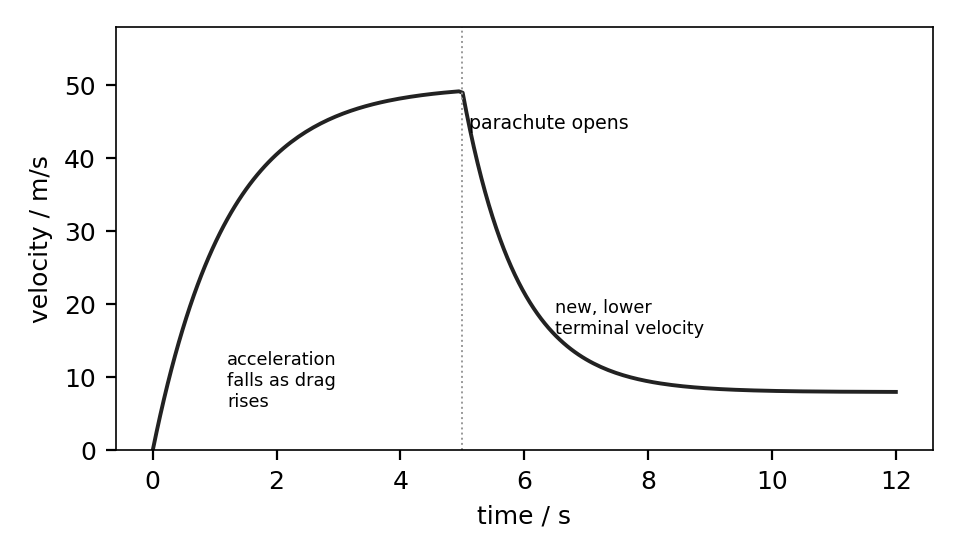
    السرعة المتجهة ضد الزمن لمقفز بالمظلة: سرعة نهائية أولى، ثم أقل بعد فتحها.

    (P) مركز الكتلة والعزوم

    مركز الكتلة هو النقطة التي يمكن اعتبار كتلة الجسم مركزة فيها؛ يتوقف الجسم المعلق بحرية بحيث يقع مركزه تحت نقطة التعليق، ويقع مركز كتلة جسم متماثل على محور التماثل. أوجد مركز كتلة صفيحة غير منتظمة بتعليقها من نقطتين ورسم خطوط عمودية.

    $$M = F \times d$$

    الجسم المتوازن له عزمان كليان في اتجاه عقارب الساعة وعكس عقارب الساعة متساويان؛ الرافعات تضاعف القوة. إذا سقط خط عمل الوزن خارج القاعدة، فإن العزم المحصل يقلب الجسم (المركبات، الألعاب المتوازنة).
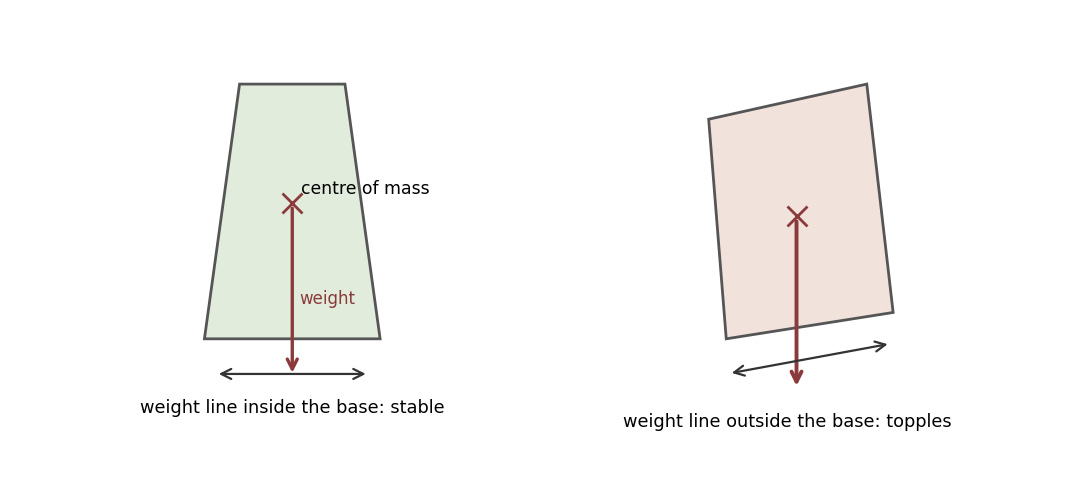
    كتلة مستقرة يكون خط وزنها داخل القاعدة؛ كتلة مائلة يكون خط وزنها خارج القاعدة فتنقلب.

    تحقق من نفسك

    1. أعط مثالاً واحداً لكل من قوة تلامسية وقوة غير تلامسية.
    2. أي مما يلي يعتبر متجهات: السرعة، الإزاحة، الزمن، القوة؟
    3. اكتب معادلة الزنبرك واسم ثابتها.
    4. نص laws نيوتن الثلاثة في جملة واحدة لكل منها.
    5. سيارة كتلتها 900 كجم تتسارع بمقدار 2 م/ث². احسب القوة المحصلة.
    6. سمّ عاملاًين يطيلان مسافة التفكير وعاملين يطيلان مسافة الفرملة.
    7. (P) اشرح كيف تحمي منطقة الانطواء الركاب باستخدام F = Δp/t.
    8. (P) لماذا يصل القافز بالمظلة إلى سرعة نهائية أقل بعد فتح المظلة؟
    9. (P) أين يقع مركز كتلة جسم متماثل؟
    10. (P) قوة مقدارها 250 نيوتن تؤثر على بُعد 0.4 متر من نقطة الارتكاز. احسب عزمها.

    الإجابات: 1 تلامسية — الاحتكاك/الشد/مقاومة الهواء/الردود؛ غير تلامسية — الجاذبية/الكهرب الساكنة/المغناطيسية؛ 2 الإزاحة والقوة؛ 3 $F = ke$، ثابت الزنبرك (نيوتن/متر)؛ 4 الأول — عدم وجود قوة محصلة يعني عدم تغير في السرعة؛ الثاني — $F = ma$ في اتجاه المحصلة؛ الثالث — التفاعلات تعطي قوى متساوية ومعاكسة؛ 5 $F = 900 \times 2 = 1800$ نيوتن؛ 6 التفكير — الإرهاق، المشتتات، المخدرات/الكحول (أي اثنين)؛ الفرملة — طرق مبللة أو جليدية، فرامل أو إطارات تالفة (أي اثنين)؛ 7 (P) منطقة الانطواء تطيل زمن الاصطدام؛ بالنسبة لتغير نفس كمية الحركة، $F = \Delta p/t$ تكون أصغر، لذا تصل قوة أقل للركاب؛ 8 (P) المظلة تزيد مقاومة الهواء بشكل كبير، فتتوازن مقاومة الوزن عند سرعة أقل بكثير؛ 9 (P) على محور تماثله؛ 10 (P) $M = 250 \times 0.4 = 100$ نيوتن·متر.
    مفردات
    English العربية
    friction/ˈfrɪkʃn/ احتكاك
    scalar/ˈskeɪlə/ كمية قياسية
    vector/ˈvektə/ كمية متجهة
    momentum/məʊˈmentəm/ كمية الحركة
    terminal velocity/ˈtɜːmɪnl vəˈlɒsɪti/ السرعة النهائية
    centre of mass/ˈsentə ɒv mæs/ مركز الكتلة
    moment/ˈməʊmənt/ عزم القوة
  • 2

    3.2 · Energy

    برنامج تعليمي قادم قريبًا

    ورقة عمل

    English

    Energy: the accountant of physics

    Nothing destroys energy — it is only moved between stores and partly dissipated into less useful forms. OxfordAQA's second topic builds the accounting: work and power, the three energy-store equations, conservation with Sankey diagrams, and the choices behind national energy resources.

    OxfordAQA International GCSE Physics 9203, topic 3.2 (Version 5.1). Statements marked (P) are Paper-2-only.

    Forces and energy

    $$W = F \times d \qquad E_e = \tfrac{1}{2}ke^2 \qquad E_p = mgh \qquad E_k = \tfrac{1}{2}mv^2 \qquad P = \frac{E}{t}$$

    Work 功 is done when a force moves its point of application through a distance; work against friction transfers energy by heating (shuttle re-entry, meteorites, brakes). A stretched spring stores elastic potential energy $\frac{1}{2}ke^2$; a raised mass stores gravitational potential energy mgh; a moving mass carries kinetic energy ½mv² — doubling mass doubles it, doubling speed quadruples it (the road-safety link). Power 功率 is the rate of energy transfer.

    Worked check. A 1500 kg car at 20 m/s brakes to rest: KE removed $= \frac{1}{2} \times 1500 \times 400 = 300\,000$ J — all transferred to heating the brakes. Lifting it 2 m at g = 10 N/kg stores $1500 \times 10 \times 2 = 30\,000$ J.

    Energy transfers and dissipation

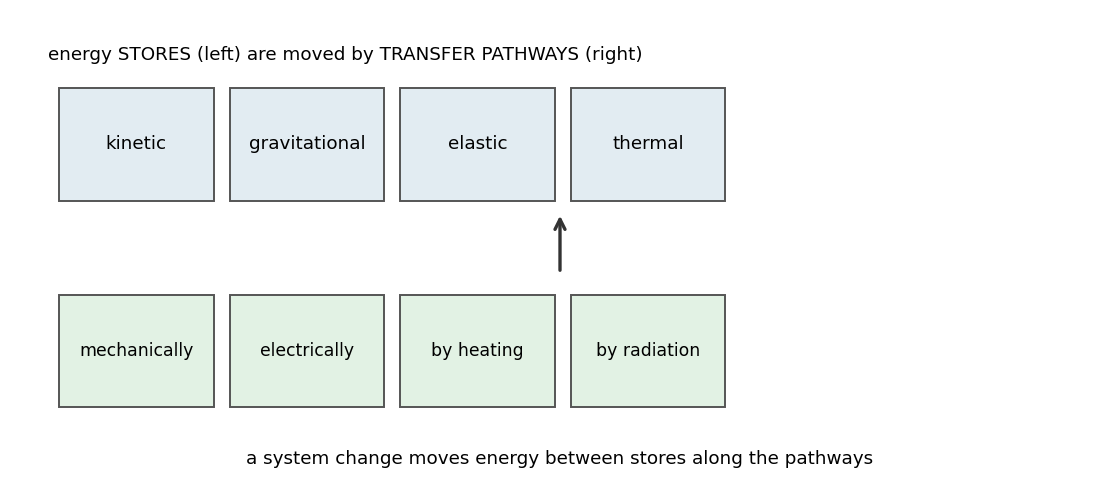
    Energy stores on top, transfer pathways below; a system change moves energy between stores.

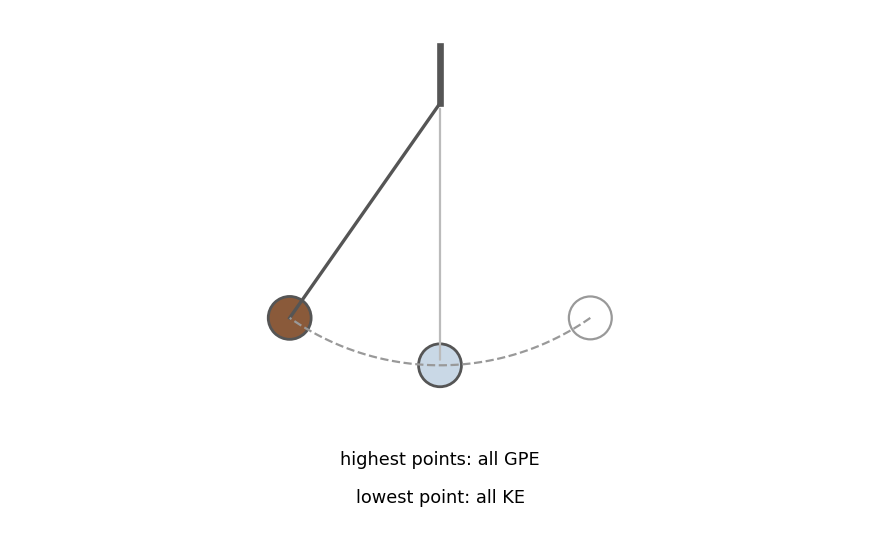
    When a system changes, energy is transferred — usefully, stored, or dissipated 耗散 ("wasted") into less useful stores; it is never created or destroyed. Friction and air resistance dissipate energy by heating. (P) A pendulum swaps kinetic and gravitational potential energy each swing.

    A pendulum: all GPE at the top of each swing, all KE at the bottom.
    $$\text{efficiency} = \frac{\text{useful energy out}}{\text{total energy in}} \times 100\% \ (=\frac{\text{useful power out}}{\text{total power in}})$$

    Sankey diagrams show the redistribution: arrows split in proportion to the energy flows (draw them to scale — width ∝ energy).

    Worked check. A 60 W lamp gives 6 W of light: efficiency 效率 $= 6/60 \times 100 = 10\%$.

    Energy resources

    Fuels are chosen for ease of storage, energy content and safety; some transfer more of their energy usefully than others. National generation trades renewability against cost, reliability and the environmental cost of extraction, use and disposal.

    Four renewable technologies with one advantage and one drawback each.

    Check yourself

    1. Calculate the work done by a 50 N force moving 4 m.
    2. Calculate the elastic energy in a spring (k = 200 N/m) stretched 0.15 m.
    3. A 2 kg book is lifted 3 m at g = 10 N/kg. Calculate the GPE gained.
    4. What happens to the kinetic energy of a car when it brakes?
    5. A motor transfers 800 J in 20 s. Calculate its power.
    6. State the efficiency equation in energy and power forms.
    7. A lamp gives out 12 J of light for every 100 J in. Calculate the efficiency.
    8. What does a Sankey diagram's arrow width show?
    9. Give one advantage and one drawback of wind power.
    10. What does "dissipated" mean?

    Answers: 1 $W = 50 \times 4 = 200$ J; 2 $E_e = \frac{1}{2} \times 200 \times 0.0225 = 2.25$ J; 3 $E_p = 2 \times 10 \times 3 = 60$ J; 4 it is transferred to thermal energy of the brakes and surroundings by the friction force (the brakes heat up); 5 $P = 800/20 = 40$ W; 6 useful energy out ÷ total energy in (×100 %); equally useful power out ÷ total power in; 7 $12/100 \times 100 = 12\%$; 8 the energy flowing in that direction — width is proportional to energy; 9 renewable with no fuel or emissions; unreliable output with visual impact; 10 transferred to less useful stores (often waste heat), so it cannot readily do what we want.

    مفردات
    English العربية
    work/wɜːk/ الشغل
    power/ˈpaʊə/ القدرة
    dissipation/ˌdɪsɪˈpeɪʃn/ تبدد الطاقة
    efficiency/ɪˈfɪʃənsi/ الكفاءة
  • 3

    3.3 · Waves

    برنامج تعليمي قادم قريبًا

    ورقة عمل

    English

    Waves: carrying energy and information

    Waves move energy from a source to a receiver without moving matter — light to an eye, sound to an ear, radio to a phone. This topic builds the wave model (frequency, wavelength, speed), then applies it across the electromagnetic spectrum, to sound and (P) ultrasound, reflection, refraction with total internal reflection, and (P) lenses and the eye.

    OxfordAQA International GCSE Physics 9203, topic 3.3 (Version 5.1). Statements marked (P) are Paper-2-only.

    General properties of waves

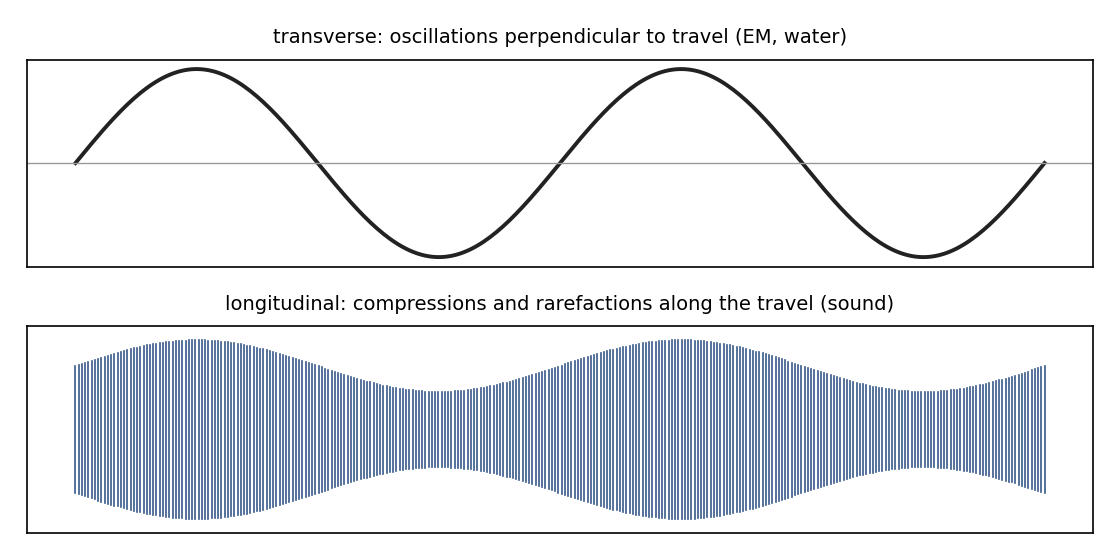
    Transverse waves oscillate across their travel; longitudinal waves compress along it.

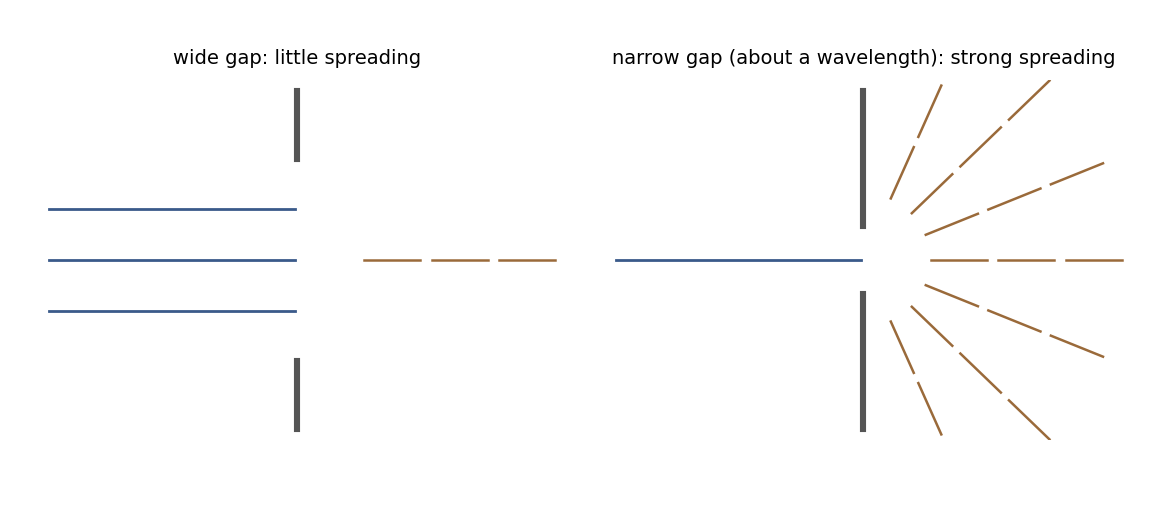
    Transverse 横波: oscillations perpendicular to travel — electromagnetic and water waves. Longitudinal 纵波: oscillations parallel, as compressions and rarefactions — sound; mechanical waves may be either. At a boundary, waves are reflected, transmitted or absorbed; refraction 折射 comes from a change of velocity between media, and diffraction 衍射 spreads waves through a gap — strongly when the gap is comparable to the wavelength.

    A wide gap gives little spreading; a gap near the wavelength spreads strongly.

    Amplitude, wavelength, frequency, period and wavefront define any wave, and:

    $$v = f \times \lambda$$

    Worked check. A water wave of frequency 2 Hz and wavelength 1.5 m travels at $2 \times 1.5 = 3$ m/s.

    The electromagnetic spectrum

    One continuous family, all transverse, all at the same speed in vacuum, ordered from radio (10⁴ m and beyond) down to gamma (10⁻¹⁵ m). Visible light is the narrow band our eyes detect — different wavelengths are different colours. Every object emits and absorbs infrared; (P) hotter objects radiate more and at higher frequencies (black-body radiation), dark matt surfaces absorb and emit best, light shiny ones reflect.

    Uses: radio — TV and radio including Bluetooth; microwaves — phones, satellite TV; infrared — remotes, night vision, heating; visible — photography, fibre optics; UV — security marking; X-rays — medical imaging; gamma — sterilising instruments and food. Hazards: microwaves heat tissue; infrared burns; UV causes skin cancer and blindness; X-rays kill cells in high doses; gamma causes mutations — limit exposure time and distance, and shield.

    X-rays: very short wavelength, high energy, ionising; they affect photographic film, are absorbed by metal and bone, and are transmitted by soft tissue — the basis of CT, fracture and dental imaging, and of cancer treatment (with careful monitoring of workers' doses).

    Sound and ultrasound

    Sound is longitudinal, vibrating a medium, heard between 20 Hz and 20 000 Hz; pitch follows frequency, loudness follows amplitude. Sound reflects (echoes) and diffracts. (P) Ultrasound 超声波 lies above 20 kHz: at a boundary between media it partially reflects, and the echo time locates the boundary:

    $$s = v \times t$$

    Worked check. An ultrasound pulse returns from a fetus boundary after $6.0 \times 10^{-5}$ s (speed 1500 m/s in tissue): boundary depth $= 1500 \times 6.0\times10^{-5}/2 = 4.5$ cm — divide by two for the round trip. Uses: prenatal scanning, breaking kidney stones.

    Reflection and refraction

    Law of reflection: angle of incidence = angle of reflection, measured from the normal. A plane mirror gives a virtual, upright, laterally inverted image; construct ray diagrams with the normal drawn in. (P) Light entering a denser medium slows and bends towards the normal; into a less dense one, away; a prism disperses white light into a spectrum. Refractive index compares speeds:

    $$n = \frac{\text{speed of light in vacuum}}{\text{speed in the medium}} = \frac{\sin i}{\sin r} \qquad \sin c = \frac{1}{n}$$

    Beyond the critical angle in the denser medium, light is totally internally reflected — how optical fibres carry visible light and infrared for medicine (endoscopes) and communications. Required practical: refraction of light by different substances.

    Lenses and the eye (P)

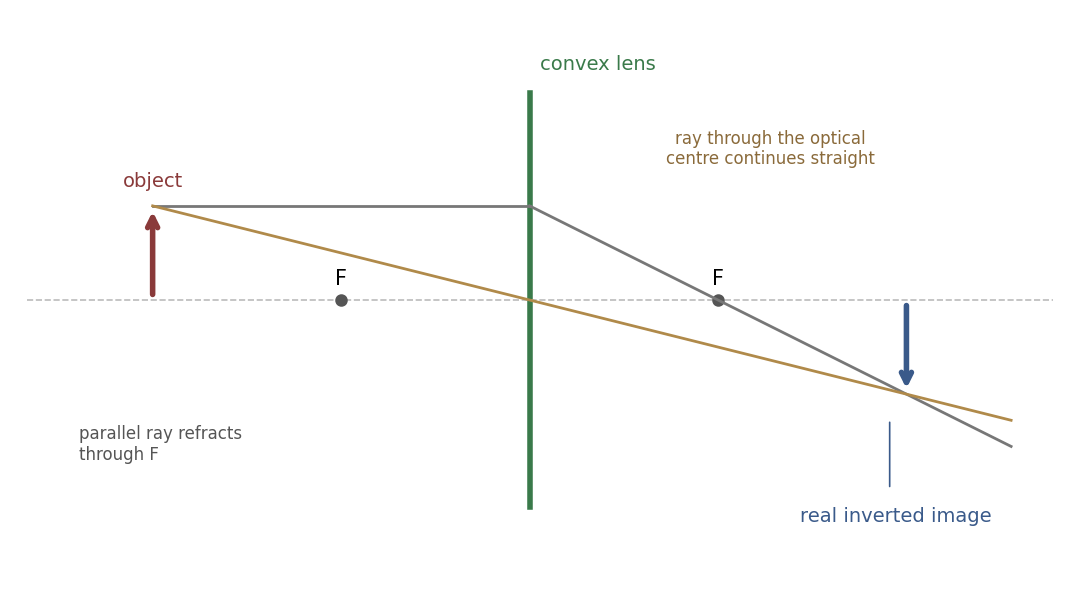
    A convex (converging) lens brings parallel rays to the principal focus (focal length from the lens); a concave (diverging) lens spreads them as if from the focus. Images are described as larger/smaller, upright/inverted, real/virtual — ray diagrams on graph paper show them, and magnification = image height ÷ object height. A converging lens held close acts as a magnifying glass (virtual, upright, enlarged).

    A convex lens forms a real, inverted image of an object beyond the focus.

    The eye: retina (detector), cornea (main refraction), variable-focus lens, pupil/iris (aperture), ciliary muscle and suspensory ligaments (change lens shape). Near point ≈ 25 cm; far point at infinity. Long sight (eyeball too short) is corrected with a convex lens; short sight (too long) with a concave lens; lasers can reshape the cornea in surgery. Against a camera: the eye focuses by changing lens shape, the camera by changing the lens–film distance; the retina plays the CCD's role.

    Check yourself

    1. Give the oscillation directions of transverse and longitudinal waves, with one example of each.
    2. State v = fλ and calculate the speed of a 500 Hz wave of wavelength 0.68 m.
    3. When is diffraction strongest through a gap?
    4. Order the EM spectrum by increasing frequency.
    5. Which surfaces best absorb infrared?
    6. State the frequency range of human hearing.
    7. (P) An ultrasound echo returns in 0.0001 s from 15 cm deep. What is the speed?
    8. State the law of reflection and the nature of a plane-mirror image.
    9. (P) Glass has n = 1.5. Calculate the critical angle.
    10. (P) Which lens corrects short sight, and why?

    Answers: 1 perpendicular — light; parallel, compressions — sound; 2 $v = 500 \times 0.68 = 340$ m/s; 3 gap ≈ one wavelength; 4 radio → microwave → IR → visible → UV → X-ray → gamma; 5 dark, matt; 6 20 Hz–20 kHz; 7 (P) $v = 0.3/10^{-4} = 3000$ m/s (round trip).

    Answers continued: 8 i = r; virtual, upright, laterally inverted; 9 (P) $\sin c = 1/1.5$, $c \approx 41.8°$; 10 (P) a concave lens — it spreads light so the too-long eye focuses it on the retina.

    مفردات
    English العربية
    transverse wave/trænsˈvɜːs weɪv/ موجة عرضية
    longitudinal wave/ˌlɒŋɡɪˈtjuːdɪnl weɪv/ موجة طولية
    refraction/rɪˈfrækʃn/ انكسار الضوء
    diffraction/dɪˈfrækʃn/ حيود الموجات
    ultrasound/ˌʊltrəˈsaʊnd/ الموجات فوق الصوتية
  • 4

    3.4 · Particle model of matter

    برنامج تعليمي قادم قريبًا

    ورقة عمل

    English

    The particle model of matter

    Everything is particles. Their energy, separation and motion explain the states of matter, heating and cooling, and why bridges need gaps. OxfordAQA's fourth topic builds the model and quantifies it: specific heat capacity, the (P) latent heats, evaporation, energy-transfer design and thermal expansion.

    OxfordAQA International GCSE Physics 9203, topic 3.4 (Version 5.1). Statements marked (P) are Paper-2-only.

    Kinetic theory

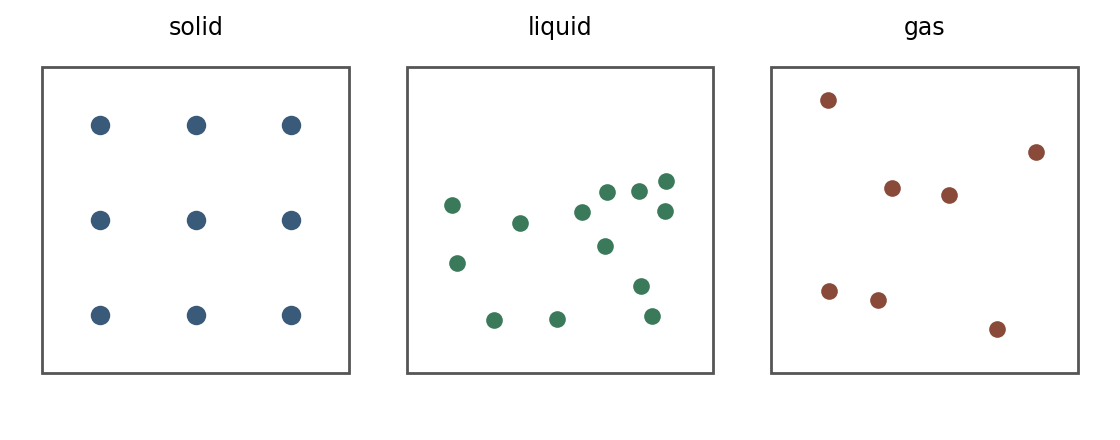
    Solids: fixed, touching particles; liquids: touching but disordered; gases: far apart and fast.

    Specific heat capacity 比热容 c is the energy to raise 1 kg of a substance by 1 °C:

    $$E = m \times c \times \Delta\theta$$

    Worked check. Heating 1.5 kg of water ($c = 4200$) by 40 °C: $E = 1.5 \times 4200 \times 40 = 252\,000$ J.

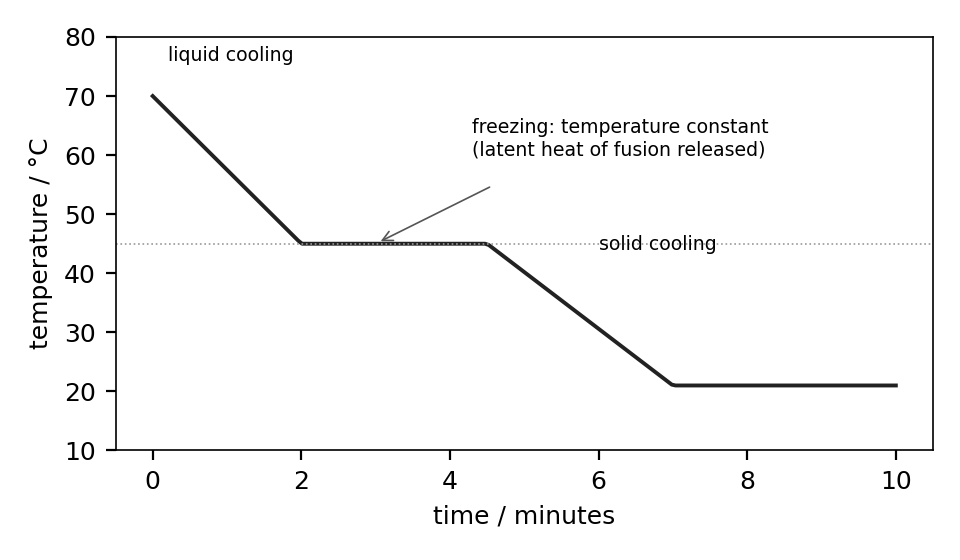
    (P) Changing state needs energy with no temperature change: latent heat of vaporisation 汽化热 $E = m \times L_V$ (liquid → vapour) and latent heat of fusion 熔化热 $E = m \times L_F$ (solid → liquid). Impurities change melting and boiling points. Required practical (P): a cooling curve for stearic acid.

    A cooling curve: the plateau while freezing releases latent heat at constant temperature.

    Energy transfers and particle motion

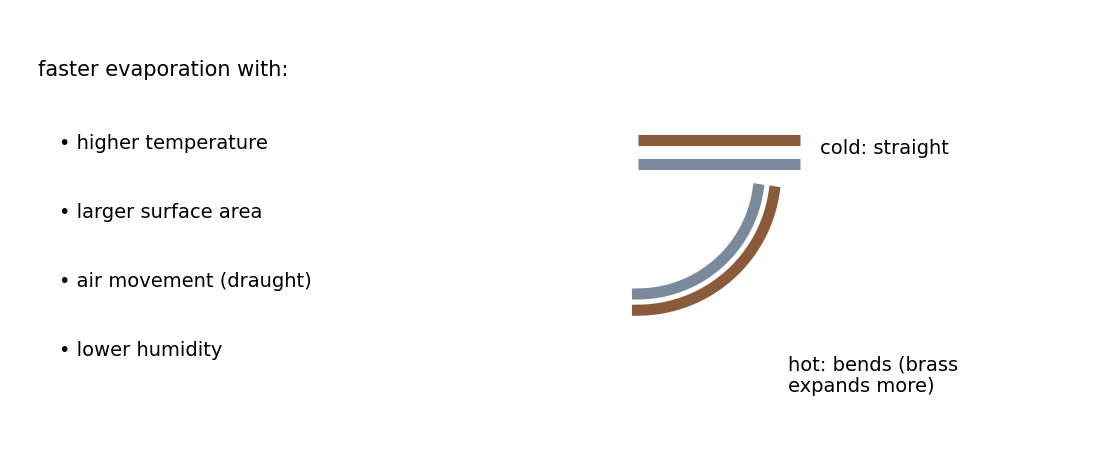
    Conduction 传导 passes energy along a solid by particle vibration, helped by free electrons in metals; insulators lack both. Convection 对流 circulates fluid: particles gain energy, move apart, the fluid becomes less dense and rises, cooler fluid sinks. Evaporation 蒸发 turns fast surface molecules to vapour, cooling what remains — faster with higher temperature, larger surface area, draughts and lower humidity; condensation reverses it.

    Evaporation factors and the bimetallic strip that bends on heating.

    The rate of energy transfer by heating grows with surface area and volume, the material, the surface in contact, and the temperature difference. Design follows: cooling fins maximise area; animals' relative ear size matches climate. Most substances expand when heated — a hazard for roofs and bridges (gaps and rollers), useful in the bimetallic-strip thermostat that bends as one metal expands more and breaks a circuit.

    Check yourself

    1. Describe the particle arrangement in a liquid.
    2. Define specific heat capacity.
    3. Calculate the energy to heat 2 kg of aluminium (c = 900) by 30 °C.
    4. (P) Why does the temperature stay constant while a substance freezes?
    5. (P) 0.5 kg of a substance has L_F = 330 000 J/kg. Calculate the energy to melt it.
    6. Explain conduction in metals, naming the extra carriers.
    7. Explain why warm water rises.
    8. Give three factors that speed evaporation.
    9. Give one hazard and one use of thermal expansion.
    10. Why do cooling fins have large surface area?

    Answers: 1 particles touch but arranged randomly, moving past each other; 2 the energy needed to change the temperature of 1 kg of the substance by 1 °C; 3 $E = 2 \times 900 \times 30 = 54\,000$ J; 4 (P) the energy released as bonds form (latent heat of fusion) leaves at the same rate energy is removed, so the particles' kinetic energy is unchanged; 5 (P) $E = 0.5 \times 330\,000 = 165\,000$ J; 6 vibrating particles pass energy to neighbours, and free electrons carry energy quickly through the metal; 7 the warmer particles move apart, making that water less dense than its surroundings, so it rises; 8 higher temperature, larger surface area, air movement over the surface (also lower humidity); 9 hazard — expansion of bridges/roofs needs gaps; use — the bending bimetallic strip in a thermostat; 10 larger area transfers energy to the surroundings faster by heating.

    مفردات
    English العربية
    specific heat capacity/spəˈsɪfɪk hiːt kəˈpæsɪti/ السعة الحرارية النوعية
    latent heat of vaporisation/ˈleɪtənt hiːt ɒv ˌveɪpəraɪˈzeɪʃn/ حرارة تبخر كامنة
    latent heat of fusion حرارة انصهار كامنة
    conduction/kənˈdʌkʃn/ توصيل حراري
    convection/kənˈvekʃn/ حمل حراري
    evaporation/ɪˌvæpəˈreɪʃn/ تبخر
  • 5

    3.5 · Electricity and magnetism

    برنامج تعليمي قادم قريبًا

    ورقة عمل

    English

    Electricity and magnetism

    Electricity is charge on the move, guided by potential difference, resisted by every component — and every current makes a magnetic field. OxfordAQA's largest topic builds the circuit toolkit, the component behaviours, and the electromagnets that follow.

    OxfordAQA International GCSE Physics 9203, topic 3.5 (Version 5.1). Statements marked (P) are Paper-2-only.

    Electrical circuits

    Metals conduct because they have free electrons; (P) an isolated charge imbalance is static electricity, discharged when a conducting route appears (lightning). Current is the rate of flow of charge:

    $$I = \frac{Q}{t} \qquad V = \frac{E}{Q} \qquad V = I \times R$$

    Voltage drives charge round a circuit; potential difference across a component measures the energy transferred per unit charge (volts = joules per coulomb). Learn the standard symbols — switch, lamp, fuse, cell, battery, diode, resistor, variable resistor, thermistor, LDR, LED, ammeter and voltmeter.

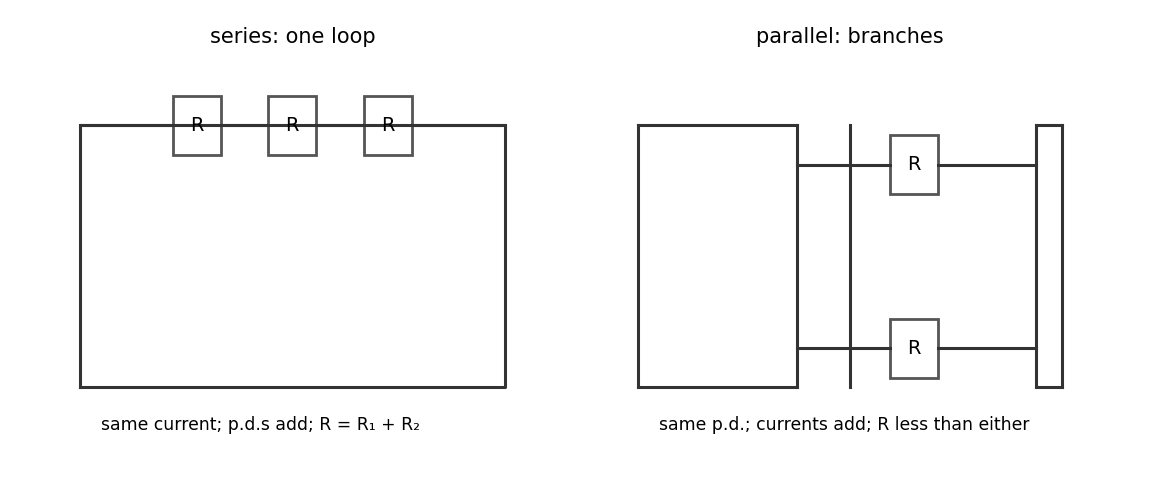
    Series: one loop, same current, resistances add. Parallel: branches share the p.d., currents add.

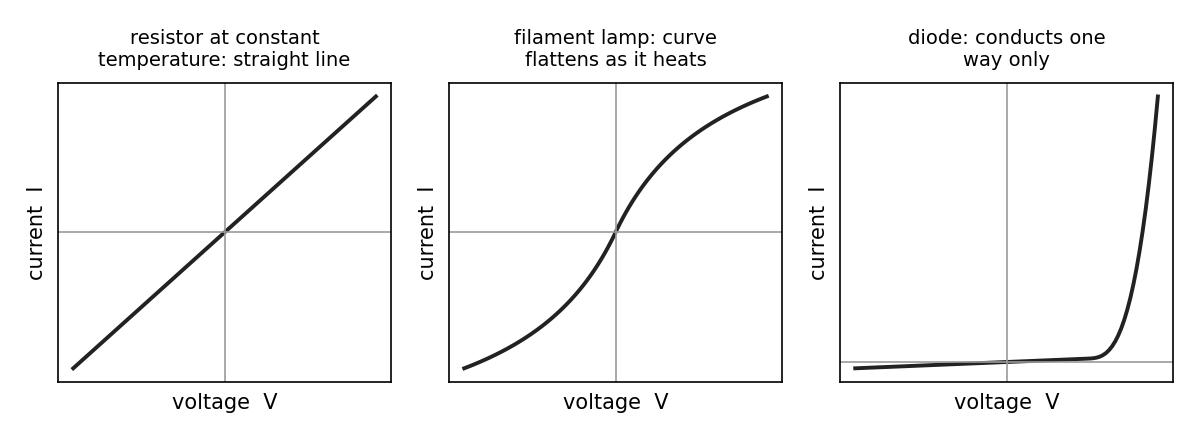
    At constant temperature a resistor's V–I graph is a straight line (ohmic); a filament lamp curves as its ions vibrate more with temperature; a diode conducts forward only; (P) a thermistor's resistance falls as temperature rises (thermostats); an LDR's falls as light rises (automatic lighting); an LED emits light forward and saves energy versus filament and CFL lamps.

    The three required V-I characteristics.

    Series: same current, p.d.s shared, resistances add. Parallel: same p.d., currents split, combined resistance less than either. Charge colliding with the lattice heats every resistor.

    Worked check. A 230 V lamp draws 0.25 A: $R = 230/0.25 = 920\ \Omega$. Two 4 Ω resistors in series across 12 V carry $I = 12/8 = 1.5$ A; in parallel, $R = 2\ \Omega$ and the supply gives $I = 12/2 = 6$ A.

    Magnetism and electromagnetism

    Poles: like repel, unlike attract — non-contact forces. Field lines run N to S outside a magnet; opposite poles facing give a uniform field between them. An induced magnet attracts while in the field and loses magnetism on removal; the Earth's field lets a plotting compass navigate.

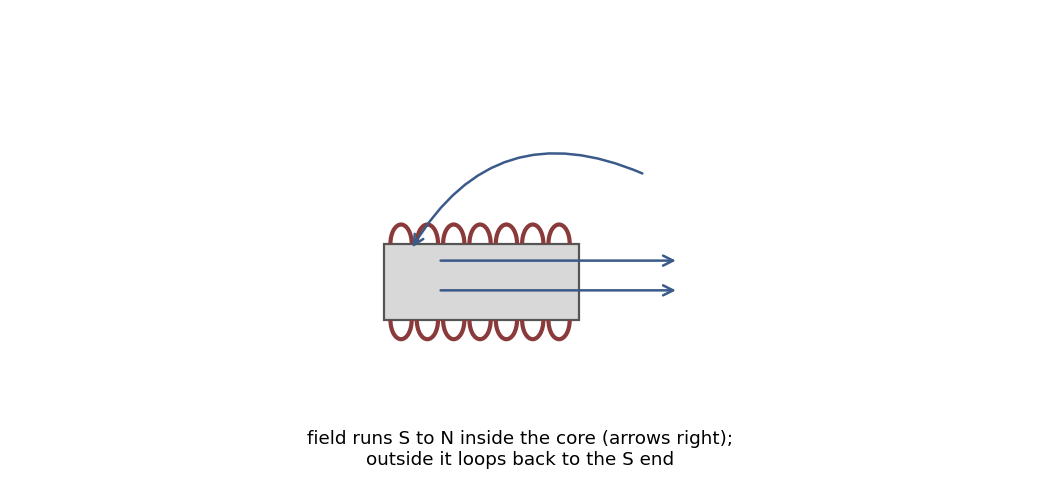
    A current-carrying wire has circular field lines around it (stronger current → stronger field; reverse current → reverse direction). A solenoid 螺线管 concentrates the field; with a soft-iron core it is an electromagnet 电磁铁 — switchable, adjustable, used in scrapyard cranes, relays and door locks. Required practical: the factors determining an electromagnet's strength.

    A solenoid on a soft-iron core: the electromagnet's field is that of a bar magnet, but switchable.

    Check yourself

    1. Why do metals conduct?
    2. State the relationship between current, charge and time with units.
    3. Calculate the charge flowing when 2 A passes for 30 s.
    4. State the V-I shape for a resistor at constant temperature and for a filament lamp.
    5. (P) What happens to a thermistor's resistance as temperature rises?
    6. State the current and p.d. rules for series and for parallel connections.
    7. Calculate R for a 12 V supply pushing 0.5 A.
    8. State the pole rule and the direction of field lines outside a magnet.
    9. What is an induced magnet?
    10. Name two ways to strengthen an electromagnet.

    Answers: 1 they contain free electrons that drift when a p.d. is applied; 2 Q = It, charge in coulombs = current in amperes × time in seconds; 3 Q = 2 × 30 = 60 C; 4 straight line through the origin; S-curve flattening as current (and so temperature) rises; 5 (P) it falls — used in thermostats; 6 series — same current everywhere, p.d.s add; parallel — same p.d. across branches, currents add; 7 R = 12/0.5 = 24 Ω; 8 like poles repel, unlike attract; N to S outside the magnet; 9 a magnetic material that becomes a magnet only while placed in a field — attraction only, losing most magnetism on removal; 10 more turns on the coil; larger current (also a soft-iron core).

    مفردات
    English العربية
    solenoid/ˈsəʊlənɔɪd/ ملف لولبي
    electromagnet/ɪˌlektrəʊˈmæɡnɪt/ مغناطيس كهربائي
  • 6

    3.6 · Generating and distributing electricity and household use

    برنامج تعليمي قادم قريبًا

    ورقة عمل

    English

    Generating and distributing electricity

    Move a magnet, move a current — a p.d. appears. OxfordAQA's sixth topic runs the full chain from the generator effect through the national grid's transformers to the appliances and safety systems of the home. All statements in this topic are Paper-2 (P).

    OxfordAQA International GCSE Physics 9203, topic 3.6 (Version 5.1) — entirely (P) content.

    Generating electricity (P)

    The generator effect 发电机效应 induces a p.d. across a conductor that moves through a magnetic field, or sits in a changing field. Reverse the motion or the polarity and the induced p.d. reverses; the induced current's own field opposes the change. The p.d. grows with faster movement, stronger field, more turns and larger coil area.

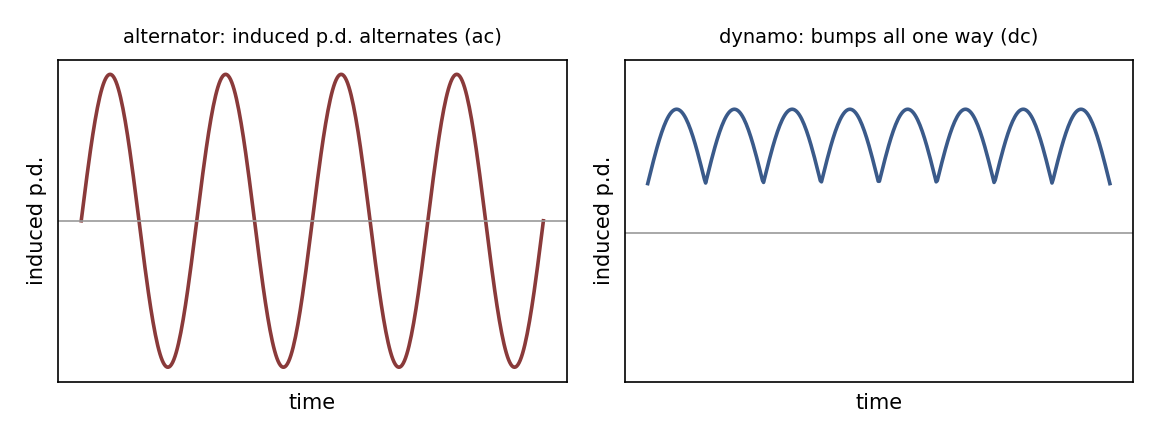
    An alternator spins a coil in a field to make a.c.; a dynamo gives d.c. — know the p.d.–time graphs. Power stations spin turbines to turn coils between magnets.

    An alternator's induced p.d. alternates; a dynamo's bumps point one way.

    Transmission, transformers and the home (P)

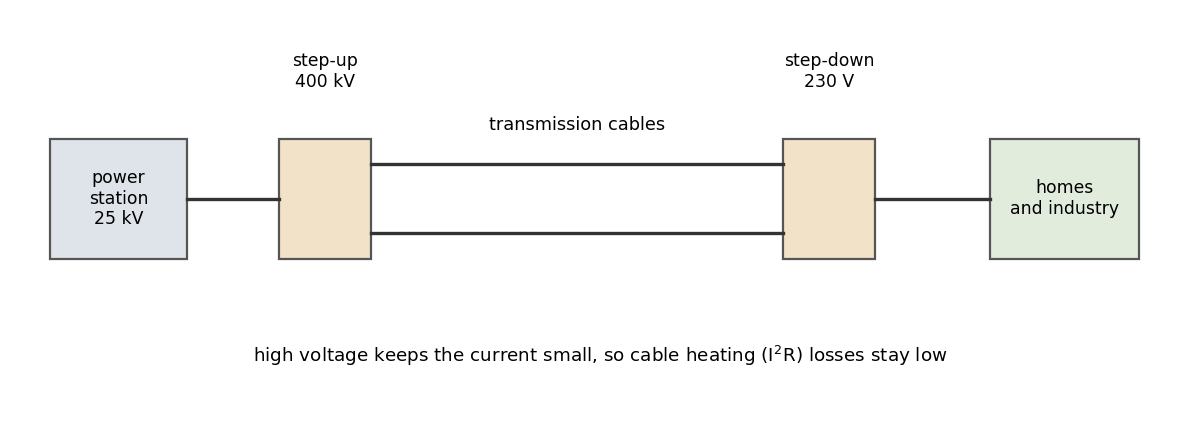
    From the station to the socket, every watt travels the same chain of coils and cables.

    Power station, step-up transformer, high-voltage cables, step-down transformer, consumers.

    For a given power, high transmission voltage means low current and so little cable heating. A transformer 变压器 is two coils on a soft-iron core: alternating current in the primary makes a changing field that induces a p.d. in the secondary.

    $$\frac{V_p}{V_s} = \frac{n_p}{n_s} \qquad V_p I_p = V_s I_s \ (100\%)$$

    Step-up before the lines, step-down after; switch-mode transformers (50–200 kHz) are small and light — phone chargers.

    Worked check. A transformer steps 25 kV up to 400 kV with 1000 primary turns: $n_s = 1000 \times 400/25 = 16\,000$ turns. At 100 MW the line current is $I = P/V = 10^8/(4 \times 10^5) = 250$ A.

    Cells give d.c.; mains is a.c. with fixed frequency and voltage — read period and frequency from oscilloscope-style traces. Safety: earthing 接地 drains fault current from metal casings; a fuse 保险丝 melts or a circuit breaker trips on excess current — the breaker is faster and resettable; double-insulated appliances need no earth.

    The motor effect (P)

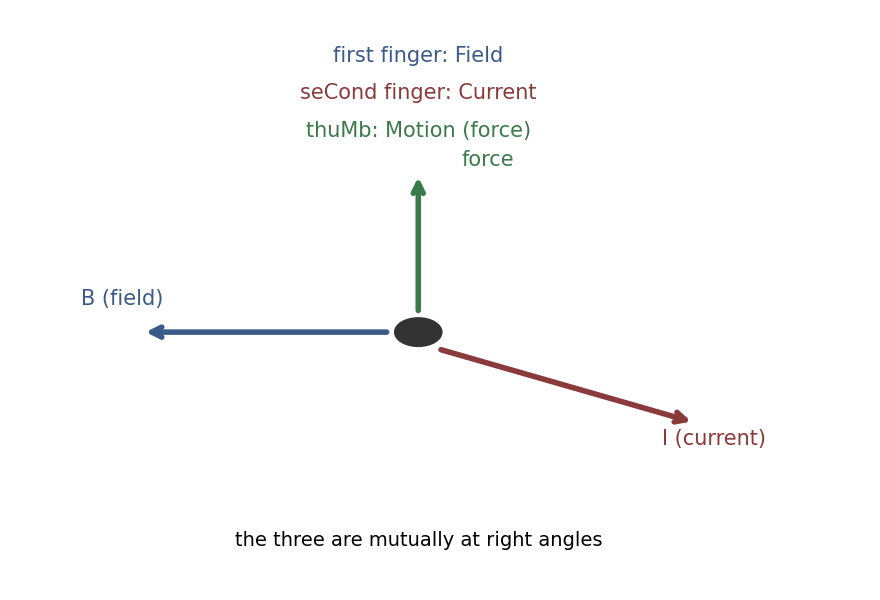
    A current-carrying wire across a magnetic field feels a force (zero if parallel to it). Force grows with stronger field, bigger current and more wire in the field; reverse either to reverse the force — Fleming's left-hand rule 左手定则 predicts the direction.

    Fleming's left-hand rule: field, current and force mutually at right angles.

    A current-carrying coil in a field rotates — the electric motor.

    Transferring electrical energy (P)

    $$P = \frac{E}{t} \qquad P = I \times V \qquad E = V \times Q \qquad E\,(\mathrm{kWh}) = P\,(\mathrm{kW}) \times t\,(\mathrm{h})$$

    Appliance labels give power; compute the current to choose a fuse, and the energy in kilowatt-hours for billing (E = Pt; cost = kWh × price per unit, read from meter readings).

    Worked check. A 2.0 kW heater for 3 h uses 6.0 kWh; at 0.9 per kWh that costs 5.4. A 230 V, 1.1 kW kettle draws I = 1100/230 ≈ 4.8 A — fit a 5 A or 13 A fuse (next rating above).

    Check yourself

    1. State two ways to induce a p.d. in a conductor.
    2. Give three factors that increase the size of an induced p.d.
    3. Sketch the p.d.–time graphs of an alternator and a dynamo.
    4. Why does the grid transmit at high voltage?
    5. A transformer has 200 primary and 3000 secondary turns on 12 V a.c. Calculate the secondary p.d.
    6. State the turns-ratio and power equations for a 100 % efficient transformer.
    7. Explain how earthing and a fuse protect a user together.
    8. State Fleming's left-hand rule.
    9. Calculate the current of a 230 V, 2.3 kW heater, and a sensible fuse.
    10. Calculate the energy in kWh used by a 1.5 kW kettle in 20 minutes.

    Answers: 1 move the conductor through a field; place it in a changing magnetic field; 2 faster motion; stronger field; more turns (also larger coil area); 3 alternator — a sine wave about zero; dynamo — humps all above (or all below) the axis; 4 for the same power the current is smaller, so I²R heating losses in the cables are far lower; 5 $V_s = 12 \times 3000/200 = 180$ V; 6 $V_p/V_s = n_p/n_s$ and $V_p I_p = V_s I_s$; 7 the earth wire gives the fault current a path to earth, and the surge blows the fuse, disconnecting the live wire; 8 first finger Field, second finger Current, thumb Motion — mutually at right angles; 9 I = 2300/230 = 10 A — use a 13 A fuse; 10 t = 1/3 h, so E = 1.5 × 1/3 = 0.5 kWh.

    مفردات
    English العربية
    generator effect تأثير المولد
    transformer/trænsˈfɔːmə/ المحول الكهربائي
    earthing أرضي (تأريض)
    fuse/fjuːz/ صمام أمان (فيوز)
    left-hand rule/left hænd ruːl/ قاعدة اليد اليسرى
  • 7

    3.7 · Nuclear physics

    برنامج تعليمي قادم قريبًا

    ورقة عمل

    English

    Nuclear physics

    The nucleus is a millionth of the atom yet holds nearly all its mass — and unstable nuclei pour out energy as radiation, fission fragments, or the fusion that lights the stars. OxfordAQA's seventh topic covers the nuclear model, the three radiations, half-life, contamination versus irradiation, reactors and (P) fusion.

    OxfordAQA International GCSE Physics 9203, topic 3.7 (Version 5.1). Statements marked (P) are Paper-2-only.

    Atomic structure

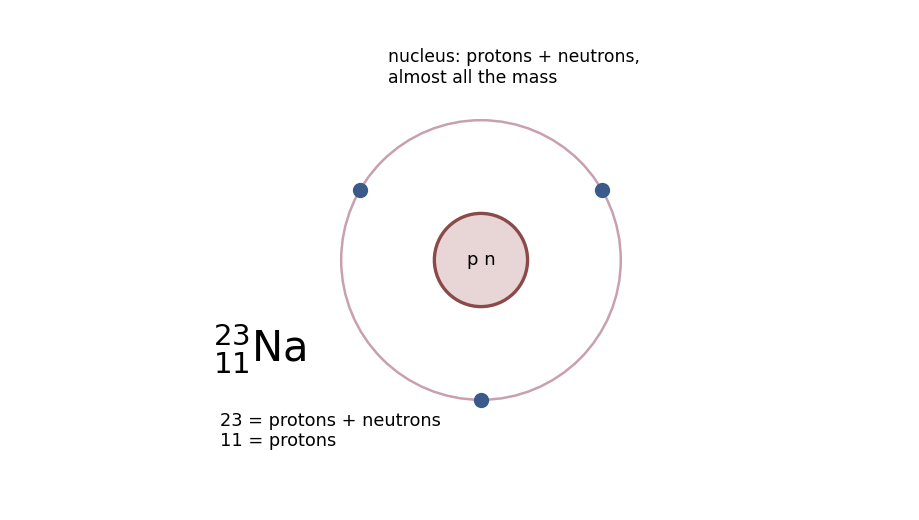
    An atom is about 10⁻¹⁰ m across: a tiny positive nucleus (protons and neutrons, nearly all the mass) with electrons around it — Rutherford's alpha-scattering evidence for the concentrated nucleus. Proton mass 1 charge +1; neutron mass 1 charge 0; electron charge −1, negligible mass. A neutral atom has equal protons and electrons; atoms lose or gain electrons to become ions.

    Nuclear notation: mass number and proton number.

    ${}^{A}_{Z}X$: A = mass number (protons + neutrons), Z = proton number; isotopes share Z and differ in neutrons.

    Ionising radiation from the nucleus

    Unstable nuclei decay randomly, unaffected by chemistry or physics, emitting:

    Radiation Nature Ionising Range in air
    alpha 2p + 2n (helium nucleus) strongest a few cm
    beta-minus fast electron (neutron → proton) medium tens of cm
    gamma electromagnetic wave weakest metres
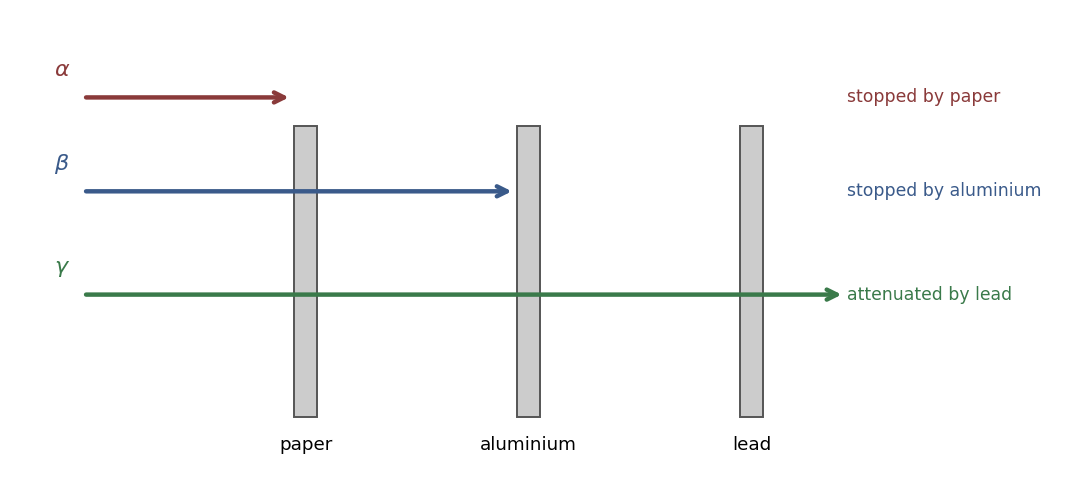
    Penetration: alpha stopped by paper, beta by aluminium, gamma attenuated by lead.

    Nuclear equations conserve mass number and charge: ${}^{238}_{92}U \rightarrow\, {}^{234}_{90}Th +\, {}^{4}_{2}He$ (alpha); ${}^{14}_{6}C \rightarrow\, {}^{14}_{7}N +\, {}^{0}_{-1}e$ (beta). Background radiation comes from rocks, space, food and medical devices. (P) The half-life 半衰期 is the time for half the nuclei (or half the count rate) to decay — most unstable nuclei have short half-lives; the least unstable last millennia. Contamination 沾污 (radioactive atoms on you) is a lasting hazard; irradiation 照射 exposes without making you radioactive. Dangers: mutations, cell and tissue damage.

    Nuclear fission and (P) fusion

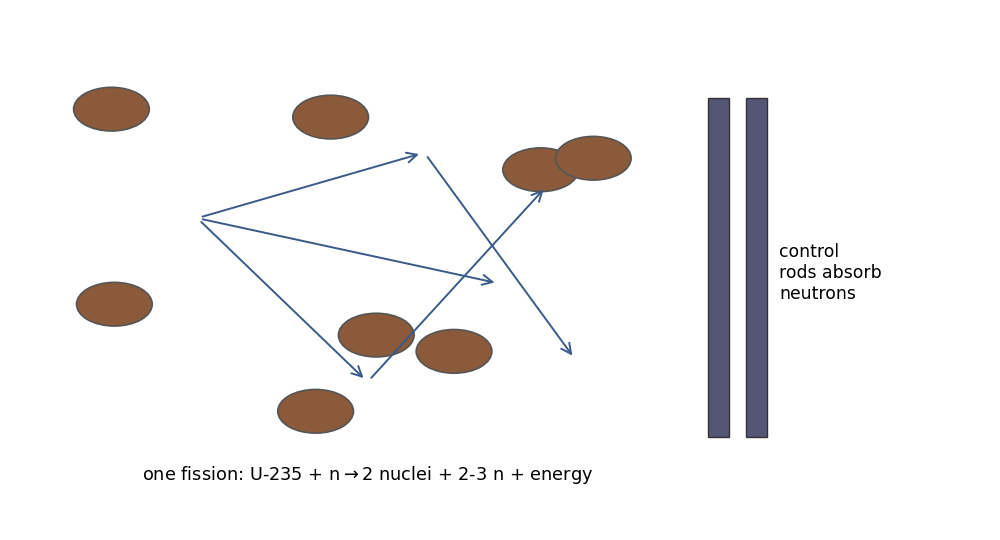
    Fission 裂变 splits a large unstable nucleus: U-235 or Pu-239 absorbs a neutron, splits into two smaller nuclei with 2–3 neutrons and far more energy than any chemical reaction. Neutrons striking further nuclei give a chain reaction; in a reactor control rods absorb neutrons to hold one fission per neutron.

    A chain reaction with control rods absorbing neutrons.

    Radioactive waste stays dangerous for times set by its half-life — a managed-disposal cost of nuclear power. (P) Fusion 聚变 joins two light nuclei into a heavier one, converting mass to energy: it powers the stars, but positive nuclei repel, so it needs extreme temperature and pressure.

    Check yourself

    1. Give the relative masses and charges of the proton, neutron and electron.
    2. In ${}^{19}_{9}F$, how many protons and neutrons?
    3. What did alpha scattering reveal about the atom?
    4. Name the three radiations and their natures.
    5. Which radiation is stopped by paper, and which penetrates aluminium?
    6. Balance the alpha decay of ${}^{226}_{88}Ra$.
    7. (P) Define half-life.
    8. (P) Explain the difference between contamination and irradiation.
    9. What do control rods do in a reactor?
    10. (P) Why does fusion need extreme temperatures?

    Answers: 1 proton 1/+1; neutron 1/0; electron negligible/−1; 2 9 protons, 10 neutrons; 3 mass and positive charge concentrate in a tiny nucleus — most alphas pass, a few bounce; 4 alpha — helium nucleus; beta — fast electron; gamma — EM wave; 5 alpha; gamma (needs thick lead); 6 ${}^{226}_{88}Ra \rightarrow\, {}^{222}_{86}Rn +\, {}^{4}_{2}He$; 7 (P) the time for half the nuclei (or the count rate) to halve; 8 (P) contamination — radioactive material on you, a hazard until removed; irradiation — exposure to radiation, ending when the source leaves; 9 absorb neutrons, holding the chain to one fission per neutron — steady; 10 (P) positive nuclei repel; they must collide at enormous speed to fuse.

    مفردات
    English العربية
    half-life/hɑːf laɪf/ النصف العمر
    contamination/kənˌtæmɪˈneɪʃn/ تلوث مشع
    irradiation/ˌɪreɪdɪˈeɪʃn/ إشعاع
    fission/ˈfɪʃn/ انشطار
    fusion/ˈfjuːʒn/ اندماج
  • 8

    3.8 · Space physics

    برنامج تعليمي قادم قريبًا

    ورقة عمل

    فيزياء الفضاء

    الجاذبية تجمع الغبار لتكوين النجوم، وتقوم النجوم بدمج العناصر، ويخبرنا الانزياح الأحمر للمجالات البعيدة بأن الكون كله يتمدد منذ بداية 14 مليار سنة. يُلخص الموضوع الأخير من أكسفورد آي كيو أسيس المسار مع دورات حياة النجوم والمدارات وأدلة الانفجار العظيم.

    فيزياء أكسفورد آي كيو أسيس الدولية 9203، موضوع 3.8 (الإصدار 5.1). العبارات التي يحملها رمز (P) خاصة بالورقة 2 فقط.

    دورة حياة النجم

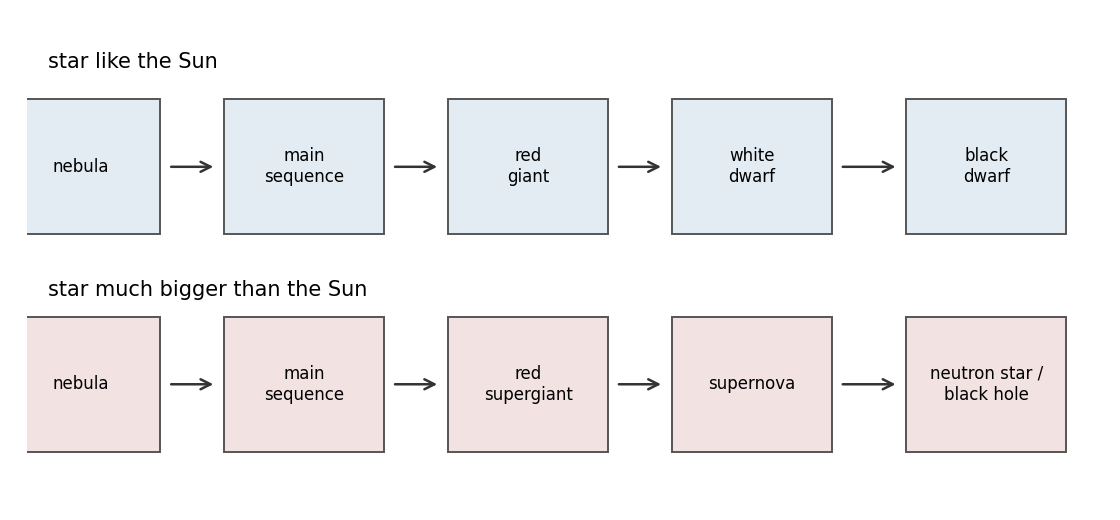
    مساران: تنتهي النجوم الشبيهة بالشمس كأقزام سوداء؛ والنجوم الضخمة تنتهي في المستعرات العظمى ونجوم النيترون أو الثقوب السوداء.

    تتكون النجوم عندما تسحب الجاذبية الغبار والغاز (معظمه هيدروجين وهيليوم) معاً — تتحول الكتل الصغيرة إلى كواكب. خلال الترتيب الرئيسي الطويل، يندمج الهيدروجين إلى هيليوم في النواة وتتوازن الجاذبية مع القوى الدافعة للداخل. كلما كانت النجمة أكثر كتلة، كان نواتها أكثر سخونة وأثقل النوى التي يمكن بناءها عن طريق الاندماج.

    عند نفاد الهيدروجين، تحدد الكتلة النهاية. النجم الشبيه بالشمس ينتفخ ليصبح عملاقاً أحمر، يفقد طبقاته، وتبرد النواة المكشوفة من القزم الأبيض إلى القزم الأسود. النجم الضخم ينتفخ ليصبح عملاقاً أحمر ضخم، يندمج عناصر increasingly أثقل (كربون، نيتروجين، أكسجين)، ثم ينفجر كمستعر عظيم — مبعثرةً العناصر (تُصنع تلك الأثقل من الحديد في الانفجار نفسه) — تاركاً نجم نيترون أو ثقب أسود. صُنع كل عنصر طبيعي في النجوم والمستعرات العظيمة: كان الكون المبكر يحتوي على الهيدروجين فقط.

    النظام الشمسي والحركة المدارية

    النظام الشمسي: ثمانية كواكب تدور حول الشمس، بالإضافة إلى الأقمار والكويكبات والكواكب القزمة والمذنبات. درب التبانة هي واحدة من ملايين المجالات، كل منها يحتوي على ملايين النجوم. مدار أقمار اصطناعية حول الأرض في مدارات متساوية الدوران أو مدارات قطرية منخفضة.

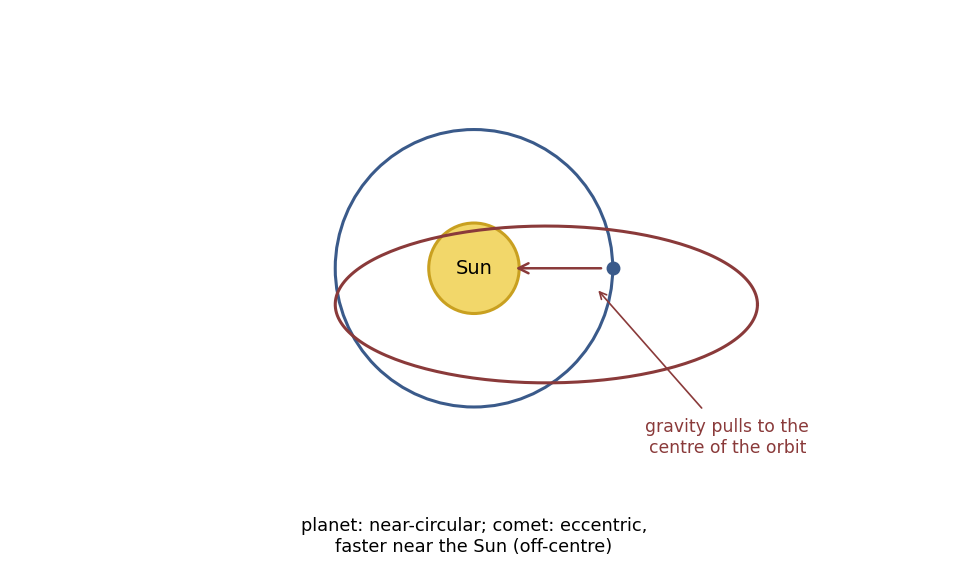
    مدار كوكبي شبه دائري ومدار مذنب شاذ، حيث توفر الجاذبية قوة جذب مركزية.

    تزود الجاذبية القوة المركزية: فهي تعمل نحو المركز، مما يغير اتجاه الحركة (السرعة المتجهة) دون تغيير السرعة. كلما زاد التباعد، ضعفت الجاذبية، مما يعني سرعة مدارية أقل: للبقاء عند نصف قطر معين، يجب أن يتحرك القمر الاصطناعي بسرعة مطابقة — تغيير السرعة يغير نصف قطر المدار.

    الانزياح الأحمر والكون المتمدد (P)

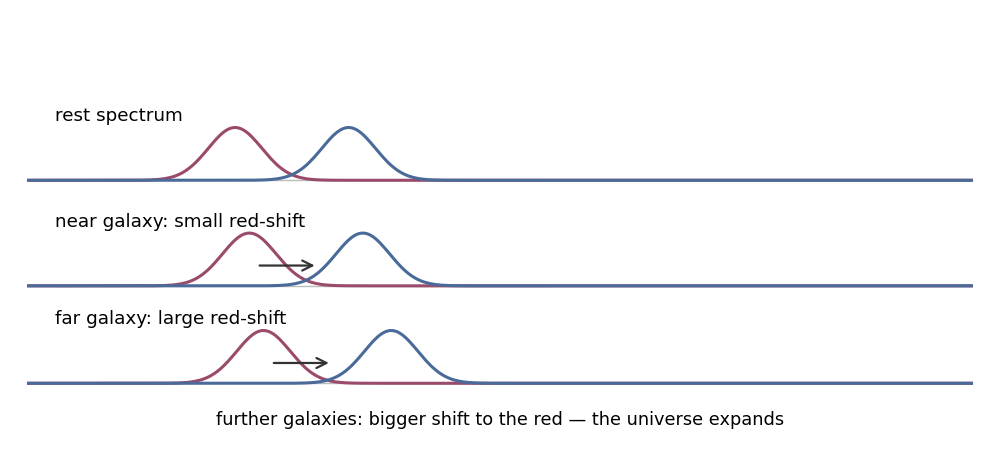
    ثلاثة أطياف: كلما ابتعدت المجلة، كان الانزياح الأحمر أكبر.

    المصدر المتحرك للموجة يغير الطول الموجي المرصود (تأثير دوبلر): المصادر المتباعدة تمتد الأمواج — طول موجي أطول، وتردد أقل. كلما ابتعدت مجلة، زادت سرعة تباعدها وكبير الانزياح الأحمر — الفضاء نفسه يتمدد، مما يشير إلى بداية صغيرة جداً: الانفجار العظيم. الخلفية الكونية الميكروية — الإشعاع الذي يملأ الكون من shortly بعد تلك البداية — هو الركن الثاني؛ نظرية الانفجار العظيم حالياً هي النظرية الوحيدة التي تفسرها.

    تحقق من نفسك

    1. ما الذي يسحب الغبار والغاز لتكوين النجوم؟
    2. ماذا يحدث في نواة نجم في الترتيب الرئيسي؟
    3. اذكر المراحل الثلاث التي تمر بها نجمة شبيهة بالشمس بعد المرحلة الرئيسية.
    4. أي النجوم تصبح مستعرات عظمى؟
    5. أين تُصنع العناصر أثقل من الحديد؟
    6. سمِّ نوعي مدارات الأقمار الصناعية الاصطناعية.
    7. لماذا تتحرك قمر صناعي في مدار أعلى بسرعة أقل؟
    8. (P) ماذا يحدث لطول موجة عندما يبتعد مصدرها؟
    9. (P) اذكر الدليلين على الانفجار العظيم.
    10. (P) ما هو إشعاع الخلفية الكونية الميكروي؟

    الإجابات: 1 الجاذبية؛ 2 نوى الهيدروجين تندمج لتكوين الهيليوم، مع إطلاق الطاقة، وتوازن الجاذبية؛ 3 عملاق أحمر، قزم أبيض، قزم أسود (ثلاث مراحل بعد المرحلة الرئيسية)؛ 4 نجوم أكبر كتلة بكثير من الشمس؛ 5 في انفجارات المستعرات العظمى؛ 6 جغرمستقري ومقطبي منخفض؛ 7 تضعف الجاذبية مع المسافة، لذا تكون قوة الجذب المركزي — والسرعة المطلوبة منها — أصغر؛ 8 (P) تزداد (انزياح نحو الأحمر)، وينخفض التردد المرصد؛ 9 (P) ازدياد الانزياح نحو الأحمر للمجالات مع المسافة، وإشعاع الخلفية الكونية الميكروي؛ 10 (P) إشعاع كهرومغناطيسي يملأ الكون، متبقي من shortly after الانفجار العظيم.

    مفردات
    English العربية
    red-shift/red ʃɪft/ انزياح أحمر
    Big Bang/bɪɡ bæŋ/ الانفجار العظيم
    cosmic microwave background/ˈkɒzmɪk ˈmaɪkrəʊweɪv ˈbækɡraʊnd/ خلفية الميكروويف الكونية

تسجيل الدخول أو إنشاء حساب

IGCSE, A-Level & AP