| English | 释义 | 拼音 |
|---|---|---|
| momentum/məʊˈmentəm/ | 动量 | dòng liàng |
| collision/kəˈlɪʒn/ | 碰撞 | pèng zhuàng |
| conservation of momentum/ˌkɒnsəˈveɪʃn ɒv məʊˈmentəm/ | 动量守恒 | dòng liàng shǒu héng |
| impulse/ˈɪmpʌls/ | 冲量 | chōng liàng |
Hard to stop
- An empty shopping trolley is easy to stop. A loaded truck at the same speed is not.
- The truck has much more momentum 动量.
- Momentum links mass, velocity, force and collisions 碰撞. In a collision with no outside force, the total momentum stays the same.
Momentum
- Momentum is mass times velocity:
- It is a vector: it has a direction (the direction of motion). The unit is kg m/s.
- Example: a 1500 kg car at 20 m/s has $p$ = 1500 × 20 = 30 000 kg m/s. A 0.15 kg cricket ball would need to move at 200 000 m/s to match it.
Momentum is a vector.
难度 1/5 · 今日首次完成可获 100 金币及少量额外奖励
Momentum is mass × velocity, and velocity has a direction, so momentum is a vector.
A $1000\ \text{kg}$ car moves at $20\ \text{m/s}$. What is its momentum, in kg m/s?
难度 2/5 · 今日首次完成可获 140 金币及少量额外奖励
$p = mv = 1000 \times 20 = 20\,000\ \text{kg}\,\text{m/s}$.
Impulse and force
- When a force acts for a time, it changes the momentum. Impulse 冲量 = force × time = change in momentum: $F\Delta t = \Delta(mv)$. Unit: N s (the same as kg m/s).
- Rearranged, the resultant force is the change in momentum per unit time: $F = \dfrac{\Delta p}{\Delta t}$.
- For the same change in momentum, a longer time means a smaller force. Crumple zones, airbags, seat belts and crash mats all make the stop take longer, so the force on the person is smaller.
Worked example: a bounce. A 0.50 kg ball hits a wall at 8.0 m/s and bounces straight back at 6.0 m/s. It touches the wall for 0.020 s.
- Take the direction towards the wall as positive. Before: $p$ = 0.50 × 8.0 = +4.0 kg m/s. After: $p$ = 0.50 × (−6.0) = −3.0 kg m/s.
- change in momentum = −3.0 − 4.0 = −7.0 kg m/s, so the impulse has size 7.0 N s.
- average force = 7.0 ÷ 0.020 = 350 N, away from the wall.
- Common mistake: 4.0 − 3.0 = 1.0. A bounce reverses the direction, so the two momenta add.
Why does a car's crumple zone reduce the force on the passengers in a crash?
难度 1/5 · 今日首次完成可获 100 金币及少量额外奖励
Since $F = \dfrac{\Delta p}{\Delta t}$, spreading the same momentum change over a longer time gives a smaller force.
A ball's momentum changes by $20\ \text{kg}\,\text{m/s}$ during a push lasting $2.0\ \text{s}$. What is the average force, in N?
难度 2/5 · 今日首次完成可获 140 金币及少量额外奖励
$F = \dfrac{\Delta p}{\Delta t} = \dfrac{20}{2.0} = 10\ \text{N}$.
A tennis racket exerts an average force of 200 N on a ball for 0.015 s. What is the impulse on the ball, in N s?
难度 2/5 · 今日首次完成可获 140 金币及少量额外奖励
Impulse = F × Δt = 200 × 0.015 = 3.0 N s. This is also the change in the ball's momentum.
A 0.20 kg ball hits the floor at 5.0 m/s and bounces up at 4.0 m/s. What is the size of its change in momentum, in kg m/s?
难度 2/5 · 今日首次完成可获 140 金币及少量额外奖励
Down is +, up is −: before +1.0, after −0.80. Change = −0.80 − 1.0 = −1.8 kg m/s, size 1.8. The direction reverses, so the two sizes add.
Conservation of momentum 动量守恒
- When objects collide or push apart and no outside force acts, the total momentum before = total momentum after: $m_1 u_1 + m_2 u_2 = m_1 v_1 + m_2 v_2$ ($u$ = velocity before, $v$ = velocity after).
- Choose one direction as positive. A velocity in the other direction is negative.
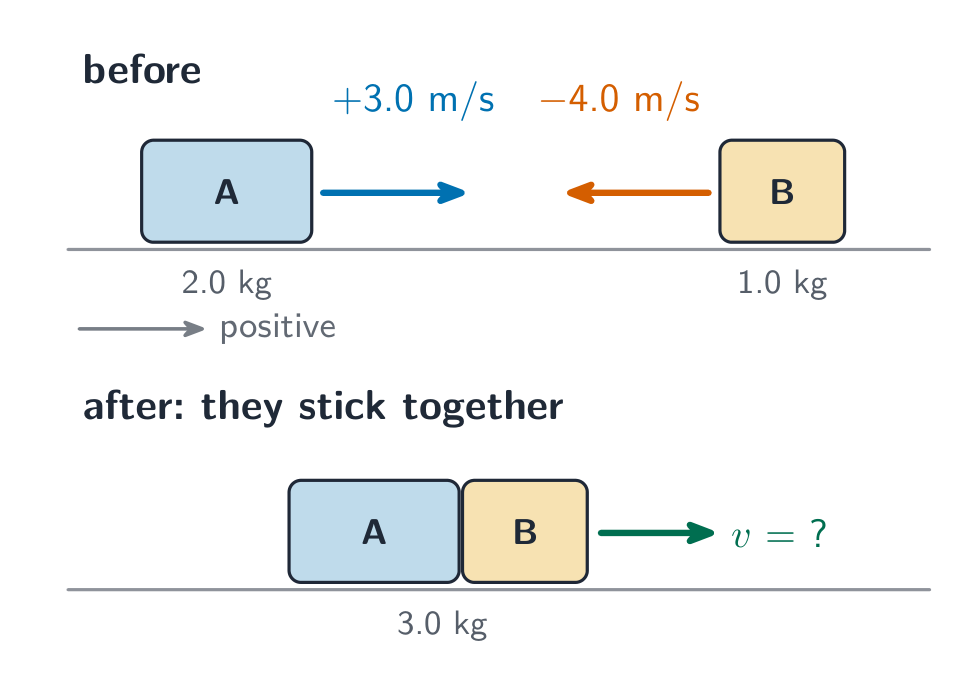
Exam question. Trolley A (2.0 kg, +3.0 m/s) and trolley B (1.0 kg, −4.0 m/s) collide and stick together. Calculate their velocity after the collision. [3]
- momentum before = (2.0 × 3.0) + (1.0 × −4.0) = 6.0 − 4.0 = 2.0 kg m/s (1)
- momentum after = (2.0 + 1.0) × v = 3.0v (1)
- 3.0v = 2.0, so v = 0.67 m/s, in A's original direction (1)
- Mark-scheme reasoning: the most common error is adding 6.0 + 4.0 = 10, which ignores the directions. Give the direction with the answer: the sign tells you which way the trolleys move.
Explosion (starting from rest). A 60 kg skater pushes off from a 40 kg skater; both start at rest. Total momentum before = 0, so after: 60 × v₁ + 40 × v₂ = 0. If the 60 kg skater moves at −2.0 m/s, then 40 × v₂ = 120, so the 40 kg skater moves at +3.0 m/s. They move apart in opposite directions, and the lighter one moves faster.
See momentum being conserved
Two trolleys collide and stick together.
A $2.0\ \text{kg}$ trolley moving at $3.0\ \text{m/s}$ hits a stationary $1.0\ \text{kg}$ trolley and they stick together. What is their speed afterwards, in m/s?
难度 2/5 · 今日首次完成可获 140 金币及少量额外奖励
Before: $2.0 \times 3.0 + 1.0 \times 0 = 6.0\ \text{kg}\,\text{m/s}$. After: $(2.0 + 1.0)v = 6.0$, so $v = 2.0\ \text{m/s}$.
A 3.0 kg trolley at +2.0 m/s meets a 1.0 kg trolley at −2.0 m/s. They stick together. What is their velocity after, in m/s?
难度 2/5 · 今日首次完成可获 140 金币及少量额外奖励
Before: 3.0 × 2.0 + 1.0 × (−2.0) = 6.0 − 2.0 = 4.0 kg m/s. After: 4.0 × v = 4.0, so v = +1.0 m/s, in the heavier trolley's direction.
A 2.0 kg toy cannon at rest fires a 0.050 kg ball forwards at 12 m/s. What is the size of the cannon's recoil speed, in m/s?
难度 2/5 · 今日首次完成可获 140 金币及少量额外奖励
Total momentum stays 0: 0.050 × 12 + 2.0 × v = 0, so 2.0v = −0.60 and v = −0.30 m/s. The cannon moves backwards at 0.30 m/s.
You've got it
- momentum $p = mv$: a vector, unit kg m/s
- impulse $= F\Delta t = \Delta(mv)$, unit N s; a longer time of impact means a smaller force
- resultant force $F = \dfrac{\Delta p}{\Delta t}$
- conservation: total momentum before = total momentum after; choose a positive direction and give opposite velocities a minus sign
- a bounce reverses momentum, so the change is the sum of the two sizes; from rest, the total momentum stays zero
A 4 kg trolley moves at 7 metres per second and is stopped in 0.50 s. What are its momentum and the average stopping force?
4 times 7 is 28. 28 divided by 0.50 is 56 newtons.
What is the momentum of the trolley?
难度 1/5 · 今日首次完成可获 100 金币及少量额外奖励
4 times 7 is 28 kilogram metres per second.