Measurement, scalars and vectors · 测量、标量与矢量
| English | 中文 | Pinyin · 拼音 |
|---|---|---|
| measurement/ˈmeʒəmənt/ | 测量 | cè liáng |
| scalar/ˈskeɪlə/ | 标量 | biāo liàng |
| vector/ˈvektə/ | 矢量 | shǐ liàng |
| parallax/ˈpærəlæks/ | 视差 | shì chā |
| meniscus/ˈmenɪskəs/ | 弯月面 | wān yuè miàn |
| period/ˈpɪərɪəd/ | 周期 | zhōu qī |
| resultant/rɪˈzʌltənt/ | 合矢量 | hé shǐ liàng |
Why measure carefully?
- Physics starts with measurement 测量 — turning the real world into good numbers.
- A careless reading can ruin a whole experiment.
- So first we learn to measure length and volume, handle tiny amounts, and tell scalars 标量 from vectors 矢量.
为什么要仔细测量?
- 物理学从测量(measurement)开始——把真实世界变成好的数字。
- 一个粗心的读数能毁掉整个实验。
- 所以首先我们学习测量长度和体积、处理微小的量,并区分标量和矢量。
Length and volume
- Measure length with a ruler.
- Put your eye straight in front of the mark — looking from the side gives a wrong reading (a parallax 视差 error).
- Measure the volume of a liquid with a measuring cylinder.
- Read the scale at the bottom of the curved surface (the meniscus 弯月面), with your eye level with it.
Read a measuring cylinder at the bottom of the meniscus, with your eye level
长度和体积
- 用一把尺子测量长度。
- 把你的眼睛放在刻度正前方——从侧面看给出一个错误的读数(一个视差(parallax)误差)。
- 用一个量筒测量一种液体的体积。
- 在弯曲表面的底部(弯月面(meniscus))读刻度,你的眼睛与它齐平。
Scalars & vectors · 标量与矢量
resultant = a + b · 合矢量 = a + b
Add two vectors tip-to-tail to find the resultant. · 把两个矢量首尾相接相加以找出合矢量。
You measure water in a measuring cylinder. How should you read the scale? · 你在一个量筒中测量水。你应该如何读刻度?
Read at the bottom of the meniscus with your eye level with it — looking from above or below gives a parallax error (a wrong reading). · 在弯月面的底部读,眼睛与它齐平——从上方或下方看给出一个视差误差(一个错误的读数)。
Measuring tiny amounts
- One thin page, or one quick swing, is too small to measure well.
- The trick: measure many, then divide.
- Stack 100 sheets of paper, measure the height, then $\div 100$ → the thickness of one sheet.
- Time 20 swings of a pendulum, then $\div 20$ → the period 周期 (the time for one swing).
- Measuring many at once makes the error much smaller.
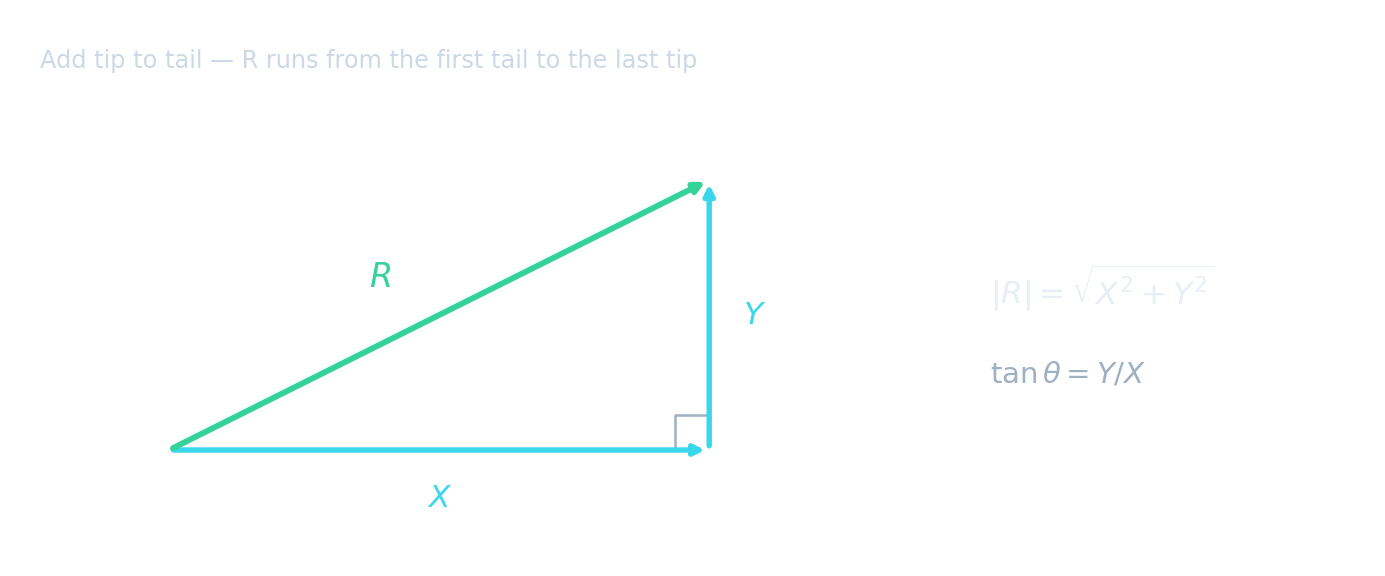
Two vectors at right angles add to a resultant 合矢量, the diagonal of the rectangle
测量微小的量
- 一张薄页,或一次快速的摆动,太小而无法很好地测量。
- 诀窍:测量许多,然后除。
- 叠 100 张纸,测量高度,然后 $\div 100$ → 一张纸的厚度。
- 给一个摆的 20 次摆动计时,然后 $\div 20$ → 周期(period,一次摆动的时间)。
- 一次测量许多使误差小得多。

两个成直角的矢量相加为一个合矢量,即矩形的对角线
A stack of 100 sheets of paper is $12\ \text{mm}$ tall. How thick is one sheet, in mm? · 一叠 100 张纸高 $12\ \text{mm}$。一张纸有多厚,以 mm 计?
Measure many and divide: $12 \div 100 = 0.12\ \text{mm}$. Dividing makes the small measurement much more accurate. · 测量许多并除:$12 \div 100 = 0.12\ \text{mm}$。除使这个小测量准确得多。
20 swings of a pendulum take $30\ \text{s}$. What is the period (time for one swing), in s? · 一个摆的 20 次摆动花 $30\ \text{s}$。周期(一次摆动的时间)是多少,以 s 计?
The period is the time for one swing: $30 \div 20 = 1.5\ \text{s}$. · 周期是一次摆动的时间:$30 \div 20 = 1.5\ \text{s}$。
Scalars and vectors
- A scalar has size only.
- A vector has size and direction.
- Scalars: distance, speed, time, mass, energy, temperature.
- Vectors: force, weight, velocity, acceleration, momentum.
- "$30\ \text{m/s}$" is a speed (scalar). "$30\ \text{m/s}$ due north" is a velocity (vector).
标量和矢量
- 一个标量(scalar)只有大小。
- 一个矢量(vector)有大小和方向。
- 标量:距离、速率、时间、质量、能量、温度。
- 矢量:力、重量、速度、加速度、动量。
- "$30\ \text{m/s}$"是一个速率(标量)。"向正北 $30\ \text{m/s}$"是一个速度(矢量)。
Select all · 所有 the quantities that are vectors. · 选择所有是矢量的量。
Vectors have size and direction: force, velocity, acceleration. Mass and temperature are scalars (size only). · 矢量有大小和方向:力、速度、加速度。质量和温度是标量(只有大小)。
Speed is a vector. · 速率是一个矢量。
Speed has size only, so it is a scalar. Velocity (speed in a stated direction) is the vector. · 速率只有大小,所以它是一个标量。速度(一个陈述方向上的速率)是矢量。
Adding vectors at right angles
- Two vectors at $90°$ add to a resultant — the diagonal of the rectangle they make.
- Find its size with Pythagoras:
- Find its direction with trigonometry (an angle measured from one side).
把成直角的矢量相加
- 两个成 $90°$ 的矢量相加为一个合矢量(resultant)——它们组成的矩形的对角线。
- 用毕达哥拉斯定理找它的大小:
- 用三角学找它的方向(从一边测量的一个角)。
A force of $3.0\ \text{N}$ acts east and $4.0\ \text{N}$ acts north. What is the size of the resultant, in N? · 一个 $3.0\ \text{N}$ 的力向东作用,$4.0\ \text{N}$ 向北作用。合力的大小是多少,以 N 计?
They are at right angles, so use Pythagoras: $R = \sqrt{3.0^2 + 4.0^2} = \sqrt{25} = 5.0\ \text{N}$. · 它们成直角,所以用毕达哥拉斯定理:$R = \sqrt{3.0^2 + 4.0^2} = \sqrt{25} = 5.0\ \text{N}$。
You've got it
- read a scale with your eye level with the mark; read a liquid at the meniscus
- for tiny amounts, measure many and divide
- scalar = size only; vector = size and direction
- two vectors at $90°$ → resultant $R = \sqrt{a^2 + b^2}$
你掌握了
- 读刻度时眼睛与刻度齐平;在弯月面读液体
- 对微小的量,测量许多并除
- 标量 = 只有大小;矢量 = 大小和方向
- 两个成 $90°$ 的矢量 → 合矢量 $R = \sqrt{a^2 + b^2}$