Gradient · 斜率
| English | 中文 | Pinyin · 拼音 |
|---|---|---|
| rise/raɪz/ | 上升量 | shàng shēng liàng |
| run/rʌn/ | 水平量 | shuǐ píng liàng |
| gradient/ˈɡreɪdɪənt/ | 斜率 | xié lǜ |
The steepest street on Earth
- Baldwin Street in Dunedin, New Zealand, climbs 35 m for every 100 m along the ground.
- That ratio — rise 上升量 ÷ run 水平量 — is what mathematicians call the gradient 斜率.
- A single number tells you exactly how steep something is, whether it's a street, a roof, or a line on a graph.
What gradient measures
- The gradient $m$ tells you two things about a straight line:
- How steep it is (larger absolute gradient = steeper).
- Which direction it goes (positive = up to the right, negative = down to the right).
- A gradient of $0$ means the line is perfectly horizontal — no rise at all.

A steep alpine pass: gradient measures steepness as rise over run
Gradient · 斜率
y = ax + b
The gradient a measures steepness — rise over run. · 斜率 a 衡量陡度——上升对水平距离。
A line that goes down as you move to the right has a gradient that is: · 一条随着你向右移动而下降的线有一个以下的斜率:
Falling to the right means the change in y is negative for a positive change in x, so the gradient is negative. · 向右下降意味着对一个正的 x 变化,y 的变化是负的,所以斜率是负的。
The gradient of a horizontal line is 0. · 一条水平线的斜率是 0。
A horizontal line has no vertical change (rise = 0), so m = 0/run = 0. · 一条水平线没有竖直变化(上升 = 0),所以 m = 0/水平距离 = 0。
Gradient from a grid; coordinates in Extended
- Pick any two points on the line, $(x_1, y_1)$ and $(x_2, y_2)$:
- The rise is the vertical gap between the points; the run is the horizontal gap.
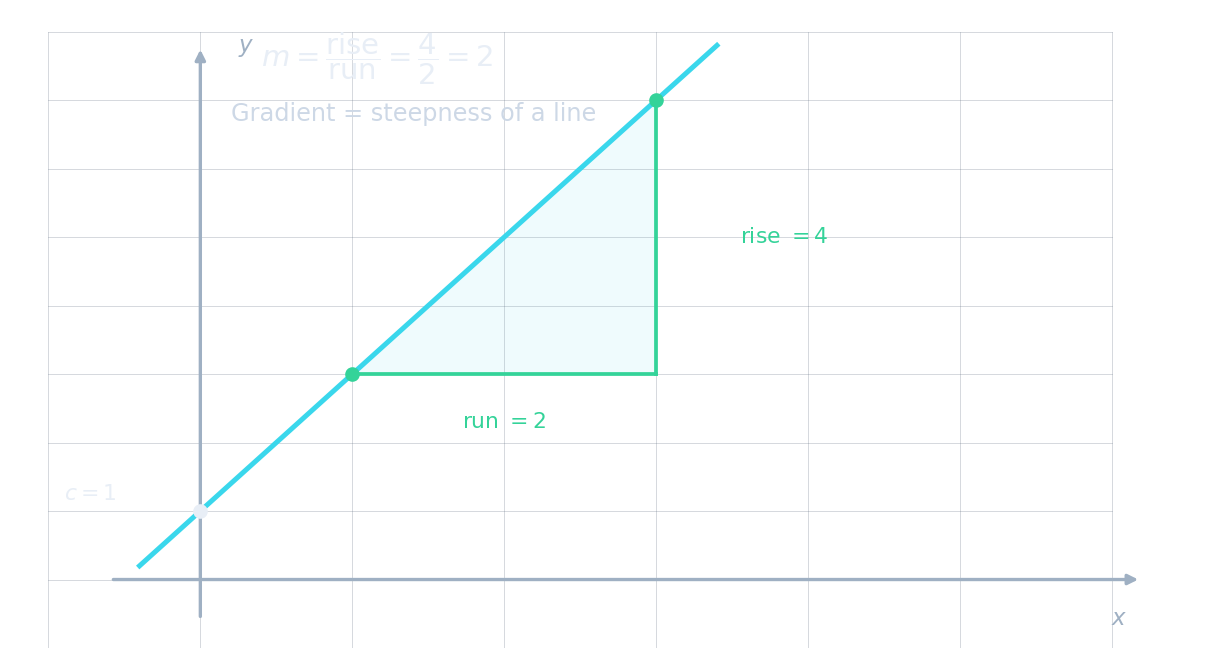
The gradient triangle: count the squares up (rise) and across (run), then divide.
Complete the formula: m = (y₂ − y₁) / (? − x₁). · 完成公式:m = (y₂ − y₁) / (? − x₁)。
The full formula is m = (y₂ − y₁) / (x₂ − x₁). The denominator is the change in x, which is x₂ − x₁. · 完整的公式是 m = (y₂ − y₁) / (x₂ − x₁)。分母是 x 的变化,即 x₂ − x₁。
Worked example
- Find the gradient of the line through $(1, 2)$ and $(4, 11)$.
- Rise $= 11 - 2 = 9$; run $= 4 - 1 = 3$.
- $m = \dfrac{9}{3} = 3$.
- The line climbs $3$ units up for every $1$ unit across — quite steep.
Quick check. Through $(0, 1)$ and $(2, 7)$: rise $= 7 - 1 = 6$, run $= 2 - 0 = 2$, so $m = \dfrac{6}{2} = 3$. Same gradient, same steepness — different line.
Find the gradient of the line through (1, 2) and (4, 11). · 求通过 (1, 2) 和 (4, 11) 的线的斜率。
(11 − 2)/(4 − 1) = 9/3 = 3. · (11 − 2)/(4 − 1) = 9/3 = 3。
Find the gradient of the line through (0, 1) and (2, 7). · 求通过 (0, 1) 和 (2, 7) 的线的斜率。
(7 − 1)/(2 − 0) = 6/2 = 3. · (7 − 1)/(2 − 0) = 6/2 = 3。
The subtraction trap
- You must subtract in the same order for both coordinates:
- $(y_2 - y_1)$ paired with $(x_2 - x_1)$, or $(y_1 - y_2)$ paired with $(x_1 - x_2)$.
- Mixing the order flips the sign and gives the wrong gradient.
Common mistake. Through $(1, 2)$ and $(4, 11)$: if you write $\dfrac{11 - 2}{1 - 4} = \dfrac{9}{-3} = -3$ you mixed the order — you took $y_2 - y_1$ on top but $x_1 - x_2$ on the bottom. Pick one point to be "first" and stick with it.
Gradient in the real world
- Road signs show gradient as a percentage: a 10% hill rises 10 m for every 100 m along.
- Wheelchair ramps must have a gradient of at most $\dfrac{1}{12}$ (about 8%) — that's building code in many countries.
- Roof pitch is a gradient too — steeper roofs shed rain faster.
Match each description to the correct gradient property. · 把每个描述匹配到正确的斜率性质。
Positive = rising rightward; zero = flat; negative = falling rightward; a larger magnitude means a steeper slope. · 正 = 向右上升;零 = 平坦;负 = 向右下降;更大的量级意味着更陡的斜率。
You've got it
- gradient $m = \dfrac{\text{rise}}{\text{run}} = \dfrac{y_2 - y_1}{x_2 - x_1}$
- positive gradient → line goes up to the right; negative → down to the right; zero → horizontal
- subtract in the same order for both coordinates — mixing up the order flips the sign
- through $(1,2)$ and $(4,11)$: $m = \dfrac{9}{3} = 3$