Direct and inverse proportion · 正比例与反比例
| English | 中文 | Pinyin · 拼音 |
|---|---|---|
| direct proportion/daɪˈrekt prəˈpɔːʃn/ | 正比例 | zhèng bǐ lì |
| constant of proportionality/ˈkɒnstənt ɒv prəˌpɔːʃəˈnælɪti/ | 比例常数 | bǐ lì cháng shù |
| inverse proportion/ɪnˈvɜːs prəˈpɔːʃn/ | 反比例 | fǎn bǐ lì |
The golden ratio of recipes
- A pancake recipe for 4 needs 200 g flour. How much for 10 people? $200 \div 4 = 50$ g per person, $50 \times 10 = 500$ g.
- That's direct proportion 正比例: double the people, double the flour. The ratio stays the same.
配方的黄金比例
- 一个给 4 人的煎饼配方需要 200 g 面粉。给 10 人需要多少?$200 \div 4 = 50$ g 每人,$50 \times 10 = 500$ g。
- 那是正比例(direct proportion):人数翻倍,面粉翻倍。比保持相同。
Direct proportion
- $y \propto x$ means $y = kx$ for some constant $k$ (the constant of proportionality 比例常数).
- If $y$ doubles, $x$ doubles too — they scale together.
- Find $k$ from a known pair, then use it.
$y \propto x$, $y = 12$ at $x = 3$. $k = \dfrac{12}{3} = 4$, so $y = 4x$. At $x = 7$: $y = 28$.
正比例
- $y \propto x$ 意味着 $y = kx$ 对于某个常数 $k$(即比例常数)。
- 如果 $y$ 翻倍,$x$ 也翻倍——它们一起缩放。
- 从一对已知的值求 $k$,然后使用它。
$y \propto x$,$y = 12$ 在 $x = 3$。$k = \dfrac{12}{3} = 4$,所以 $y = 4x$。在 $x = 7$:$y = 28$。
Inverse proportion · 反比例
y = a/x
Inverse proportion: as x doubles, y halves — a reciprocal curve with two asymptotes. · 反比例:x 翻倍,y 减半——一条带两条渐近线的倒数曲线。
y is directly proportional to x, and y = 12 when x = 3. Find y when x = 7. · y 与 x 成正比,且 y = 12 当 x = 3。求 y 当 x = 7。
k = 12/3 = 4, so y = 4x; at x = 7, y = 28. · k = 12/3 = 4,所以 y = 4x;在 x = 7,y = 28。
You find the constant of proportionality k from a known pair of values. · 你从一对已知的值求比例常数 k。
Substitute the known x and y to solve for k, then use the rule. · 代入已知的 x 和 y 解出 k,然后使用规则。
Inverse proportion 反比例
- $y \propto \dfrac{1}{x}$ means $y = \dfrac{k}{x}$ — as one rises, the other falls.
- More workers → less time. More speed → less travel time.
Don't confuse the two. Direct: $y$ goes up as $x$ goes up ($y = kx$). Inverse: $y$ goes down as $x$ goes up ($y = k/x$). The graph shapes are very different.
反比例
- $y \propto \dfrac{1}{x}$ 意味着 $y = \dfrac{k}{x}$——一个上升时,另一个下降。
- 更多工人 → 更少时间。更高速度 → 更少旅行时间。
不要把两者搞混。 正比例:$y$ 随 $x$ 上升而上升($y = kx$)。反比例:$y$ 随 $x$ 上升而下降($y = k/x$)。图形形状非常不同。
Inverse proportion y ∝ 1/x means: · 反比例 y ∝ 1/x 意味着:
Inverse proportion: as x rises, y falls, given by y = k/x. · 反比例:x 上升,y 下降,由 y = k/x 给出。
y ∝ 1/x, and y = 6 when x = 4. Find y when x = 12. · y ∝ 1/x,且 y = 6 当 x = 4。求 y 当 x = 12。
6 = k/4 → k = 24. At x = 12: y = 24/12 = 2. · 6 = k/4 → k = 24。在 x = 12:y = 24/12 = 2。
Proportion to powers and roots
- Proportion can be to a square, cube, or square root:
- $y \propto x^2$: $y = kx^2$. If $x$ doubles, $y$ quadruples.
- $y \propto \sqrt{x}$: $y = k\sqrt{x}$.
Direct proportion is a straight line through the origin. Non-linear proportion (to a square, cube, or root) curves away.
对幂和根的比例
- 比例能对一个平方、立方或平方根:
- $y \propto x^2$:$y = kx^2$。如果 $x$ 翻倍,$y$ 变四倍。
- $y \propto \sqrt{x}$: $y = k\sqrt{x}$.
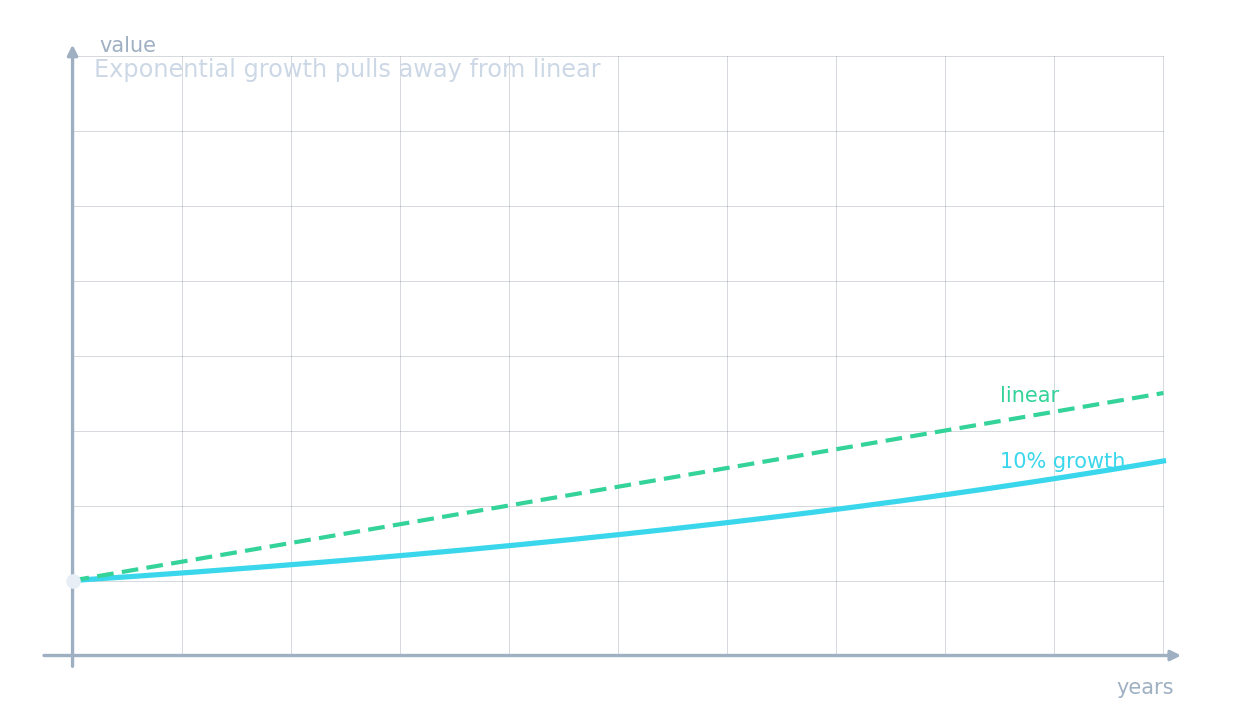
正比例是一条通过原点的直线。非线性比例(对一个平方、立方或根)弯曲离开。
Worked example
- $y \propto x^2$, and $y = 50$ when $x = 5$. Find $y$ when $x = 8$.
- $50 = k(5^2) = 25k \Rightarrow k = 2$.
- $y = 2(8^2) = 2(64) = 128$.
示例
- $y \propto x^2$,且 $y = 50$ 当 $x = 5$。求 $y$ 当 $x = 8$。
- $50 = k(5^2) = 25k \Rightarrow k = 2$.
- $y = 2(8^2) = 2(64) = 128$.
y ∝ x², and y = 50 when x = 5. Find y when x = 8. · y ∝ x²,且 y = 50 当 x = 5。求 y 当 x = 8。
50 = k(25) → k = 2. At x = 8: y = 2(64) = 128. · 50 = k(25) → k = 2。在 x = 8:y = 2(64) = 128。
Match each proportion statement to its equation. · 把每个比例陈述匹配到它的方程。
Direct: y = kx. Inverse: y = k/x. Proportional to x²: y = kx². Proportional to √x: y = k√x. · 正:y = kx。反:y = k/x。与 x² 成正比:y = kx²。与 √x 成正比:y = k√x。
An inverse calculation
- Six equally productive workers take 10 days. With fixed work, $t=k/w$, so $k=tw=10(6)=60$ worker-days.
- Ten workers take $t=60/10=6$ days, assuming equal productivity. Do not use direct proportion: more workers should reduce the time.
反推计算
- 六名生产效率相同的工人需要 10 天完成。在工作量固定的情况下,$t=k/w$,即 $k=tw=10(6)=60$ 个工日。
- 十名工人需要 $t=60/10=6$ 天完成,假设效率相同。请勿使用正比例关系:工人越多,所需时间应越少。
Six workers take 10 days. At the same productivity, how many days do 10 workers take? · 六名工人需要 10 天完成工作。若生产效率相同,10 名工人需要多少天?
The fixed work is 60 worker-days; 60 / 10 = 6 days. · 固定工作量为 60 人·天;60 ÷ 10 = 6 天。
You've got it
- direct: $y = kx$; inverse: $y = \dfrac{k}{x}$
- find $k$ from a known pair, then substitute
- proportion can also be to a square ($kx^2$), cube ($kx^3$), or root ($k\sqrt{x}$)
你掌握了
- 正:$y = kx$;反:$y = \dfrac{k}{x}$
- 从一对已知的值求 $k$,然后代入
- 比例也能对一个平方($kx^2$)、立方($kx^3$)或根($k\sqrt{x}$)