Graphs in practical situations · 实际情境中的图
| English | 中文 | Pinyin · 拼音 |
|---|---|---|
| gradient/ˈɡreɪdɪənt/ | 斜率 | xié lǜ |
| acceleration/əkˌseləˈreɪʃn/ | 加速度 | jiā sù dù |
| conversion graph/kənˈvɜːʃn ɡræf/ | 换算图 | huàn suàn tú |
Reading the story in a graph
- A distance–time graph is not just a line — it's a story of a journey. A steep section means fast travel; a flat section means stopped.
- Every graph tells a story through its shape and gradient 斜率.
读图中的故事
- 一个距离-时间图不只是一条线——它是一段旅程的故事。一个陡峭的部分意味着快速行进;一个平坦的部分意味着停止。
- 每个图通过它的形状和斜率(gradient)讲一个故事。
Distance–time graphs
- Gradient = speed (distance ÷ time).
- Steeper line = faster speed.
- Flat line = stationary (not moving).
- Curved line = changing speed (accelerating or decelerating).
A car travels 60 km in 2 hours, stops for 30 minutes, then returns in 1.5 hours. The graph has three sections: slope up, flat, slope down.
On a distance-time graph the gradient is the speed; a flat section means the object has stopped
距离-时间图
- 斜率 = 速度(距离 ÷ 时间)。
- 更陡的线 = 更快的速度。
- 平坦的线 = 静止(不移动)。
- 弯曲的线 = 变化的速度(加速或减速)。
一辆车在 2 小时内行进 60 km,停 30 分钟,然后在 1.5 小时内返回。图有三个部分:向上斜、平坦、向下斜。
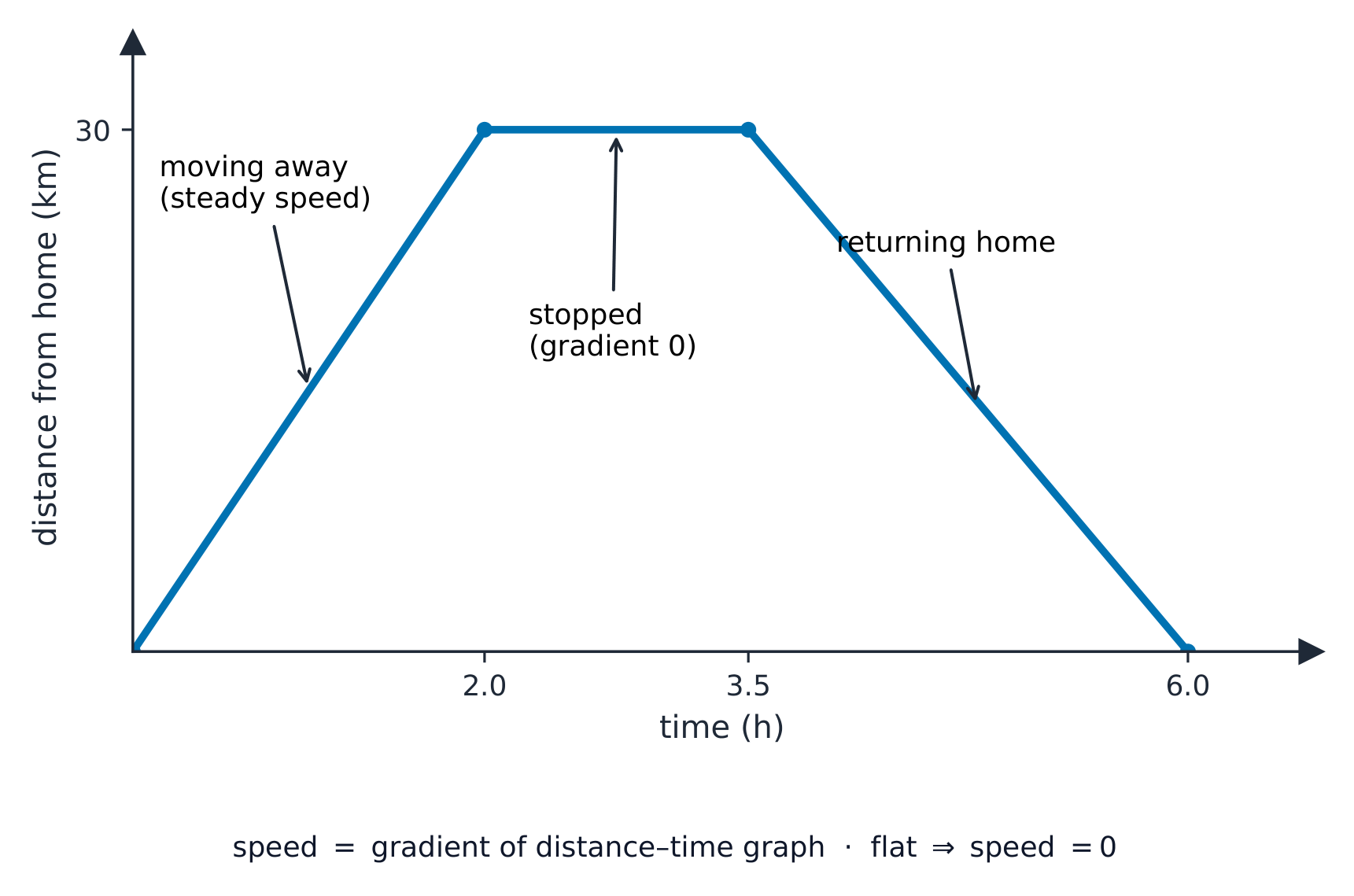
在一个距离-时间图上斜率是速度;一个平坦的部分意味着物体已停止
Real-life graphs · 现实生活的图
y = ax + b
A distance–time or cost graph is read from its gradient and its intercept. · 一个距离-时间或成本图从它的斜率和它的截距读取。
On a distance–time graph, the gradient represents the: · 在一个距离-时间图上,斜率代表:
Distance ÷ time = speed, which is the gradient. · 距离 ÷ 时间 = 速度,这就是斜率。
On a distance–time graph, a flat (horizontal) section means the object is stationary. · 在一个距离-时间图上,一个平坦(水平)的部分意味着物体是静止的。
A flat section has gradient 0, meaning distance is not changing — the object is not moving. · 一个平坦的部分有斜率 0,意味着距离不变——物体不移动。
Speed–time graphs (Extended)
- Gradient = acceleration 加速度 (change in speed ÷ time).
- Area under the graph = total distance travelled.
The area under a speed–time graph gives the distance: triangle $+$ rectangle $= 80 + 240 = 320$ m.
Area, not height. The distance is the area under the graph, not the speed reading. A car going 20 m/s for 12 s covers $20 \times 12 = 240$ m — the rectangle's area.
速度-时间图(扩展)
- 斜率 = 加速度(速度变化 ÷ 时间)。
- 图下方的面积 = 行进的总距离。
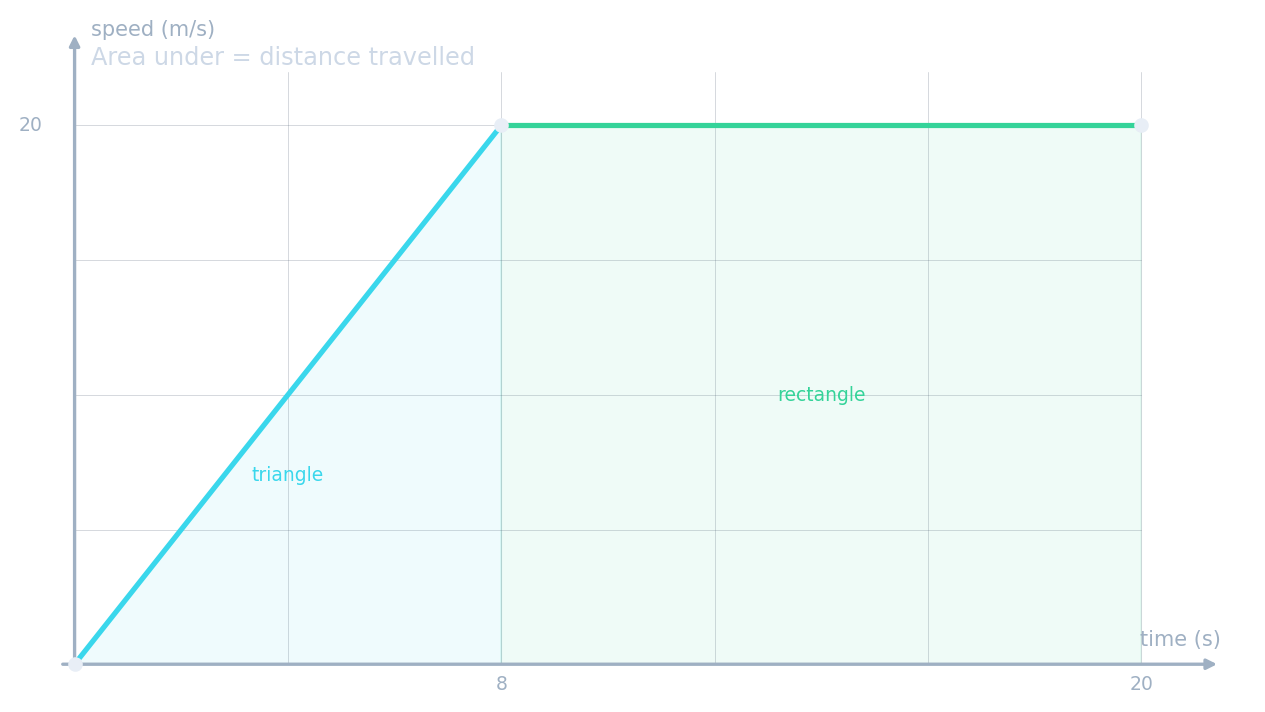
一个速度-时间图下方的面积给出距离:三角形 $+$ 矩形 $= 80 + 240 = 320$ m。
是面积,不是高度。 距离是图下方的面积,不是速度读数。一辆以 20 m/s 行驶 12 s 的车行进 $20 \times 12 = 240$ m——矩形的面积。
A car speeds up from rest to 20 m/s in 8 s. What is the acceleration (m/s²)? · 一辆车在 8 s 内从静止加速到 20 m/s。加速度(m/s²)是多少?
acceleration = 20/8 = 2.5 m/s² (the gradient of the speed–time graph). · 加速度 = 20/8 = 2.5 m/s²(速度-时间图的斜率)。
On a speed–time graph, the ______ under the graph gives the distance travelled. · 在一个速度-时间图上,图下方的______给出行进的距离。
The area under a speed-time graph equals distance (speed × time, integrated over the duration). · 一个速度-时间图下方的面积等于距离(速度 × 时间,在持续时间上积分)。
Worked example
- A car accelerates from rest to 20 m/s in 8 s, then travels at 20 m/s for 12 s.
- Acceleration $= \dfrac{20}{8} = 2.5$ m/s² (the gradient of the first section).
- Distance $= \dfrac{1}{2}(8)(20) + (12)(20) = 80 + 240 = 320$ m (area of triangle + rectangle).
On a speed-time graph the gradient is the acceleration and the area underneath is the distance travelled
例题
- 一辆车在 8 s 内从静止加速到 20 m/s,然后以 20 m/s 行驶 12 s。
- 加速度 $= \dfrac{20}{8} = 2.5$ m/s²(第一个部分的斜率)。
- 距离 $= \dfrac{1}{2}(8)(20) + (12)(20) = 80 + 240 = 320$ m(三角形 + 矩形的面积)。

在一个速度-时间图上斜率是加速度,下方的面积是行进的距离
Then it stays at 20 m/s for 12 s. Total distance = ½(8)(20) + 12(20). What is it (m)? · 然后它以 20 m/s 保持 12 s。总距离 = ½(8)(20) + 12(20)。它是多少(m)?
Area = triangle 80 + rectangle 240 = 320 m. · 面积 = 三角形 80 + 矩形 240 = 320 m。
Conversion graphs 换算图
- A conversion graph is a straight line that converts between two units.
- Miles to km: draw a line through $(0, 0)$ and $(5, 8)$ (5 miles ≈ 8 km).
- Read across from one axis, up/down to the line, then across to the other axis.
转换图
- 一个转换图(conversion graph)是一条在两个单位之间转换的直线。
- 英里到 km:画一条通过 $(0, 0)$ 和 $(5, 8)$ 的线(5 英里 ≈ 8 km)。
- 从一个轴横向读,向上/下到线,然后横向到另一个轴。
A conversion graph passes through (0, 0) and (5, 8) for miles to km. How many km is 10 miles? · 一个英里到 km 的转换图通过 (0, 0) 和 (5, 8)。10 英里是多少 km?
Gradient = 8/5 = 1.6 km per mile. 10 miles = 10 × 1.6 = 16 km. · 斜率 = 8/5 = 每英里 1.6 km。10 英里 = 10 × 1.6 = 16 km。
You've got it
- distance–time: gradient $=$ speed; flat $=$ stationary
- speed–time: gradient $=$ acceleration; area $=$ distance
- a conversion graph converts between two units via a straight line
你掌握了
- 距离-时间:斜率 $=$ 速度;平坦 $=$ 静止
- 速度-时间:斜率 $=$ 加速度;面积 $=$ 距离
- 一个转换图通过一条直线在两个单位之间转换