Sequences · 数列
| English | 中文 | Pinyin · 拼音 |
|---|---|---|
| sequence/ˈsiːkwəns/ | 数列 | shù liè |
| term-to-term rule/tɜːm tə tɜːm ruːl/ | 递推规则 | dì tuī guī zé |
| common difference/ˈkɒmən ˈdɪfrəns/ | 公差 | gōng chāi |
| nth term/ˌenˌtiːˈeɪtʃ tɜːm/ | 通项 | tōng xiàng |
| quadratic sequence/kwɒˈdrætɪk ˈsiːkwəns/ | 二次数列 | èr cì shù liè |
| geometric sequence/ˌdʒiːəʊˈmetrɪk ˈsiːkwəns/ | 等比数列 | děng bǐ shù liè |
| common ratio/ˈkɒmən ˈreɪʃɪəʊ/ | 公比 | gōng bǐ |
Predicting the future
- A sunflower adds a ring of petals following the Fibonacci pattern: 1, 1, 2, 3, 5, 8, 13, …
- Sequences 数列 are patterns in numbers. Once you know the rule, you can predict any term — even the millionth.
Term-to-term rule 递推规则
- The simplest sequences add (or subtract) a fixed amount each time: $2, 5, 8, 11, \dots$ goes up by $3$.
- This is the term-to-term rule (the common difference 公差).

Romanesco broccoli: self-similar spirals form a natural number pattern
Sequences · 数列
uₙ = a + (n − 1)d
An arithmetic sequence adds the same step each time; the sum · 和 grows steadily. · 一个算术数列每次加相同的步;和稳步增长。
The nth term 通项 (position-to-term rule)
- For a linear sequence (constant difference $d$), the nth term is $dn + c$.
- $2, 5, 8, 11, \dots$: difference $d = 3$, first term $= 2$, so $3n - 1$.
- Check: $n=1 \Rightarrow 3(1)-1 = 2$ ✓; $\;n=4 \Rightarrow 3(4)-1 = 11$ ✓.
Finding c. The sequence starts at $2$ when $n=1$: $3(1) + c = 2 \Rightarrow c = -1$. So the nth term is $3n - 1$.
The nth term of 2, 5, 8, 11, … is 3n − 1. What is the 10th term? · 2, 5, 8, 11, … 的第 n 项是 3n − 1。第 10 项是多少?
3 × 10 − 1 = 30 − 1 = 29.
For a linear sequence going up by 3 each time, the nth term contains: · 对一个每次上升 3 的线性数列,第 n 项包含:
A constant difference of 3 means the nth term is 3n adjusted by a constant. · 一个恒定差 3 意味着第 n 项是用一个常数调整的 3n。
The nth term of 4, 7, 10, 13, … is 3n + ______. · 4, 7, 10, 13, … 的第 n 项是 3n + ______。
3(1) + c = 4 → c = 1. The nth term is 3n + 1. · 3(1) + c = 4 → c = 1。第 n 项是 3n + 1。
Simple quadratic sequences 二次数列
- When the first differences change but the second differences are constant, it's a quadratic sequence.
- $2, 5, 10, 17, \dots$: first differences $3, 5, 7$; second differences $2, 2$.
- The $n^2$ coefficient is half the second difference: $\dfrac{2}{2} = 1$, so the $n^2$ term is $n^2$.
- Adjust: $n^2 + 1$ gives $2, 5, 10, 17$. ✓
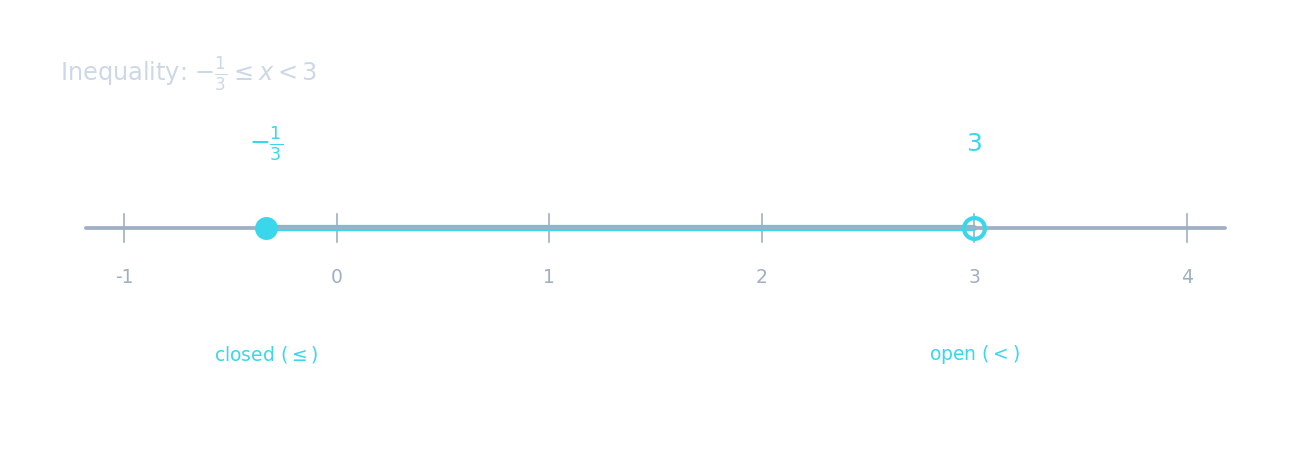
Number lines show patterns too: in a quadratic sequence, the gaps between terms grow steadily.
Half the second difference. The $n^2$ coefficient is $\dfrac{\text{second difference}}{2}$, not the second difference itself. For $2, 5, 10, 17$ the second difference is $2$, giving $n^2$ (not $2n^2$).
The nth term of 2, 5, 10, 17, … is n² + 1. What is the 5th term? · 2, 5, 10, 17, … 的第 n 项是 n² + 1。第 5 项是多少?
5² + 1 = 25 + 1 = 26.
In a quadratic sequence, the second differences are constant. · 在一个二次数列中,二阶差是恒定的。
The first differences change steadily, but the second differences (differences of differences) are constant. · 一阶差稳步变化,但二阶差(差的差)是恒定的。
Geometric sequences 等比数列
- Each term is multiplied by a fixed ratio: $3, 6, 12, 24, \dots$ (multiply by 2 each time).
- The nth term is $a \times r^{n-1}$, where $a$ is the first term and $r$ is the common ratio 公比.
- $3 \times 2^{n-1}$: $\;n=1 \Rightarrow 3$, $\;n=4 \Rightarrow 3 \times 8 = 24$. ✓
The nth term of 3, 6, 12, 24, … is 3 × 2^(n−1). What is the 6th term? · 3, 6, 12, 24, … 的第 n 项是 3 × 2^(n−1)。第 6 项是多少?
3 × 2⁵ = 3 × 32 = 96.
Find the fifth term of uₙ = n³ + 2. · 求 uₙ = n³ + 2 的第五项。
5³ + 2 = 125 + 2 = 127.
Cubes and a term-number check
- Core includes simple cubic sequences. $3,10,29,66$ are 2 more than $1^3,2^3,3^3,4^3$, so $u_n=n^3+2$. The fifth term is $u_5=125+2=127$.
- For $u_n=4n+3$, testing whether 100 is a term gives $4n+3=100$, so $n=24.25$. A term number must be a positive integer, so 100 is not in this sequence.
You've got it
- linear sequence: nth term $= dn + c$ (constant difference $d$) → $2,5,8,11 \to 3n-1$
- simple quadratic: second difference $= 2 \times$ the $n^2$ coefficient → $2,5,10,17 \to n^2 + 1$
- geometric: nth term $= a \times r^{n-1}$ (constant ratio $r$) → $3,6,12,24 \to 3 \times 2^{n-1}$