Diffusion · 扩散
| English | 中文 | Pinyin · 拼音 |
|---|---|---|
| diffusion/dɪˈfjuːʒn/ | 扩散 | kuò sàn |
| concentration gradient/ˌkɒnsənˈtreɪʃn ˈɡreɪdɪənt/ | 浓度梯度 | nóng dù tī dù |
| surface area/ˈsɜːfɪs ˈeərɪə/ | 表面积 | biǎo miàn jī |
How things move in and out of cells
- Cells constantly take in oxygen and food, and get rid of waste — without any pumps.
- Much of this happens by diffusion 扩散: things simply spreading out.
东西如何进出细胞
- 细胞不断摄取氧和食物,并排出废物——没有任何泵。
- 这大部分通过扩散(diffusion)发生:东西简单地散开。
Diffusion is the net movement of particles from a region of: · 扩散是颗粒从一个区域的净移动,这个区域是:
Particles move down the concentration gradient. · 颗粒沿浓度梯度向下移动。
Diffusion requires energy from the cell. · 扩散需要来自细胞的能量。
Diffusion is passive — it needs no energy from the cell. · 扩散是被动的——它不需要来自细胞的能量。
Diffusion is the ______ movement of particles down a concentration gradient. · 扩散是颗粒沿浓度梯度向下的______移动。
Particles move both ways, but the net flow is high to low. · 颗粒双向移动,但净流动是从高到低。
What diffusion is
- Diffusion is the net movement of particles from a region of high concentration to a region of low concentration.
- It happens because particles are always moving randomly, and it needs no energy from the cell.
Particles move down the concentration gradient 浓度梯度 until evenly spread.
扩散是什么
- 扩散是颗粒从高浓度区域到低浓度区域的净移动。
- 它发生是因为颗粒总是随机移动,而它不需要细胞的能量。
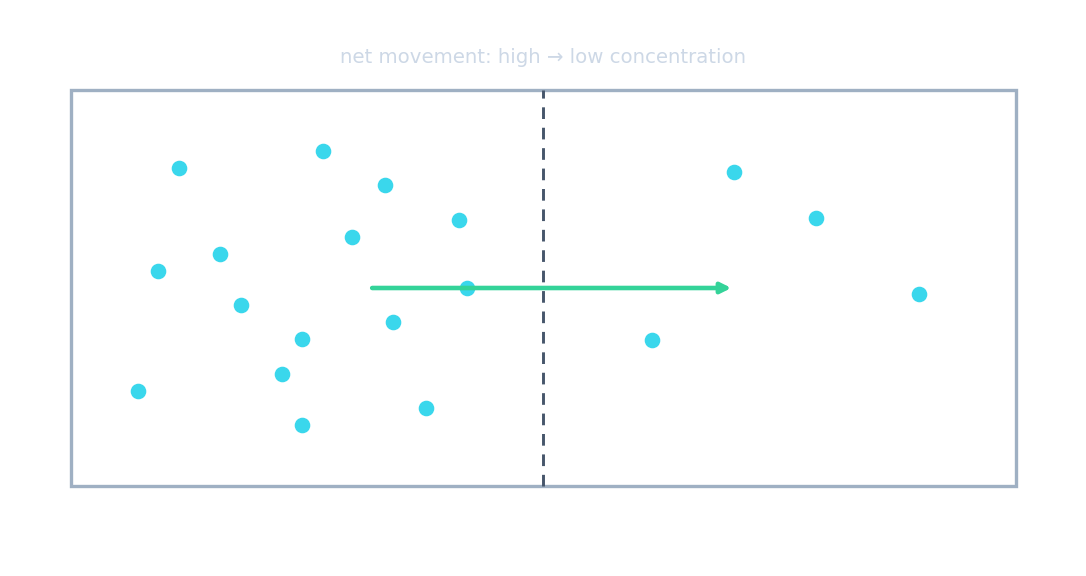
颗粒沿浓度梯度向下移动,直到均匀散开。
Diffusion · 扩散
net movement: high → low · 净移动:高 → 低
Particles spread down the gradient, from where they're crowded to where they're sparse. · 颗粒沿梯度向下散开,从拥挤的地方到稀疏的地方。
In a respiring cell, oxygen diffuses: · 在一个进行呼吸作用的细胞中,氧扩散:
Oxygen is used up inside, so it diffuses in down the gradient. · 氧在内部被用掉,所以它沿梯度向下扩散进来。
Diffusion in living things
- Oxygen diffuses into cells for respiration; carbon dioxide diffuses out.
- In the lungs, gut and leaves, diffusion moves substances across surfaces.
Plasmolysed cells: the contents have pulled away from the cell walls
活的东西中的扩散
- 氧扩散进细胞用于呼吸作用;二氧化碳扩散出来。
- 在肺、肠道和叶中,扩散把物质移过表面。

质壁分离的细胞:内容物已从细胞壁拉开
Which increase the rate of diffusion? (Select all that apply.) · 哪些增加扩散速率?(选择所有适用项。)
A thicker barrier slows diffusion; the others speed it up. · 一个更厚的屏障减慢扩散;其他的加快它。
What affects the rate
- Steeper concentration gradient → faster diffusion.
- Higher temperature → faster (particles move faster).
- Larger surface area 表面积 and shorter distance → faster.
Diffusion is the NET movement. Particles move both ways, but more move from high to low concentration. Once evenly spread, movement continues but there is no net change.
Diffusion: particles spread from higher to lower concentration, down the gradient
什么影响速率
- 更陡的浓度梯度 → 更快的扩散。
- 更高的温度 → 更快(颗粒移动得更快)。
- 更大的表面积和更短的距离 → 更快。
扩散是净移动。 颗粒双向移动,但更多从高浓度向低浓度移动。一旦均匀散开,移动继续但没有净变化。

扩散:颗粒从更高向更低浓度散开,沿梯度向下
You've got it
- diffusion = net movement from high to low concentration; no energy needed
- it supplies oxygen and removes carbon dioxide in cells
- rate rises with a steeper gradient, higher temperature, more surface area, shorter distance
你掌握了
- 扩散 = 从高到低浓度的净移动;不需要能量
- 它在细胞中供应氧并移除二氧化碳
- 速率随更陡的梯度、更高的温度、更多的表面积、更短的距离上升