| English | 释义 | 拼音 |
|---|---|---|
| evaluation/ɪˌvæljuːˈeɪʃn/ | 评估 | píng gū |
| self-management/self ˈmænɪdʒmənt/ | 自我管理 | zì wǒ guǎn lǐ |
| social awareness/ˈsəʊʃl əˈweənəs/ | 社会意识 | shè huì yì shí |
| error category/ˈerə ˈkætɪɡəri/ | 错误类别 | cuò wù lèi bié |
| capacity issue/kəˈpæsɪti ˈɪʃuː/ | 容量问题 | róng liàng wèn tí |
| cause hypothesis/kɔːz haɪˈpɒθəsɪs/ | 原因假设 | yuán yīn jiǎ shè |
| change log/tʃeɪndʒ lɒɡ/ | 变更记录 | biàn gēng jì lù |
| follow-up trial/ˈfɒləʊ ʌp ˈtraɪəl/ | 后续试用 | hòu xù shì yòng |
| comparability/ˌkɒmpərəˈbɪlɪti/ | 可比性 | kě bǐ xìng |
| revision record/rɪˈvɪʒn ˈrekɔːd/ | 修订记录 | xiū dìng jì lù |
Read the result before changing the design
This is original GAC031-aligned practice for unit 3.4, Revise and Update. It continues the fictional library sign project from units 3.1–3.3. It is not an ACT assessment.
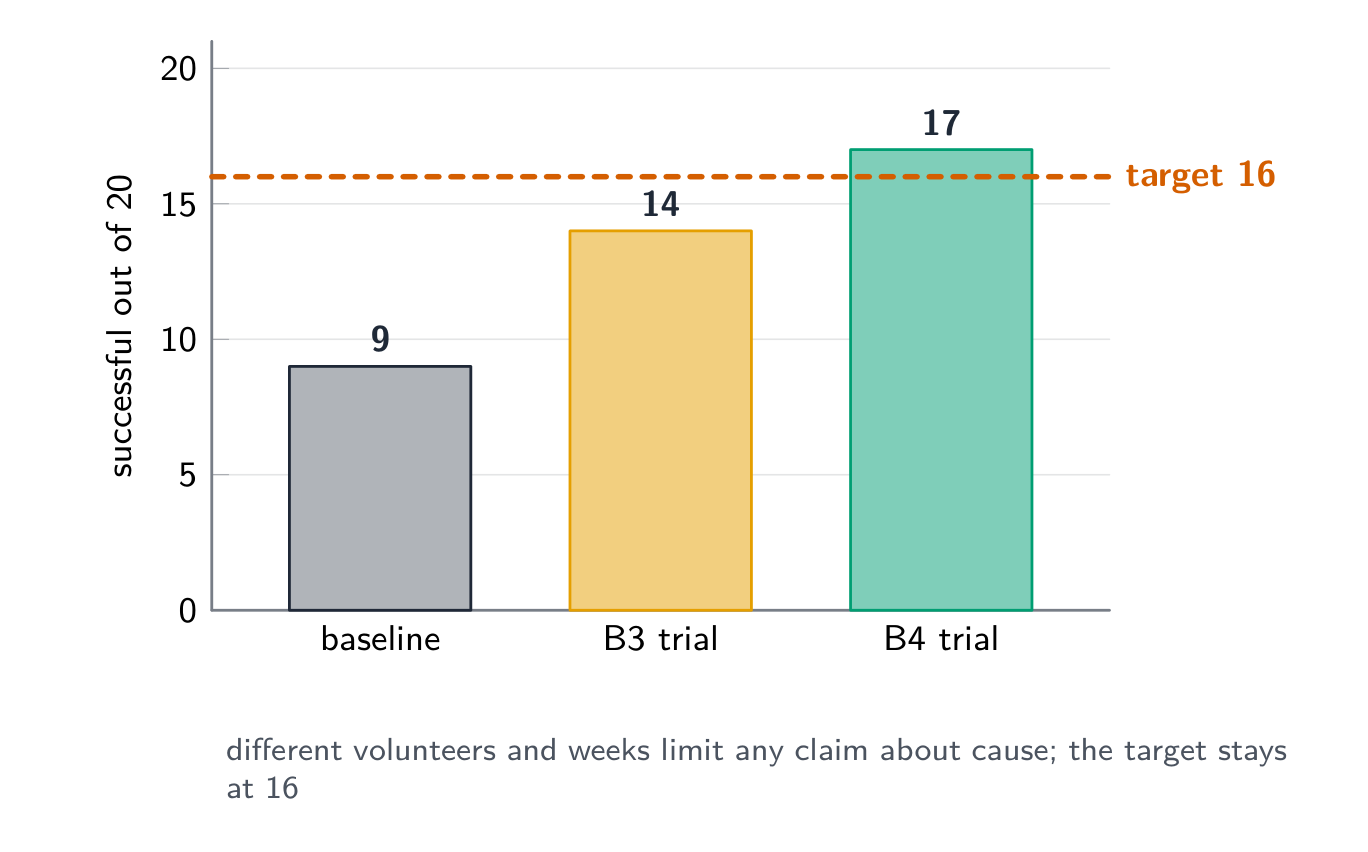
The signs were installed with the librarian's permission. In the one-week trial, 14 of 20 new volunteers found a suitable quiet or discussion area within two minutes. Before the signs, 9 of 20 volunteers had done so. The team records a gain of five successful attempts in equal-sized groups. Its target, written before the trial, was at least 16 of 20. The team did not reach it.
This evaluation 评估 is more useful than simply calling the design a success or a failure. The two groups were different people, and library use changed during exam week. The result suggests that the signs may have helped these volunteers. It does not prove the signs caused the full difference. The team keeps the target visible and asks what prevented the remaining six people from completing the task.
Missing a target is frustrating. The group practises self-management 自我管理 by discussing the result without blaming a teammate. It practises social awareness 社会意识 by listening to the volunteers' accounts, including a problem that a sign alone cannot solve. Those habits help the team revise the service rather than defend its first design.
Do not lower the target to 14 after seeing the result. A new target may be appropriate for a later project, but changing the original target now would hide what this trial actually achieved.
The new sign may be bright, but it cannot argue with the observation log.
B3 试用中,20 人有 14 人成功。对照原目标,小组应怎样报告?
难度 1/5 · 今日首次完成可获 100 金币及少量额外奖励
14 比 16 少 2。与先前一组相比多 5 人成功,是描述性证据;两组人不同,不能证明差距由标识造成。
Sort problems by what can be changed
Observers recorded what each unsuccessful volunteer did, without recording names. The six cases fall into an error category 错误类别 table:
| Observation | Number | First question for the team |
|---|---|---|
| Chose the discussion route when they needed quiet | 3 | Did the two arrows look too similar? |
| Passed the entrance sign without noticing it | 2 | Was the sign visible before the first choice? |
| Found the right room, but it was full | 1 | Can the service offer a nearby alternative? |
The last person knew the route but could not use the room. A bigger arrow would not create another seat. The team tells the librarian about this capacity issue 容量问题 rather than counting it as proof that the arrow is wrong. It also reads the volunteers' comments. One said the quiet arrow looked like part of the discussion arrow; another said the entrance sign was behind a display board.
An observation is not yet a cause. The team writes a cause hypothesis 原因假设: “The two arrows share a shape, so some people treat them as one route.” It can test that idea by changing the arrows while keeping other wording steady. If the error continues, the hypothesis needs another look.
哪两项回应与六份观察记录相符?
难度 2/5 · 今日首次完成可获 140 金币及少量额外奖励
三人走错路线提示需要检查标识排布;两人没看见标识提示需要检查位置。房间满员属于容量问题,姓名无需公布。
Make a version that answers the evidence
The group prepares version B4. B3 already had separate arrows, but several readers still treated them as one route. B4 puts more space between them and places “Quiet study” and “Discussion” directly beside the corresponding arrows. It also proposes moving the entrance sign to the wall before the first turn, where the display board cannot hide it. This move needs the librarian's approval because an approved position cannot be changed silently.
A change log 变更记录 keeps the decision clear:
| B3 problem | B4 change | Check |
|---|---|---|
| Three wrong turns between quiet and discussion | Space the arrows farther apart and align each word with its arrow | Ask a new user to point to each route |
| Two people missed the entrance sign | Move it before the choice point, if approved | Walk from the entrance and note when it becomes visible |
| One room was full | Ask the librarian about a backup room | Confirm an available alternative before promising one |
The team changes only what it can defend. It does not add an invented “space available” light, because no system currently reports room occupancy. A note saying “ask the desk if full” might help, but it is not the same as showing live availability. B3 remains in the folder, so the team can see what changed between versions.
B3 的 20 人中有 14 人成功;随后 B4 的 20 人中有 17 人成功。B4 组多几人成功?
难度 2/5 · 今日首次完成可获 140 金币及少量额外奖励
17 − 14 = 3。两组人数相同,但这个差值不能单独证明修改的因果效果。
Check the update under comparable conditions
After the librarian approves the new position, the team asks two people who did not see B3 to follow B4 on paper. Both understand the separate arrows. This quick check catches obvious wording problems; two people cannot establish the one-week target. The team then installs B4 and runs a follow-up trial 后续试用 with 20 other new volunteers.
To make the comparison useful, the team keeps the same entrance, task instructions and two-minute clock. It records when the trial happened and whether the rooms were available. This is comparability 可比性: the groups should face a similar task, even though the team cannot make two busy library weeks identical. Seventeen of 20 volunteers complete the task with B4. That meets the original numerical target in this second trial. It does not prove B4 alone caused every difference from B3; the sample, room use and time of week may also matter.
The team looks beyond the score. No one in the follow-up trial mistakes the quiet arrow for the discussion arrow, but one person still walks past the entrance sign. The revision appears to address one specific problem more convincingly than the other. The team keeps that remaining observation in the record instead of declaring the design perfect.
按照课文,把 B4 修改步骤排成正确顺序。
难度 3/5 · 今日首次完成可获 200 金币及少量额外奖励
观察到的问题指导 B4 修改;移动标识前须获批;小规模纸面检查应早于安装和更新版试用。
Decide what to keep and what to investigate
The librarian agrees to keep B4 in place for a longer observation period. The team records the approved file, its location, the date it was installed and who will check that it remains visible. The room-full case goes into a separate service question: can staff identify a nearby available room when the intended one is occupied? That question cannot be answered by the sign data alone.
The project folder now contains the original target, the B3 result, the six observation notes, the B4 change log, approval, and the B4 follow-up result. A revision record 修订记录 lets the next team understand why the sign looks as it does and what still needs attention. Unit 3.5 will turn this record into a short presentation and reflection.
Revision is a chain of reasons: compare with the original target → classify observed problems → propose a cause → change the relevant feature → get approval → test again → state the remaining limit.
由于 B4 的 20 名志愿者中有 17 人成功,小组可以说全部改善只由 B4 引起,而且标识不必继续观察。
难度 1/5 · 今日首次完成可获 100 金币及少量额外奖励
后一组达到了原数字目标,但志愿者与图书馆使用条件不同,不能据此断定因果关系。仍有一人错过入口标识,因此小组继续观察。