Advanced passive · 高级被动语态
The passive in any tense
- The passive isn't only present and past — it works in every tense.
- Just change be; the past participle stays the same.
- It has been done. It will be done. It is being done.
The cake had been eaten before anyone admitted to seeing it.
各种时态的被动
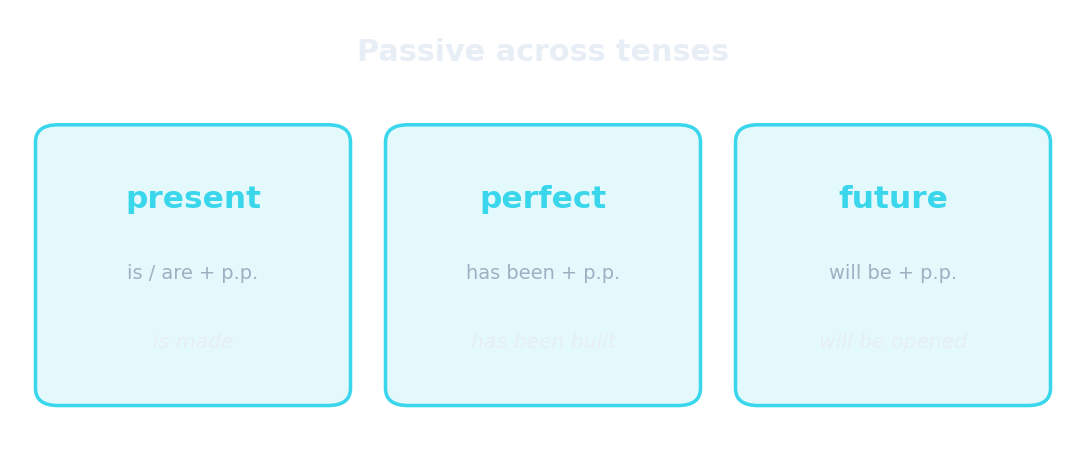
- 被动不只有现在和过去 —— 它可以用在任何时态。
- 只改变 be,过去分词保持不变。
- It has been done. It will be done. It is being done.
还没人承认看见蛋糕,它就已经被吃掉了。
Form across tenses
- Present perfect: has / have been + p.p. → The bridge has been repaired.
- Future: will be + p.p. → The work will be done soon.
- Modal: must / can be + p.p. → It must be finished today.
各时态的结构
- 现在完成:has / have been + 过去分词 → (冠词)The 桥bridge (完成)has (被动)been 修理repaired.(桥已经修好了。)
- 将来:will be + 过去分词 → The work will be done soon.
- 情态:must / can be + 过去分词 → It must be finished today.
Same passive, four tenses · 同一个被动,四种时态
The passive follows every tense — only 'be' changes its form; the past participle never moves. · 被动语态跟随所有时态——只有 be 在变形,过去分词永远不变。
Choose the present perfect passive: The bridge ___. · 选出现在完成时的被动:The bridge ___。
Present perfect passive = has/have been + past participle. · 现在完成被动 = has/have been + 过去分词。
Complete the future passive: The work will ___ done soon. (one word) · 补全将来被动:The work will ___ done soon。(一个词)
Future passive = will be + past participle: “will be done”. · 将来被动 = will be + 过去分词:will be done。
Passive reporting (it is said that …)
- To report a general opinion without naming who: It is said / believed / thought that ….
- Or: subject + is said / believed to + verb.
- It is said that he is rich. = He is said to be rich.
被动转述 (it is said that …)
- 转述大家的看法、却不点名是谁说时:It is said / believed / thought that …。
- 或者:主语 + is said / believed to + 动词。
- (形式主语)It (被动)is 说said (连词)that 他he 是is 富有rich.(据说他很有钱。)
Is “It is said that he is rich.” a correct passive reporting structure? · “It is said that he is rich.” 是正确的被动转述结构吗?
Yes — “It is said/believed/thought that …” reports an opinion impersonally. · 对 —— It is said/believed/thought that … 客观地转述看法。
Translate into English: 据说他很有钱。 · 翻译成英语:据说他很有钱。
Impersonal report → “It is said that he is very rich.” · 客观转述 → It is said that he is very rich。
Why use it
- Common in news and formal writing.
- It reports unconfirmed information objectively, without a source.
为什么用它
- 在新闻和正式写作里很常见。
- 它能客观地转述未经证实的信息,不指明来源。
Common mistakes
- ❌ The bridge has repaired. → ✓ The bridge has been repaired. — don't drop been.
- ❌ The problem must be solve. → ✓ …must be solved. — modal + be + participle.
- ❌ He is said that he is rich. → ✓ It is said that he is rich. / He is said to be rich.
常见错误
- ❌ The bridge has repaired. → ✓ The bridge has been repaired。—— 完成时被动最容易丢 been。
- ❌ The problem must be solve. → ✓ …must be solved。—— 情态被动 = 情态 + be + 过去分词。
- ❌ He is said that he is rich. → ✓ It is said that he is rich。/ He is said to be rich。—— 两种结构别拼在一起。
Match the tense to its passive shape. · 把时态和它的被动形式配对。
be carries the tense; the participle never changes. · be 承担时态变化;过去分词永远不变。
Complete with one word: The road is ___ repaired at the moment. · 填一个词:The road is ___ repaired at the moment.
Continuous passive: is / are being + participle. · 进行时被动:is / are being + 过去分词。
- Passive = be (any tense) + past participle.
- Perfect: has been + p.p.; future: will be + p.p.
- It is said that … reports an opinion impersonally.
- 被动 = be(任意时态)+ 过去分词。
- 完成:has been + 过去分词;将来:will be + 过去分词。
- It is said that … 客观地转述看法。
Write one passive sentence using a perfect or future tense (for example: “… has been built”, “… will be opened”). · 写一个被动句,用上完成时或将来时(例如:“… has been built”、“… will be opened”)。
Example: “A new library has been built in our town.” · 例如:A new library has been built in our town。