Your learning plan · Continue · Review →
The passive
IntroducedYour saved position stays in this browser. Resuming does not complete the lesson or answer its questions.
Choosing the topic and naming the doer
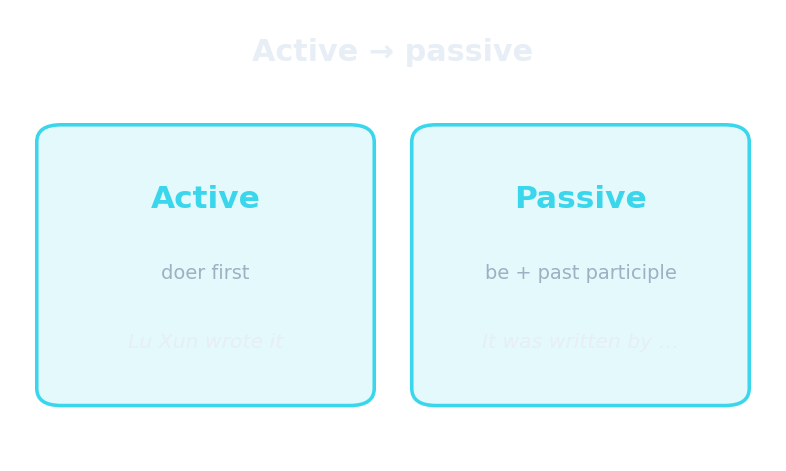
- A passive clause can keep a person, thing or event as the topic while presenting what happened to it. It can still name the doer: The painting was bought by a museum. Voice changes the presentation, not the truth of the report.
- English is spoken here. The window was broken.
- In the simple active/passive pairs here, the active object becomes the passive subject. This is a useful starting pattern, not a claim that every subject physically receives an action.
- Outcome: choose an active or passive report with clear event, time and responsibility. Start with past simple. Starting check: does The window was broken identify who broke it? The agent is not stated.
The cake was eaten; the suspect left crumbs.
Form: be + past participle
- be (in the right tense) + past participle.
- Present: is / are + p.p. → The cars are made here.
- Past: was / were + p.p. → The house was built in 1990.
Turn active into passive
Walk through one simple active/passive example: the active object becomes the passive subject, while the report can retain the named agent. This does not change its truth.
Make it passive: “People speak English here.”
Difficulty 1/5 · 100 coins + a small bonus on first completion today
Passive = be + past participle: “English is spoken here.”
Complete: The window was ___ (break) yesterday.
Difficulty 1/5 · 100 coins + a small bonus on first completion today
was + past participle: break → broken.
by + the doer
- A by phrase can name the agent: The painting was bought by a museum. Naming a relevant doer can clarify responsibility, even in a passive report.
- This book was written by Lu Xun.
- You may omit an unknown, obvious or irrelevant agent. Do not invent one from the passive form; if responsibility matters, say what the source establishes.
Do we use “by” to say who did the action?
Difficulty 1/5 · 100 coins + a small bonus on first completion today
Yes — “by + the doer”: “It was written by Lu Xun.”
Translate into English: 这本书是鲁迅写的。
Difficulty 3/5 · 200 coins + a small bonus on first completion today
The passive reference keeps the book as topic and names the author with by. The active “Lu Xun wrote this book” can also translate the message naturally; voice is a presentation choice, not a truth guarantee.
When to use it
- The doer is unknown or unimportant: The road was repaired.
- You want to focus on the receiver: The painting was bought by a museum.
Common mistakes
- ❌ The window was broke. → ✓ The window was broken. — the passive needs the participle.
- ❌ The accident was happened. → ✓ The accident happened. — happen has no passive.
- To describe your birth with born, use I was born in 2008, not I born. Other English expressions, such as My birth took place in 2008, are possible; not every statement about birth must be passive.
- Near miss: The road was repaired by the council adds an agent absent from The road was repaired. Use the agent only if your source identifies it; a grammatical addition can still invent a fact.
Match the active sentence to its passive.
Difficulty 2/5 · 140 coins + a small bonus on first completion today
These simple object-taking active examples have the supplied passive partners. The active object becomes the passive subject, with be + participle. Do not infer an unnamed agent or assume every English verb has a natural passive.
Complete: This book was ___ by Lu Xun. (write)
Difficulty 1/5 · 100 coins + a small bonus on first completion today
write – wrote – written: the passive takes the third form.
- In these simple patterns, passive = be + past participle. Check the whole verb frame and whether the verb permits the intended passive.
- Add by + the doer only if it matters.
- Choose voice for the topic and relevant responsibility. Later recall: rewrite a new repair notice in two voices without inventing an agent. Continue with advanced passive reporting to distinguish impersonal wording from reliable evidence.
Usage guidance checked 2026-10-20: British Council, passives. Local source checks; independent language, answer and learner review pending.
Write one passive sentence about something that is made, grown or built (for example: “Rice is grown in …”).
Difficulty 3/5 · 200 coins + a small bonus on first completion today
Example: “Tea is grown in many countries.”
Three worked choices: topic, roles and missing information
1. Change the topic, keep the facts
Source: Tariq repaired the club’s kite on Tuesday. If the reader asks about the kite, The club’s kite was repaired by Tariq on Tuesday puts it first while retaining the repairer and day. The kite was repaired by the owner is a weaker rewrite: it replaces a supplied name with an unsupported identity. Voice is a choice about presentation, not permission to improve the story.
2. An unnamed agent is not no agent
Someone moved the music stand yesterday can become The music stand was moved yesterday. The identity is still unknown. The stand moved the volunteer reverses the roles; The caretaker moved the stand invents an agent. If the task needs credit or responsibility and the source names a person, keep that information. The music stand has not volunteered its own witness statement.
3. Not every verb needs a passive
A delay happened at noon reports an event using the ordinary active pattern for happen. Adding was does not produce a natural passive of that verb in this use. Compare the object-taking action A volunteer packed the boxes → The boxes were packed by a volunteer. Choose a suitable verb frame and keep the same relationship; a formal-looking extra word is not automatically an improvement.
Use the guided choices to check the event, affected thing, agent and time. Suggested study: two sessions of about 25 minutes including writing and revision; this is an unmeasured local planning allowance, not official timing.
A note says, “Mara packed the tents on Monday.” Rewrite it with the tents as topic while keeping the named packer and day.
Difficulty 1/5 · 100 coins + a small bonus on first completion today
Were packed keeps the past event, by Mara retains the stated agent, and on Monday preserves the day. A new name or every Monday would change facts, not merely voice. Check event, agent and time separately.
“Someone moved the noticeboard yesterday.” No identity is known. Which passive keeps that information?
Difficulty 1/5 · 100 coins + a small bonus on first completion today
Was moved presents the noticeboard as topic without inventing a known agent. The headteacher is not identified, and the active self-moving daily event changes the original message. Unknown does not mean nobody acted.
Use the simple-past passive of take: “The photograph was ___ on Sunday.”
Difficulty 1/5 · 100 coins + a small bonus on first completion today
Was + taken gives the requested passive. Took is the simple-past form; taking would require a different construction. Read the complete frame, not only the past time word.
“The key was found by Jo.” Who is the named finder?
Difficulty 1/5 · 100 coins + a small bonus on first completion today
By Jo identifies the agent in this sentence. The key is the thing found and the grammatical subject. Passive voice can retain a relevant doer; it does not always hide one.
The source says, “A loud crash happened at noon.” Which report preserves the intended verb pattern?
Difficulty 1/5 · 100 coins + a small bonus on first completion today
Happened is the ordinary active pattern for this event; happen does not take a passive in this use. Adding was is not a general way to make a report more formal. Repaired changes the event entirely.
A process description says, “Workers wash these jars here every morning.” Which passive keeps the routine?
Difficulty 1/5 · 100 coins + a small bonus on first completion today
Are washed preserves the present routine and the jars as the affected things. The other options change the time/frequency or reverse who acts on what. Choose voice after preserving the relationship.
Independent reports and a topic-first note
Read each fresh report as a whole. Identify the supplied information before choosing an active or passive version. In your English note, make the borrowed tent the topic while retaining the named repairer. Separate missing payment information from a claim that a bill was paid or that the work was free.
The question is “What happened to the borrowed tent?” Facts: Rafi dried it yesterday. Which reply makes the tent the topic and retains the known agent?
Difficulty 1/5 · 100 coins + a small bonus on first completion today
The tent-first passive answers the topic question and keeps Rafi and yesterday. Calling the agent unknown loses supplied information; the future promise changes the event time. Active wording could be natural in another context, but this task explicitly asks for the tent as topic.
“The parcel was collected at three.” Which detail would require more information?
Difficulty 1/5 · 100 coins + a small bonus on first completion today
The passive reports an event and time but omits the collector. It does not identify a driver, neighbour or staff member. Keep the unknown agent unknown rather than filling it from a plausible story.
A report says, “The volunteer folded the blankets.” Which version reverses the supplied roles?
Difficulty 1/5 · 100 coins + a small bonus on first completion today
The volunteer is the actor and blankets are affected in the source. Making the volunteer the thing folded changes the event. The correct passive and original active can both report the supplied relationship; voice alone does not reverse roles.
A guide says, “The plates are made in this workshop.” Which paraphrase keeps the location without inventing a person?
Difficulty 1/5 · 100 coins + a small bonus on first completion today
The generic people supplies no specific new identity and keeps the workshop location. The owner-alone claim adds unsupported responsibility; the other option changes place and time. This is a natural meaning-preserving active alternative.
“The banner was designed by Ema, but painted by a community group.” Which summary preserves both roles?
Difficulty 1/5 · 100 coins + a small bonus on first completion today
The two by phrases assign different actions to different agents. Preserve each action/agent pair. Combining all work under Ema or swapping the agents changes responsibility, even if the result is a fluent sentence.
A learner writes, “I was born in 2011.” Which comment is accurate?
Difficulty 1/5 · 100 coins + a small bonus on first completion today
Was born is the ordinary frame here. It does not make alternatives such as My birth was in 2011 impossible, and it does not report a later house move. Learn the useful expression without turning it into a universal rule about all wording.
“The cupboard was opened at ten, but the missing folder was not found.” Which update goes beyond the facts?
Difficulty 1/5 · 100 coins + a small bonus on first completion today
Opening and finding are separate events. The first claim invents a successful resolution despite the stated not-found result. Passive form does not license adding an outcome. Keep the event and result separate.
The source states, “Inez repaired the puppet.” A rewrite says, “The puppet was repaired.” What information has been omitted?
Difficulty 1/5 · 100 coins + a small bonus on first completion today
The short passive keeps the repair and puppet but omits Inez. That may suit some contexts, but it is a real information choice. If responsibility or credit matters, retain by Inez or use the original active.
Facts: Imani repaired the borrowed tent on Wednesday; the torn panel was replaced; no payment information is given. Write a 3–4 sentence English note for the tent’s owner. Make the tent the topic of one passive sentence, retain the named repairer and day, and keep the panel work distinct from any unstated payment. Compare, then revise one changed agent, time or added fact.
Compare the source facts, topic, agent, reference time and status. This is local written self-review, not automatic correctness, a speaking assessment or a proficiency result.
Transfer: update only what the source adds
A later source may identify an agent or confirm a result. Add that new information without replacing the original event or inventing another consequence. In your club update, keep the unknown mover separate from the known contents check and propose a useful way to find the missing information.
A first notice says, “The costumes were washed.” A later signed note identifies the washing team as the drama club. You must credit the supplied team without changing the event. Which revision fits?
Difficulty 1/5 · 100 coins + a small bonus on first completion today
The later note supplies the agent, so adding by the drama club is supported. A commercial provider/payment or a new future washing is not supplied. Update only the information the new source actually adds.
The hall log says, “The screen was damaged during transport; the responsible person is unknown.” Which message preserves that limit?
Difficulty 1/5 · 100 coins + a small bonus on first completion today
The log gives damage and context, not a responsible person. Unknown is different from no person or a confirmed driver. Preserve the limit when writing a practical update; a grammatical by phrase is not evidence.
Facts: the club’s display case was moved on Thursday; nobody in the supplied report knows who moved it; a later check confirms that the contents are still inside. Write a 3–4 sentence English update for club members with a passive report, the unknown agent and the later contents check kept clear. Give a useful next check without blaming a person. Compare and revise one invented agent or result.
Compare the source facts, topic, agent, reference time and status. This is local written self-review, not automatic correctness, a speaking assessment or a proficiency result.
Later retrieval and the next report
On a later study day, try the two review reports before rereading. Explain what voice changes and which facts it must preserve, then compare the feedback. These familiar cards support retrieval rather than reserved assessment or a proficiency claim. Delayed-recall evidence requires an earlier successful attempt on an earlier session day. Continue with advanced passive reports to distinguish ongoing work, completion, requirements and reported claims.
“Lena collected the notebooks on Friday.” Choose the notebook-first version that preserves both supplied agent and time.
Difficulty 1/5 · 100 coins + a small bonus on first completion today
Were collected keeps the past event; by Lena and on Friday preserve the supplied details. The alternatives change frequency or remove the known name. Recover the source facts before selecting the passive frame.
“The room was cleaned” does not name a cleaner. Which conclusion is justified?
Difficulty 1/5 · 100 coins + a small bonus on first completion today
An omitted agent remains unidentified. It is not proof of no action or proof of a familiar likely worker. Voice controls presentation; further facts need a source.