The passive · 被动语态
When the action matters, not the doer
- The passive focuses on what happens to something, not on who does it.
- English is spoken here. The window was broken.
- The receiver of the action becomes the subject.
The cake was eaten; the suspect left crumbs.
重要的是动作,不是谁做的
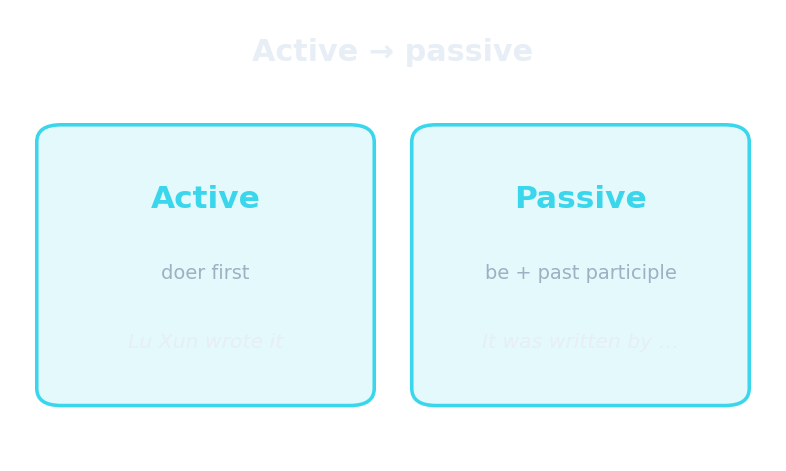
- 被动语态 (the passive) 强调"发生了什么",而不是"谁做的"。
- 英语English (被动)is 说spoken 这里here.(这里讲英语。)
- 动作的承受者成了主语。
蛋糕被吃了;嫌疑人留下了碎屑。
Form: be + past participle
- be (in the right tense) + past participle.
- Present: is / are + p.p. → The cars are made here.
- Past: was / were + p.p. → The house was built in 1990.
结构:be + 过去分词
- be(用正确的时态)+ 过去分词。
- 现在:is / are + 过去分词 → The cars are made here.
- 过去:was / were + 过去分词 → (冠词)The 窗户window (被动)was 打破broken.(窗户被打破了。)
Turn active into passive · 把主动句变成被动句
The object moves to the front, and the verb becomes be + past participle. · 宾语移到前面,动词变成 be + 过去分词。
Make it passive: “People speak English here.” · 改成被动:“People speak English here.”
Passive = be + past participle: “English is spoken here.” · 被动 = be + 过去分词:English is spoken here。
Complete: The window was ___ (break) yesterday. · 填空:The window was ___ (break) yesterday。
was + past participle: break → broken. · was + 过去分词:break → broken。
by + the doer
- Add by to say who did it — if it matters.
- This book was written by Lu Xun.
- If the doer is unknown or unimportant, leave it out.
by + 动作执行者
- 用 by 说明是谁做的 —— 如果重要的话。
- 这This 书book (被动)was 写written 被by 鲁迅Lu Xun.(这本书是鲁迅写的。)
- 如果执行者不重要,就省略。
Do we use “by” to say who did the action? · 我们用 by 来说明动作是谁做的,对吗?
Yes — “by + the doer”: “It was written by Lu Xun.” · 对 —— by + 动作执行者:It was written by Lu Xun。
Translate into English: 这本书是鲁迅写的。 · 翻译成英语:这本书是鲁迅写的。
Passive + by: “This book was written by Lu Xun.” · 被动 + by:This book was written by Lu Xun。
When to use it
- The doer is unknown or unimportant: The road was repaired.
- You want to focus on the receiver: The painting was bought by a museum.
什么时候用
- 不知道、或不重要是谁做的:The road was repaired.(路被修好了。)
- 想强调承受者:The painting was bought by a museum.
Common mistakes
- ❌ The window was broke. → ✓ The window was broken. — the passive needs the participle.
- ❌ The accident was happened. → ✓ The accident happened. — happen has no passive.
- Remember: ✓ I was born in 2008. — always passive in English.
常见错误
- ❌ The window was broke. → ✓ The window was broken。—— 被动用过去分词,不是过去式。
- ❌ The accident was happened. → ✓ The accident happened。—— happen 是不及物动词,没有被动。
- 记住:✓ I was born in 2008。—— 中文"出生"是主动,英语永远用被动。
Match the active sentence to its passive. · 把主动句和它的被动句配对。
The object moves to the front; be takes the tense; the verb becomes a participle. · 宾语提前作主语;be 承担时态;动词变过去分词。
Complete: This book was ___ by Lu Xun. (write) · 填空:This book was ___ by Lu Xun.(write)
write – wrote – written: the passive takes the third form. · write – wrote – written:被动用第三列过去分词。
- Passive = be + past participle (be carries the tense).
- Add by + the doer only if it matters.
- Use it when the doer is unknown/unimportant or to focus on the receiver.
- 被动 = be + 过去分词(be 承担时态)。
- 只在重要时加 by + 动作执行者。
- 当执行者不重要,或想强调承受者时使用。
Write one passive sentence about something that is made, grown or built (for example: “Rice is grown in …”). · 写一个被动句,说说某样东西是被制造、种植或建造的(例如:“Rice is grown in …”)。
Example: “Tea is grown in many countries.” · 例如:Tea is grown in many countries。