Reported speech · 间接引语
Telling people what others said
- Reported speech tells what someone said — without quotation marks.
- Direct: "I am tired," he said.
- Reported: He said he was tired.
He said he was early. The clock reported a different story.
转述别人说的话
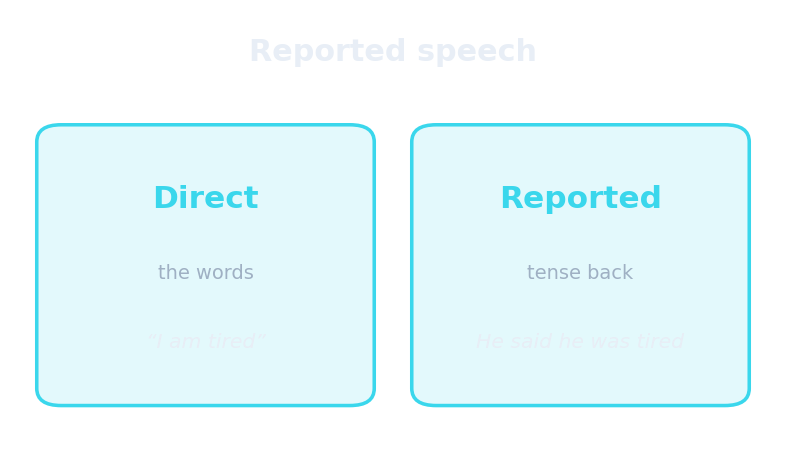
- 间接引语 (reported speech) 用来转述别人说过的话 —— 不用引号。
- 直接引语:"I am tired," he said.
- 间接引语:他He 说said 他he (过去)was 累tired.(他说他累了。)
他说自己来得早;时钟却讲了另一个故事。
say and tell
- say (that) … — no listener: She said she was busy.
- tell someone (that) … — with a listener: She told me she was busy.
- that can be left out.
say 和 tell
- say (that) … —— 不接听话人:She said she was busy.
- tell 某人 (that) … —— 要接听话人:她She 告诉told 我me 她she (过去)was 忙busy.(她告诉我她很忙。)
- that 可以省略。
Complete with say or tell: He ___ me that he was busy. · 用 say 或 tell 填空:He ___ me that he was busy。
“tell” takes a listener (me): “He told me …”. “say” does not. · tell 后面跟听话人(me):He told me …。say 不接听话人。
Tense backshift
- When the reporting verb is past (said, told), the tense moves back one step.
- am / is → was; are → were; will → would; can → could.
- present perfect / past simple → past perfect.
时态后移
- 引述动词是过去时(said、told)时,从句时态往后退一步。
- am / is → was;are → were;will → would;can → could。
- 现在完成 / 一般过去 → 过去完成。
Direct → reported speech · 直接引语 → 间接引语
Shift the tense back, change the pronoun, and adjust time words. · 时态后移、人称变化、时间词调整。
Report this: She said, “I will help you.” · 转述这句:She said, “I will help you.”
After “said”, will moves back to would: “She said she would help me.” · said 之后 will 后移为 would:She said she would help me。
Translate into English: 他说他累了。 · 翻译成英语:他说他累了。
Backshift after “said”: is → was: “He said he was tired.” · said 之后时态后移:is → was:He said he was tired。
Pronouns and time words change
- I → he / she, you → me, my → his / her.
- now → then, today → that day, tomorrow → the next day.
人称和时间词也要变
- I → he / she、you → me、my → his / her。
- now → then、today → that day、tomorrow → the next day。
In reported speech, does “tomorrow” often change to “the next day”? · 在间接引语里,“tomorrow” 常变成 “the next day” 吗?
Yes — time words shift too: tomorrow → the next day, now → then. · 对 —— 时间词也要变:tomorrow → the next day,now → then。
Common mistakes
- ❌ He said me that he was busy. → ✓ He told me… / He said… — tell takes a person, say doesn't.
- ❌ She asked me where did I live. → ✓ …where I lived. — statement order, no did.
- ❌ He said he will come tomorrow. → ✓ …he would come the next day.
常见错误
- ❌ He said me that he was busy. → ✓ He told me… / He said…—— tell 接人,say 不接人。
- ❌ She asked me where did I live. → ✓ …where I lived。—— 转述疑问句用陈述语序,did 消失。
- ❌ He said he will come tomorrow. → ✓ …he would come the next day。—— 时态和时间词一起后移。
Match the direct speech to its reported form. · 把直接引语和转述后的句子配对。
Backshift: am → was, will → would, can → could. · 时态后移:am → was、will → would、can → could。
Report the question: “Are you busy?” · 转述这个问题:“Are you busy?”
Yes/no questions report with if / whether + statement order. · 一般疑问句用 if / whether + 陈述语序转述。
- say (no listener) / tell + someone.
- Past reporting verb → backshift (is → was, will → would).
- Pronouns and time words change too (tomorrow → the next day).
- say(不接听话人)/ tell + 某人。
- 引述动词为过去时 → 时态后移(is → was,will → would)。
- 人称和时间词也变(tomorrow → the next day)。
Think of something a friend said. Report it in one sentence using “said” or “told” (with backshift). · 想想朋友说过的一句话。用 said 或 told 转述成一句话(注意时态后移)。
Example: “My friend told me she had passed the exam.” · 例如:My friend told me she had passed the exam。