Past perfect — the past before the past · 过去完成时 — 过去的过去
Which happened first?
- The past perfect is for an action that happened before another past action.
- When I arrived, the train had already left.
- It puts two past events in order.
By the time I reached the station, the train had started its own adventure.
哪件事先发生?
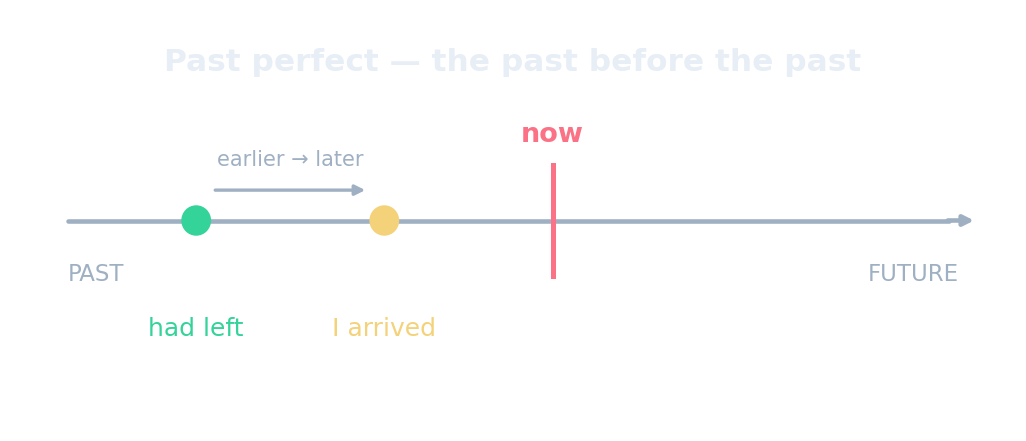
- 过去完成时 (past perfect) 表示在另一个过去动作之前已经发生的事。
- 当...时When 我I 到达arrived (冠词), the 火车train (过去完成)had 离开left.(我到的时候,火车已经开走了。)
- 它把两件过去的事排出先后。
等我到车站时,火车早就开启了自己的旅程。
Form: had + past participle
- had + past participle, the same for every subject.
- I had finished. She had gone. They had eaten.
- Short form: I'd, she'd, they'd.
结构:had + 过去分词
- had + 过去分词,所有人称都一样。
- 她She (过去完成)had 去了gone 家home.(她已经回家了。)
- 缩写:I'd、she'd、they'd。
Complete: When we got home, the guests had already ___ (leave). · 填空:When we got home, the guests had already ___ (leave)。
had + past participle: leave → left. · had + 过去分词:leave → left。
Which happened first?
- The earlier action → past perfect (had done).
- The later action → past simple (did).
- The film had started when we arrived. (started first)
谁先发生?
- 更早的动作 → 过去完成时(had done)。
- 较晚的动作 → 一般过去时(did)。
- The film had started when we arrived.(我们到时电影已经开始了。)
Two past events, in order · 两件过去的事,按先后
The earlier action takes the past perfect; the later one takes the past simple. · 更早的动作用过去完成时,较晚的用一般过去时。
Which happened FIRST? “When I arrived, the train had left.” · 哪件事先发生? “When I arrived, the train had left.”
“had left” (past perfect) is the earlier action — it happened first. · had left(过去完成时)是更早的动作,先发生。
Does the past perfect show the EARLIER of two past actions? · 过去完成时表示两个过去动作中更早的那个,对吗?
Yes — past perfect (had + p.p.) = the action that happened first. · 对 —— 过去完成时(had + 过去分词)= 先发生的那个动作。
Translate into English: 我到的时候,火车已经开走了。 · 翻译成英语:我到的时候,火车已经开走了。
Earlier action → past perfect: “When I arrived, the train had left.” · 更早的动作 → 过去完成时:When I arrived, the train had left。
When you need it
- Use it when the order matters or could be confusing.
- A simple story in order can stay in the past simple.
什么时候用
- 当先后顺序重要、或可能引起混淆时才用。
- 按顺序讲的简单故事,可以都用一般过去时。
Common mistakes
- ❌ After he had left, I had cleaned the room. → only the earlier action takes had.
- ❌ I had seen this film. (no other past event) → ✓ I have seen this film.
- by the time + past simple → the other action usually takes the past perfect.
常见错误
- ❌ After he had left, I had cleaned the room. → 只有更早的动作用 had,不是两个都用。
- ❌ I had seen this film.(没有别的过去事件)→ ✓ I have seen this film。—— 过去完成时必须有过去参照点。
- by the time + 过去时 → 另一个动作通常用过去完成时。
By the time we arrived, the film ___ .
The start came before our arrival — earlier of two past events → past perfect. · 电影开始在我们到达之前——两个过去事件中更早的用过去完成时。
Two past actions told in the order they happened — do you NEED the past perfect? · 两件过去的事按发生顺序讲——必须用过去完成时吗?
No — in-order stories use the past simple. The past perfect is for jumping back. · 不必——按顺序叙述用一般过去时;过去完成时用于"倒回去"补充更早的事。
- Past perfect = had + past participle = the past before the past.
- Earlier action → past perfect; later action → past simple.
- Use it when the order of two past events matters.
- 过去完成时 = had + 过去分词 = 过去的过去。
- 更早的动作 → 过去完成时;较晚的 → 一般过去时。
- 当两件过去事的顺序重要时使用。
Write one sentence about two past events, using the past perfect for the one that happened first. · 写一句话,讲两件过去的事,把先发生的那件用过去完成时。
Example: “The class had started when I arrived.” · 例如:The class had started when I arrived。