used to — past habits · used to — 过去的习惯
How things used to be
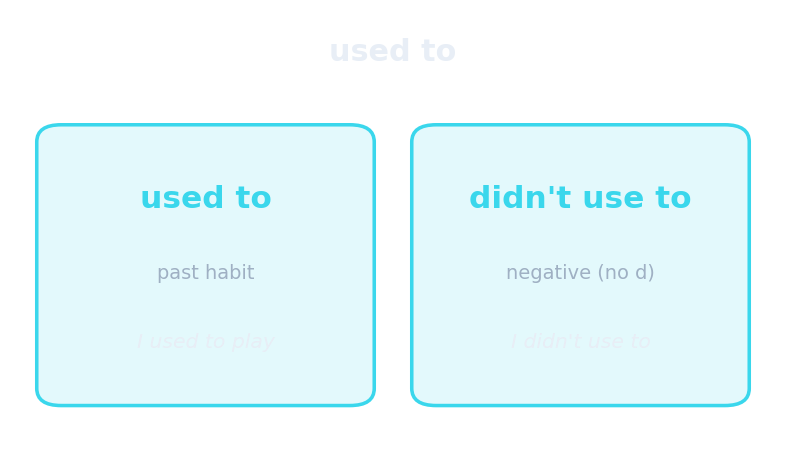
- used to describes a past habit or state that is now over.
- I used to play football. There used to be a shop here.
- It tells us "before, but not now".
I used to wake early; my alarm clock misses that version of me.
过去是什么样
- used to 表示过去经常做、现在不再做的习惯,或过去的状态。
- 我I 过去常used to 踢play 足球football.(我过去常踢足球。)
- 它表示"以前是这样,现在不是了"。
我过去常早起;闹钟很怀念那时的我。
Form: used to + base verb
- used to + base verb, the same for every subject.
- She used to live in Paris. We used to walk to school.
- Not used to played — the verb stays in its base form.
结构:used to + 动词原形
- used to + 动词原形,所有人称一样。
- 她She 过去used to 住live 在in 巴黎Paris.(她以前住在巴黎。)
- 不是 ~~used to played~~ —— 动词保持原形。
Which sentence is correct? · 哪一句正确?
used to + base verb: “I used to play football.” · used to + 动词原形:I used to play football。
Translate into English: 我过去常踢足球。 · 翻译成英语:我过去常踢足球。
Past habit → used to + base verb: “I used to play football.” · 过去的习惯 → used to + 动词原形:I used to play football。
Negatives & questions: didn't use to
- Negative: didn't use to + base verb.
- Question: Did … use to …?
- Careful: here it's use to (no "d") after did.
否定与疑问:didn't use to
- 否定:didn't use to + 动词原形。
- 疑问:Did … use to …?
- 注意:did 后面是 use to(没有 d)。
used to — correct or wrong? · used to —— 对还是错?
used to + base verb; the negative/question is 'use to' (no d). · used to + 动词原形;否定/疑问是 use to(没有 d)。
Make it negative: I ___ use to like coffee. (didn't / wasn't) · 改成否定:I ___ use to like coffee。(didn't / wasn't)
Negative = didn't use to (no “d” on use). · 否定 = didn't use to(use 不加 d)。
Only the past
- used to is only for the past.
- For a habit you have now, use the present simple.
- I used to swim a lot. → now: I swim sometimes.
只讲过去
- used to 只用于过去。
- 讲现在的习惯,用一般现在时。
- I used to swim a lot. → 现在:I swim sometimes.
Can “used to” describe a habit you have NOW? · “used to” 能描述你现在的习惯吗?
No — used to is only for the past. For now, use the present simple. · 不能 —— used to 只讲过去。讲现在用一般现在时。
Common mistakes
- ❌ I am used to play football. → two different patterns: used to play (past habit) vs am used to playing (accustomed to).
- ❌ I use to get up early. (about now) → ✓ I usually get up early. — no present form of used to.
- ❌ She used to living here. → ✓ She used to live here.
常见错误
- ❌ I am used to play football. → 两个不同结构:used to play(过去常做)vs am used to playing(习惯于)。
- ❌ I use to get up early.(说现在)→ ✓ I usually get up early。—— used to 没有现在时。
- ❌ She used to living here. → ✓ She used to live here。—— used to 后接原形。
Match each sentence to its meaning. · 把句子和它的含义配对。
used to + base = past habit; be used to + noun/-ing = accustomed; usually = present habit. · used to + 原形 = 过去习惯;be used to + 名词/-ing = 习惯于;usually = 现在习惯。
Complete: I ___ use to like coffee, but now I love it. · 填空:I ___ use to like coffee, but now I love it.
Negative: didn't use to (no d on use). · 否定:didn't use to(use 后面没有 d)。
- used to + base verb = a past habit or state, now finished.
- Negative / question: didn't use to / Did … use to …? (no "d").
- Only for the past — present habits use the present simple.
- used to + 动词原形 = 过去的习惯或状态,现在已结束。
- 否定 / 疑问:didn't use to / Did … use to …?(没有 d)。
- 只讲过去 —— 现在的习惯用一般现在时。
Write one sentence about something that was different in the past, using “used to”. · 用 used to 写一句话,说说过去和现在不一样的一件事。
Example: “I used to be afraid of dogs.” · 例如:I used to be afraid of dogs。