| English | 释义 | 拼音 |
|---|---|---|
| devshirme/ˈdevʃɜːm/ | 德夫希尔梅制度 | dé fū xī ěr méi zhì dù |
| tax farming/tæks ˈfɑːmɪŋ/ | 包税制 | bāo shuì zhì |
A Christian boy becomes the sultan's architect, about 1512
- Around 1512, Ottoman officials took a Christian boy named Joseph from a village in Anatolia. Under the devshirme 德夫希尔梅制度 system, he was converted to Islam, trained, and served as a military engineer. As Mimar Sinan, he became chief architect to the sultan and designed over 300 buildings, including the Süleymaniye Mosque. The system took boys from Christian families and made them loyal servants of the sultan alone.
- From 1450 to 1750, land-based empires solved the same problems — staff, revenue and legitimacy — in different ways.
Sinan designed over 300 buildings. If he worked for about 50 years, about how many buildings per year?
难度 2/5 · 今日首次完成可获 140 金币及少量额外奖励
300 ÷ 50.
Compare methods, not empires
- Every empire needed loyal officials and soldiers, money and a reason for people to obey.
- A good comparison asks how each empire did one of these jobs.
Military and administrative methods
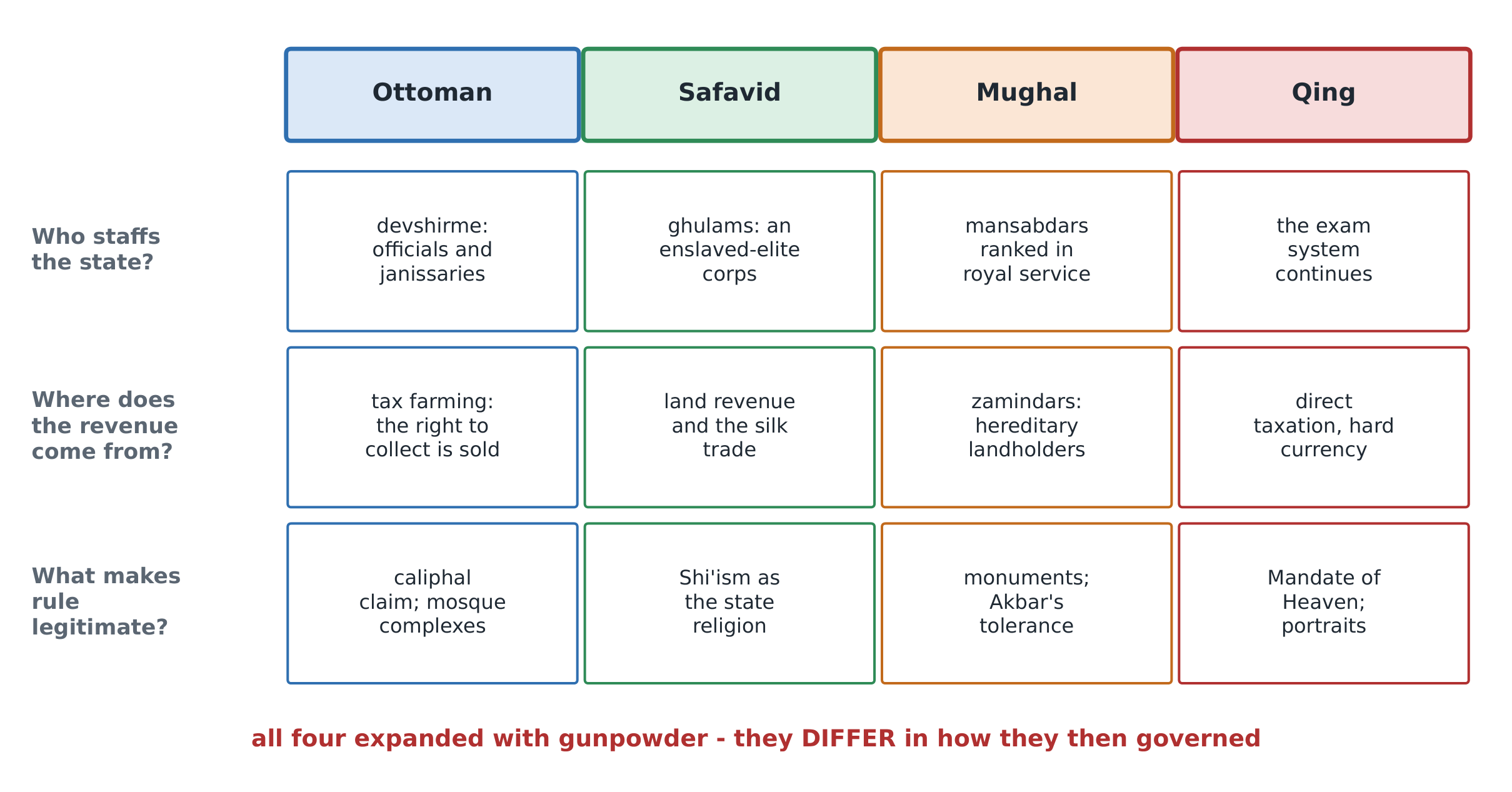
- The Ottomans' devshirme produced the Janissaries, elite infantry loyal only to the sultan.
- The Qing used civil service exams; the Mughals ranked nobles in a system of military grades.
Which method is this?
Sort each imperial action into the unit's four methods.
What was the devshirme?
难度 1/5 · 今日首次完成可获 100 金币及少量额外奖励
It produced the Janissaries.
Worked example: comparing revenue methods
- Ottoman: tax farming 包税制 — the state sold the right to collect taxes to private collectors, who paid in advance and kept what they collected above that amount.
- Mughal: the zamindars, local landholders, collected land taxes from peasants for the emperor.
- Comparison: both used local agents to collect taxes over large lands; this gave quick revenue but let collectors overcharge peasants.
What was one problem with tax farming?
难度 1/5 · 今日首次完成可获 100 金币及少量额外奖励
Quick revenue but abuses.
Ideological methods
- Qing emperors commissioned portraits and ceremonies showing them as Confucian rulers.
- In West Africa, Songhai rulers such as Askia Muhammad promoted Islam and made the pilgrimage to Mecca.
Match each ruler to their monument or symbol.
难度 2/5 · 今日首次完成可获 140 金币及少量额外奖励
Legitimacy.
Monuments as legitimacy
- Rulers built monuments to show their power: Shah Jahan's Taj Mahal (1632–53), Louis XIV's Versailles.
- The Mexica (Aztecs) displayed tribute lists and temples in Tenochtitlan.
Match each to its method.
难度 2/5 · 今日首次完成可获 140 金币及少量额外奖励
Three methods.
The devshirme was not voluntary. Boys were taken from Christian families by force, though some later rose to great power, as Sinan did.
The devshirme was voluntary.
难度 1/5 · 今日首次完成可获 100 金币及少量额外奖励
Boys were taken by force.
Land empires solved the problems of staff, revenue and legitimacy differently: the Ottomans used the devshirme and tax farming, the Mughals used zamindars, the Qing used exams and Confucian imagery, and the Songhai used Islam. Comparing methods, not just listing empires, is the skill.
Compare how two land-based empires collected revenue.
Comparison.