| English | 释义 | 拼音 |
|---|---|---|
| normal distribution/ˈnɔːml ˌdɪstrɪˈbjuːʃn/ | 正态分布 | zhèng tài fēn bù |
| z-score/zed skɔː/ | 标准分数 | biāo zhǔn fēn shù |
| standard normal/ˈstændəd ˈnɔːml/ | 标准正态 | biāo zhǔn zhèng tài |
| statistical inference/stəˈtɪstɪkl ˈɪnfərəns/ | 统计推断 | tǒng jì tuī duàn |
The bell curve returns
- Many sampling distributions are well modeled by the normal distribution 正态分布.
- It's the familiar symmetric bell, described by a mean and a standard deviation.
- When a statistic's sampling distribution is normal, we can compute probabilities for it.
- This is why the normal model is the workhorse of inference.
z-scores for a statistic
- A $z$-score 标准分数 says how many standard deviations a value sits from the mean:
-
$$z = \frac{\text{statistic} - \text{mean}}{\text{standard deviation}}$$
- For a sample statistic, the "standard deviation" is that of its sampling distribution.
- The $z$-score converts any normal value onto one common scale.
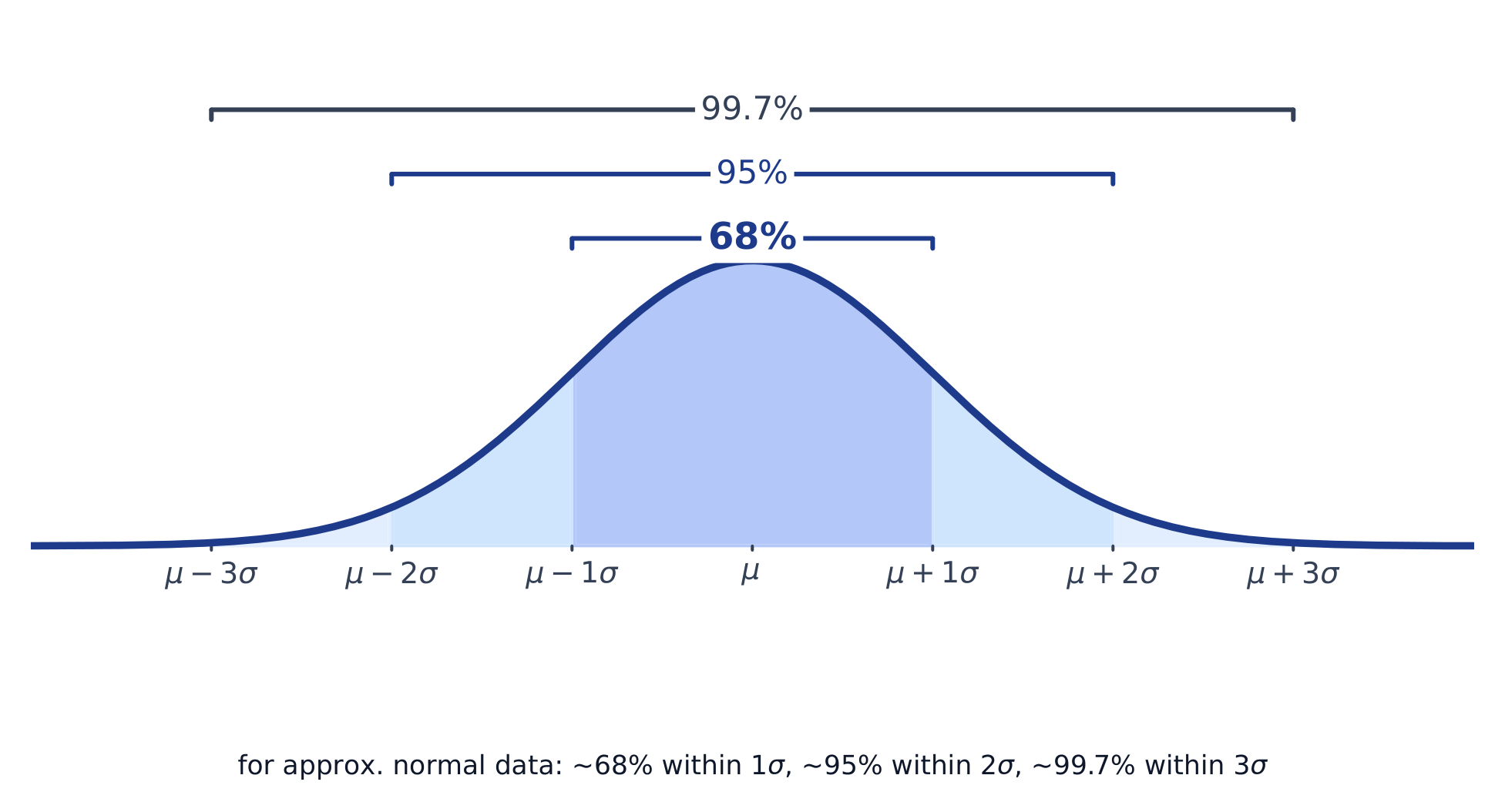
For approximately normal data about 68% lie within 1σ and 95% within 2σ and 99.7% within 3σ
The standard normal
- The standard normal 标准正态 distribution has mean $0$ and standard deviation $1$.
- If the original statistic is normally distributed, its standardized value follows this distribution. Standardizing a non-normal variable does not make it normal.
- Probabilities: area under the curve left/right of a $z$.
- Critical values: the $z$ that cuts off a chosen tail area (e.g. $z^* = 1.96$ for the middle $95\%$).
Why it matters for inference
- Inference asks: "how surprising is my sample, if a claim were true?"
- The normal model turns that into an area (a probability) under the bell.
- A statistic far out in the tail (large $|z|$) is surprising evidence.
- Normal models support many inference procedures; others use distributions such as Student’s t or chi-square, with their own conditions.
The $z$-score's denominator is the standard deviation of the sampling distribution, not the spread of one sample's raw data. Mixing these up is a classic slip. And remember the empirical rule benchmarks — about $68\%$ within $1$ SD, $95\%$ within $2$, $99.7\%$ within $3$ — for a quick sense of how extreme a $z$ is.
A statistic is normal with mean $50$ and SD $4$. You observe a value of $58$.
- $z = \dfrac{58 - 50}{4} = 2$ — two standard deviations above the mean.
- By the empirical rule, only about $2.5\%$ of values exceed $z = 2$.
- So a value of $58$ is fairly surprising under this model.
The normal distribution models many sampling distributions. A $z$-score $z = \frac{\text{stat} - \text{mean}}{\text{SD}}$ maps a value onto the standard normal (mean $0$, SD $1$), where probabilities are areas and critical values cut off tail areas. This normal machinery supports many methods of statistical inference, when their conditions hold.
Write from the data given
- A value is 62.
- The mean is 50 and the standard deviation is 4. The lesson z-score of 2 is another value.
A statistic has sampling-distribution mean 50 and standard deviation 4. Find the z-score of 62 and interpret its sign and magnitude.
Z counts standard deviations from the mean.
A statistic has sampling-distribution mean 50 and standard deviation 4. What is the z-score of 62?
难度 1/5 · 今日首次完成可获 100 金币及少量额外奖励
12 divided by 4 is 3. Other options — 2 (the other value); 12 (the raw gap).
The standard normal, shaded by z
Areas under the curve give probabilities; z marks the cutoff.
A statistic is normal with mean 50 and SD 4. Find the z-score of the value 58.
难度 2/5 · 今日首次完成可获 140 金币及少量额外奖励
z = (58 − 50)/4 = 2.
The standard normal distribution has...
难度 1/5 · 今日首次完成可获 100 金币及少量额外奖励
By definition, mean 0 and SD 1.
The critical value z* for the middle 95% of the standard normal is about... (two decimals)
难度 2/5 · 今日首次完成可获 140 金币及少量额外奖励
z* = 1.96 leaves 2.5% in each tail.
The z-score for a sample statistic uses the standard deviation of its sampling distribution.
难度 1/5 · 今日首次完成可获 100 金币及少量额外奖励
Not the spread of one sample's raw data — the sampling distribution's SD.
Under a normal model, a statistic with a large |z| is...
难度 1/5 · 今日首次完成可获 100 金币及少量额外奖励
Large |z| = far from center = surprising evidence.