| English | 释义 | 拼音 |
|---|---|---|
| treatments/ˈtriːtmənts/ | 处理 | chǔ lǐ |
| experimental units/ekˌsperɪˈmentl ˈjuːnɪts/ | 实验单元 | shí yàn dān yuán |
| placebo/pləˈsiːbəʊ/ | 安慰剂 | ān wèi jì |
| factor/ˈfæktə/ | 因子 | yīn zi |
| control/kənˈtrəʊl/ | 控制 | kòng zhì |
| randomization/ˌrændəmaɪˈzeɪʃn/ | 随机化 | suí jī huà |
| replication/ˌreplɪˈkeɪʃn/ | 重复 | chóng fù |
| control group/kənˈtrəʊl ɡruːp/ | 对照组 | duì zhào zǔ |
| blinding/ˈblaɪndɪŋ/ | 盲法 | máng fǎ |
The parts of an experiment
- An experiment imposes treatments on units and measures the result.
- Experimental units 实验单元: who or what receives a treatment (people = subjects).
- Treatments 处理: the specific conditions being compared (drug vs. placebo).
- The factor 因子 is the explanatory variable you control; the response is what you measure.
Control, randomize, replicate
- Control 控制: keep other conditions the same so only the treatment differs.
- Randomization 随机化: assign units to treatments by chance — it tends to balance both known and unknown differences, without guaranteeing identical groups.
- Replication 重复: use enough units (and repeat) so results aren't a fluke.
- These three principles are the backbone of every good experiment.
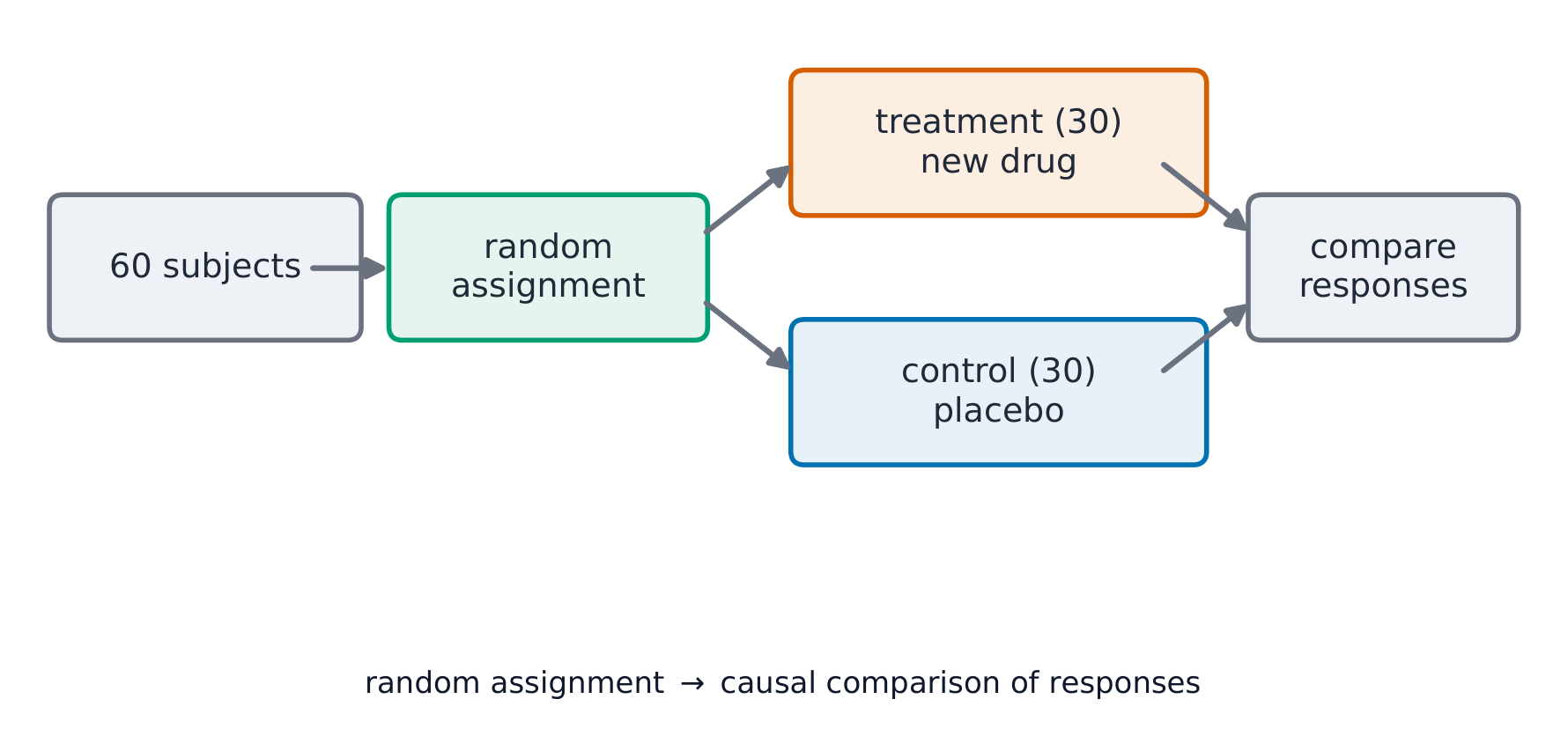
Random assignment to treatment and control lets us compare responses causally
Control group and placebo
- A control group 对照组 provides a baseline: it may receive a placebo, no treatment, or an established active treatment.
- A placebo 安慰剂 is a fake treatment (sugar pill) that looks real.
- It separates the treatment's true effect from the placebo effect (improving just from believing).
- Comparing treatment vs. placebo isolates what the treatment actually did.
Blinding
- Blinding 盲法 hides treatment identity to reduce differences caused by expectations. It does not prevent placebo responses; a placebo group helps account for them.
- Single-blind: one relevant group, such as the subjects or response assessors, does not know treatment identities; say who is blinded.
- Double-blind: neither subjects nor the people measuring them know — the strongest guard.
- Blinding keeps hopes and hunches from leaking into the data.
Keep the three principles distinct. Control holds relevant conditions comparable; randomization tends to balance known and unknown differences; replication uses enough units to estimate effects more precisely. None guarantees that an observed difference is beyond chance. Randomization is what makes a cause-and-effect conclusion possible — control and replication alone, without it, are not enough.
Testing a new headache drug.
- Units/subjects: the patients. Treatments: new drug vs. placebo.
- Control group: patients on the placebo. Response: hours until pain relief.
- Double-blind: neither patients nor nurses know who got the real drug → less risk of expectation bias in measurement.
An experiment has experimental units, treatments, a factor (explanatory) and a response. Good design uses control, randomization, and replication; a control group (often on a placebo) is the baseline, and blinding (single- or double-blind) stops expectations from biasing results.
Write from this case
- One group receives a new pain treatment.
- Another group receives a lookalike treatment with no active ingredient. Treatments are assigned at random.
An experiment randomly assigns a new pain treatment or a lookalike with no active ingredient. What role does the lookalike group play, and does blinding remove placebo responses?
A placebo control shows what happens without the active treatment.
What does the lookalike group receive?
难度 1/5 · 今日首次完成可获 100 金币及少量额外奖励
The lookalike is the control.
Splitting units into treatment and control
Randomly assign units to each treatment (and a control).
Match each principle to what it does.
难度 2/5 · 今日首次完成可获 140 金币及少量额外奖励
Control holds conditions comparable; randomization tends to balance group differences; replication improves precision. Randomization and replication do not guarantee a real effect.
A fake treatment (like a sugar pill) that looks real is a...
难度 1/5 · 今日首次完成可获 100 金币及少量额外奖励
A placebo controls for the placebo effect.
Neither the subjects nor the people measuring them know who got the real treatment. This is...
难度 1/5 · 今日首次完成可获 100 金币及少量额外奖励
Both sides blinded = double-blind.
The group that receives no active treatment, used as a baseline, is the ___ group.
难度 1/5 · 今日首次完成可获 100 金币及少量额外奖励
The control group is the comparison baseline.
Randomly assigning units to treatments is what allows a cause-and-effect conclusion.
难度 1/5 · 今日首次完成可获 100 金币及少量额外奖励
Random assignment balances confounders, enabling causal claims.