Vectors · 向量
| English | 中文 | Pinyin · 拼音 |
|---|---|---|
| vector/ˈvektə/ | 向量 | xiàng liàng |
| magnitude/ˈmæɡnɪtjuːd/ | 大小 | dà xiǎo |
| scalar/ˈskeɪlə/ | 标量 | biāo liàng |
| component form/kəmˈpəʊnənt fɔːm/ | 分量形式 | fèn liàng xíng shì |
Size and direction together
- "Drive $5$ km" is incomplete — you need to know which way.
- Many quantities are like this: velocity, force, displacement all carry a direction.
- A single number cannot capture both how much and which way.
- We need a new object — the vector — drawn as an arrow.
大小与方向合一
- "开 $5$ 公里"是不完整的——你还得知道朝哪个方向。
- 许多量都是这样:速度、力、位移都携带一个方向。
- 单个数无法同时刻画"多少"和"哪个方向"。
- 我们需要一个新对象——向量——画成一个箭头。
What a vector is
- A vector 向量 has two pieces of information: a magnitude 大小 (length) and a direction.
- It is drawn as an arrow: the length is the magnitude, the way it points is the direction.
- Contrast a scalar 标量 — a plain number with size only, like temperature or mass.
- Velocity is a vector; speed (just the number) is a scalar.
什么是向量
- 向量(vector)有两条信息:一个大小(magnitude)(长度)和一个方向。
- 它画成一个箭头:长度是大小,它指的方向是方向。
- 对比标量(scalar)——一个只有大小的普通数,比如温度或质量。
- 速度是向量;速率(只是那个数)是标量。
A vector is a quantity with… · 向量是一个具有……的量。
A vector carries both size and direction, unlike a scalar (a plain number with size only). · 向量同时携带大小和方向,不像标量(scalar)(一个只有大小的普通数)。
Component form
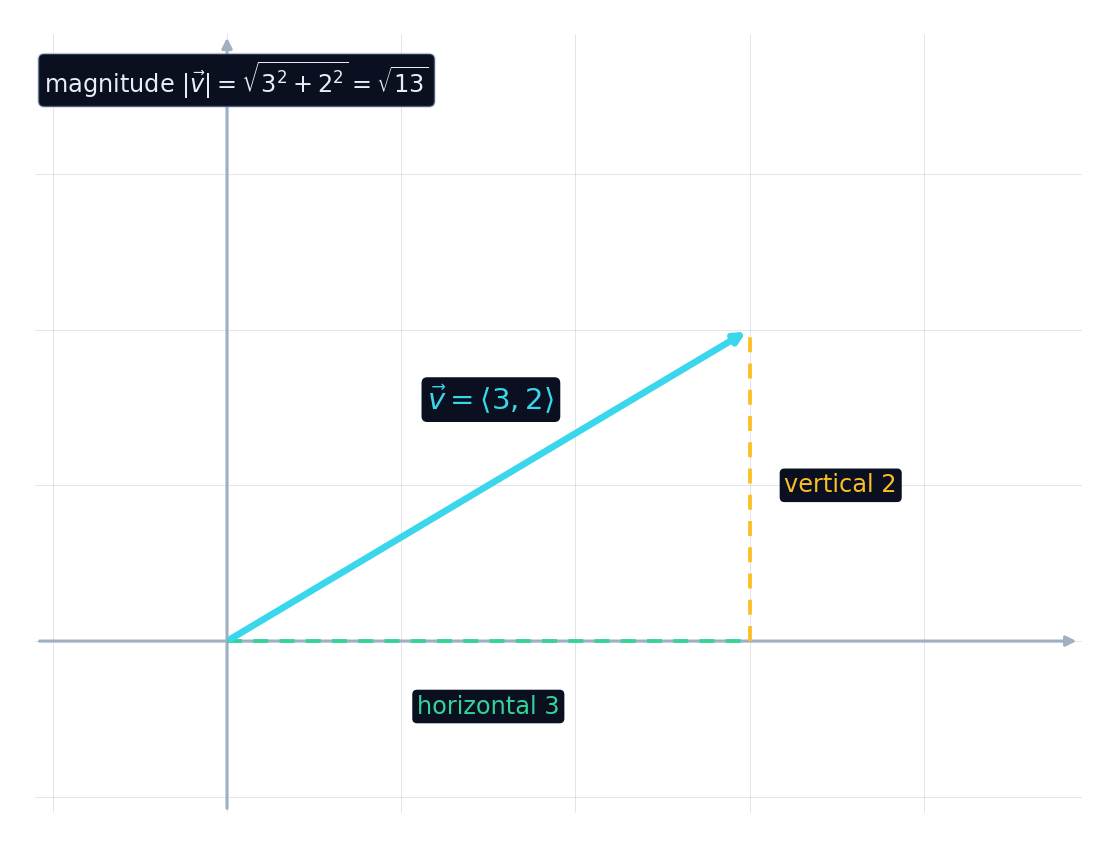
- Break a vector into how far it goes across and up: its component form 分量形式.
- $\langle 3, 2\rangle$ means $3$ to the right and $2$ up.
- The horizontal and vertical components are like the legs of a right triangle.
- Adding vectors is as easy as adding their components separately.
分量形式
- 把一个向量拆成横向走多远、纵向走多远:它的分量形式(component form)。
- $\langle 3, 2\rangle$ 意味着向右 $3$、向上 $2$。
- 水平和竖直分量就像一个直角三角形的两条直角边。
- 把向量相加,就像把它们的分量分别相加一样容易。
Add two vectors tip to tail · 首尾相接地把两个向量相加
Drag the two vectors and watch their sum. A vector has both a direction and a magnitude, unlike a plain number. · 拖动两个向量,看它们的和。向量既有方向又有大小,不像一个普通的数。
The component form $\langle 3, 2\rangle$ means the vector goes… · 分量形式 $\langle 3, 2\rangle$ 意味着向量……
Component form lists the horizontal change then the vertical change: $\langle 3, 2\rangle$ is 3 right, 2 up. · 分量形式先列水平变化,再列竖直变化:$\langle 3, 2\rangle$ 是向右 3、向上 2。
What is the magnitude of the vector $\langle 3, 4\rangle$? · 向量 $\langle 3, 4\rangle$ 的大小是多少?
Magnitude · 模长 $= \sqrt{3^2 + 4^2} = \sqrt{25} = 5$ — the length of the arrow, by the Pythagorean theorem. · 大小 $= \sqrt{3^2 + 4^2} = \sqrt{25} = 5$——箭头的长度,由勾股定理得出。
Select all · 所有 true statements about vectors. · 选出关于向量的所有正确说法。
A single number is a scalar, not a vector. The other three are correct. · 单个数是标量,不是向量。其余三条正确。
Finding the magnitude
- The magnitude is the arrow's length, found by the Pythagorean theorem.
- For $\langle a, b\rangle$, the magnitude is $\sqrt{a^2 + b^2}$.
- So $\langle 3, 4\rangle$ has magnitude $\sqrt{9 + 16} = 5$.
- The components are the legs; the magnitude is the hypotenuse.
求大小
- 大小是箭头的长度,由勾股定理求出。
- 对 $\langle a, b\rangle$,大小是 $\sqrt{a^2 + b^2}$。
- 所以 $\langle 3, 4\rangle$ 的大小是 $\sqrt{9 + 16} = 5$。
- 分量是直角边;大小是斜边。
Multiplying a vector by the scalar $2$ doubles its length but keeps its direction. · 把一个向量乘以标量 $2$,会使它的长度翻倍,但方向不变。
A positive scalar scales the magnitude and leaves the direction unchanged; a negative one also reverses it. · 一个正的标量缩放大小、方向不变;负的标量还会把方向反转。
Scaling and adding
- Multiply a vector by a scalar to stretch or shrink it: $2\langle 3, 2\rangle = \langle 6, 4\rangle$.
- A negative scalar also flips its direction.
- Add two vectors by adding components, or geometrically tip-to-tail.
- These operations let vectors model combined forces and motions.
缩放与相加
- 把一个向量乘以标量来拉长或缩短:$2\langle 3, 2\rangle = \langle 6, 4\rangle$。
- 负的标量还会把它的方向翻转。
- 把两个向量相加,可以分量相加,或几何上首尾相接。
- 这些运算让向量能给合成的力和运动建模。
Do not confuse a vector's magnitude with its components. The vector $\langle 3, 4\rangle$ has components $3$ and $4$, but magnitude $5$ — not $7$. The length is the hypotenuse, never the sum of the parts.
不要把向量的大小与它的分量搞混。向量 $\langle 3, 4\rangle$ 的分量是 $3$ 和 $4$,但大小是 $5$——不是 $7$。长度是斜边,绝不是各部分之和。
A boat heads $\langle 6, 8\rangle$ (km east, km north). How far has it travelled?
- The distance is the magnitude: $\sqrt{6^2 + 8^2} = \sqrt{36 + 64} = \sqrt{100} = 10$ km.
- Its direction is up-and-to-the-right, steeper than $45°$ (more north than east).
- Doubling the vector to $\langle 12, 16\rangle$ would double the distance to $20$ km.
一艘船朝 $\langle 6, 8\rangle$(东公里,北公里)航行。它走了多远?
- 距离是大小:$\sqrt{6^2 + 8^2} = \sqrt{36 + 64} = \sqrt{100} = 10$ 公里。
- 它的方向是向上偏右,比 $45°$ 更陡(北多于东)。
- 把向量翻倍到 $\langle 12, 16\rangle$,距离就翻倍到 $20$ 公里。
A vector carries both magnitude and direction, drawn as an arrow — unlike a scalar (a plain number). Its component form $\langle a, b\rangle$ lists horizontal and vertical parts, and its magnitude is $\sqrt{a^2 + b^2}$. Scale by multiplying, add by combining components.
向量同时携带大小和方向,画成一个箭头——不像标量(一个普通数)。它的分量形式 $\langle a, b\rangle$ 列出水平和竖直部分,大小是 $\sqrt{a^2 + b^2}$。相乘来缩放,合并分量来相加。