Vector-Valued Functions · 向量值函数
| English | 中文 | Pinyin · 拼音 |
|---|---|---|
| vector-valued function/ˈvektə ˈvæljuːd ˈfʌŋkʃn/ | 向量值函数 | xiàng liàng zhí hán shù |
| vector/ˈvektə/ | 向量 | xiàng liàng |
| parameter/pəˈræmɪtə/ | 参数 | cān shù |
A function that outputs an arrow
- Ordinary functions output a number; parametric ones output a pair of coordinates.
- A vector-valued function packages that pair into a single vector.
- Think of it as an arrow from the origin whose tip moves as time passes.
- It is the natural language for describing position, velocity, and motion in the plane.
一个输出箭头的函数
- 普通函数输出一个数;参数方程输出一对坐标。
- 向量值函数把那一对打包成一个向量。
- 把它想成一个从原点出发的箭头,它的尖端随时间移动。
- 它是描述平面上位置、速度和运动的自然语言。
What it outputs
- A vector-valued function 向量值函数 $\vec{r}(t)$ returns a vector 向量 for each input $t$.
- Usually that vector is a position: $\vec{r}(t) = \langle x(t), y(t)\rangle$.
- The parameter 参数 $t$ (often time) drives the arrow to a new spot.
- So one input gives one arrow, pointing from the origin to the current location.
它输出什么
- 向量值函数(vector-valued function)$\vec{r}(t)$ 为每个输入 $t$ 返回一个向量(vector)。
- 通常那个向量是位置:$\vec{r}(t) = \langle x(t), y(t)\rangle$。
- 参数(parameter)$t$(常常是时间)把箭头驱动到新的位置。
- 所以一个输入给出一个箭头,从原点指向当前的位置。
A vector-valued function $\vec{r}(t)$ outputs, for each $t$, a… · 一个向量值函数$\vec{r}(t)$为每个$t$输出一个……
A vector-valued function returns a vector for each input — often the position $\langle x(t), y(t)\rangle$. · 一个向量值函数为每个输入返回一个向量——通常是位置$\langle x(t), y(t)\rangle$。
The tip traces the path
- Hold the tail at the origin and let $t$ increase.
- The arrow's tip moves, and the trail it leaves is the curve.
- That curve is exactly the parametric path from earlier lessons.
- So a vector-valued function and a parametric function are two views of one idea.
尖端描出路径
- 把尾巴固定在原点,让 $t$ 增大。
- 箭头的尖端移动,它留下的轨迹就是曲线。
- 那条曲线正是前几课里的参数路径。
- 所以向量值函数和参数方程函数是同一个想法的两种视角。
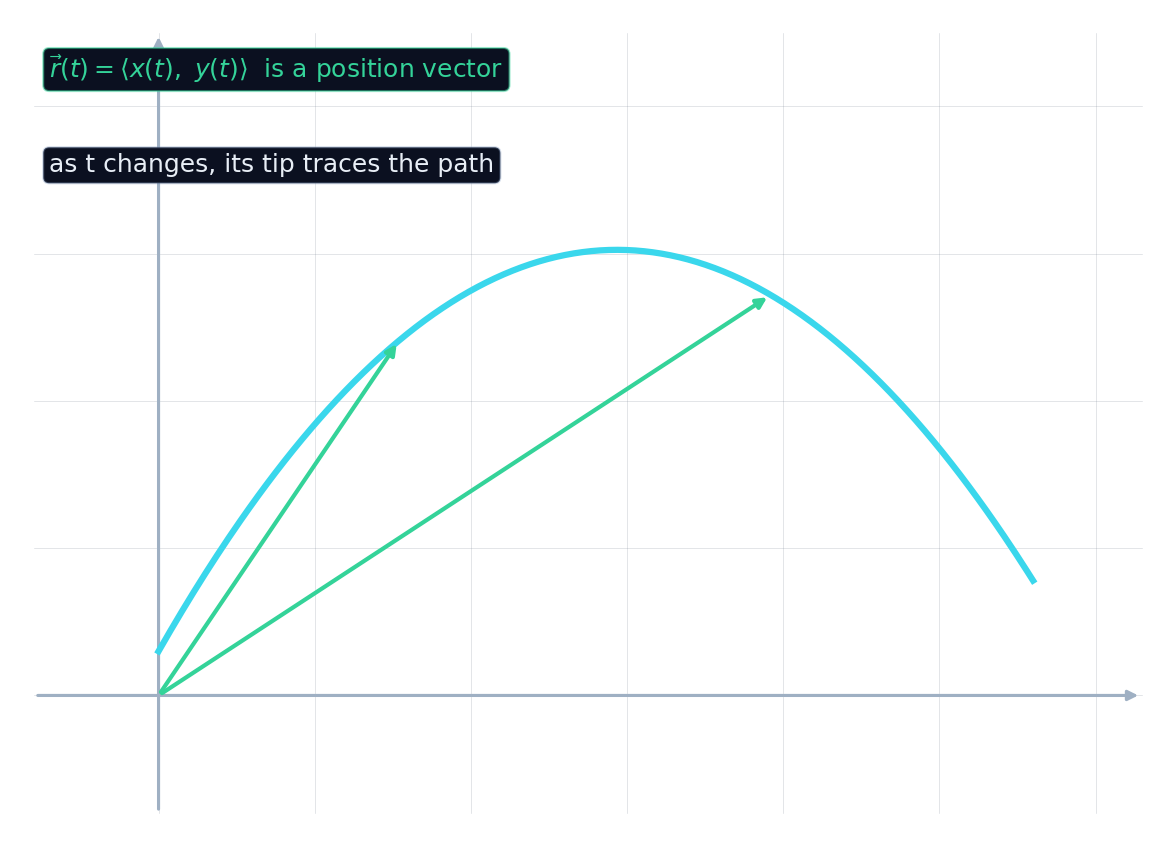
A vector-valued function $\vec{r}(t) = \langle x(t), y(t)\rangle$ is closely related to a parametric function. · 向量值函数$\vec{r}(t) = \langle x(t), y(t)\rangle$与参数函数密切相关。
They are two views of the same idea: the components $x(t), y(t)$ are exactly the parametric equations. · 它们是同一概念的两个视角:分量$x(t), y(t)$正是参数方程。
As the parameter $t$ changes, the ____ of the position vector traces the curve. · 随着参数$t$的变化,位置矢量的____描绘出曲线。
The vector starts at the origin; its arrow tip · 尖端 marks the current point on the path. · 矢量从原点开始;其箭头尖端标记路径上的当前点。
For · 支持 $\vec{r}(t) = \langle 2t,\ t^2\rangle$, what is the $y$-component at $t = 3$? · 对于 $\vec{r}(t) = \langle 2t,\ t^2\rangle$,什么是 $y$-分量在 $t = 3$?
The $y$-component is $t^2 = 3^2 = 9$; the $x$-component is $2t = 6$, so $\vec{r}(3) = \langle 6, 9\rangle$. · $y$-分量是$t^2 = 3^2 = 9$;$x$-分量是$2t = 6$,所以$\vec{r}(3) = \langle 6, 9\rangle$。
Select all · 所有 true statements about vector-valued functions. · 选择关于向量值函数的所有正确陈述。
They output a vector, not a single number. The other three are correct. · 它们输出一个向量,而不是单个数字。其他三项是正确的。
Evaluating and combining
- Evaluate $\vec{r}(t)$ by plugging $t$ into each component.
- $\vec{r}(3) = \langle 2\cdot 3,\ 3^2\rangle = \langle 6, 9\rangle$ for $\vec{r}(t) = \langle 2t, t^2\rangle$.
- The rate of change of $\vec{r}(t)$ is the velocity vector — components $\langle x'(t), y'(t)\rangle$.
- Add two vector-valued functions by adding their components.
求值与组合
- 把 $t$ 代入每个分量,来求 $\vec{r}(t)$ 的值。
- 对 $\vec{r}(t) = \langle 2t, t^2\rangle$,$\vec{r}(3) = \langle 2\cdot 3,\ 3^2\rangle = \langle 6, 9\rangle$。
- $\vec{r}(t)$ 的变化率是速度向量——分量为 $\langle x'(t), y'(t)\rangle$。
- 把两个向量值函数相加,就把它们的分量相加。
Vector-valued functions · 向量值函数
A vector-valued function outputs a vector; add the component vectors to get the resultant. · 向量值函数输出向量;将分量向量相加即可得到合向量。
Why the vector view helps
- Writing motion as one vector keeps position, velocity, and direction together.
- It generalises cleanly to three dimensions, where you add a $z(t)$ component.
- Physics and computer graphics describe moving objects exactly this way.
- The single-arrow picture makes combined motions easy to reason about.
向量视角为什么有帮助
- 把运动写成一个向量,能把位置、速度和方向放在一起。
- 它能干净地推广到三维,只需加上一个 $z(t)$ 分量。
- 物理和计算机图形学正是这样描述运动物体的。
- 单箭头的图,让组合的运动容易推理。
A vector-valued function outputs a vector, not a number. Do not treat $\vec{r}(t) = \langle x(t), y(t)\rangle$ as a single value — it always carries two components (a direction and a size), and both change with $t$.
向量值函数输出一个向量,而不是一个数。不要把 $\vec{r}(t) = \langle x(t), y(t)\rangle$ 当作单个值——它总是携带两个分量(一个方向和一个大小),而且两者都随 $t$ 变化。
A particle moves as $\vec{r}(t) = \langle t,\ t^2\rangle$.
- At $t = 0$: $\vec{r} = \langle 0, 0\rangle$ — it starts at the origin.
- At $t = 2$: $\vec{r} = \langle 2, 4\rangle$ — up and to the right.
- Its tip traces the parabola $y = x^2$ as $t$ increases.
一个粒子按 $\vec{r}(t) = \langle t,\ t^2\rangle$ 运动。
- 在 $t = 0$:$\vec{r} = \langle 0, 0\rangle$——它从原点出发。
- 在 $t = 2$:$\vec{r} = \langle 2, 4\rangle$——向上偏右。
- 当 $t$ 增大,它的尖端描出抛物线 $y = x^2$。
A vector-valued function $\vec{r}(t)$ outputs a vector for each parameter value — usually the position $\langle x(t), y(t)\rangle$. Its tip traces a path as $t$ changes, so it is the vector view of a parametric function. Evaluate it component by component.
向量值函数 $\vec{r}(t)$ 为每个参数值输出一个向量——通常是位置 $\langle x(t), y(t)\rangle$。当 $t$ 变化时它的尖端描出路径,所以它是参数方程函数的向量视角。逐个分量地求它的值。