| English | 释义 | 拼音 |
|---|---|---|
| function model/ˈfʌŋkʃn ˈmɒdl/ | 函数模型 | hán shù mó xíng |
| regression/rɪˈɡreʃn/ | 回归 | huí guī |
| interpolation/ɪnˌtɜːpəˈleɪʃn/ | 内插 | nèi chā |
| extrapolation/ekˈstræpəleɪʃn/ | 外推 | wài tuī |
| parameters/pəˈræmɪtəz/ | 参数 | cān shù |
From data to a formula
- Selecting a model family is only half the job; now you build the actual rule.
- A good model turns a table of measurements into a formula you can compute with.
- Once you have the formula, you can predict values you never measured.
- This is how precalculus becomes a tool for the real world.
Build the model
- A function model 函数模型 is a rule that captures how one quantity depends on another.
- You can build it from a verbal description, a table of values, or a graph.
- "Costs $\$5$ to start plus $\$2$ per item" becomes $C = 5 + 2n$ straight away.
- Match the family to the shape (Lesson 1.13), then pin down the exact numbers.
Regression finds the best fit
- With many scattered points, regression 回归 finds the best-fit line or curve using technology.
- It chooses the model that comes closest to all the data at once.
- The result gives you the numbers in the model rule, ready to use.
- No single point sits on it perfectly — it captures the overall trend.
一条模型直线——读出它的速率和起始值
y = ax + b
这里 a 是变化率,b 是起始值。调整它们来拟合数据,再代入一个输入来做预测。
回归能找到……
难度 1/5 · 今日首次完成可获 100 金币及少量额外奖励
回归拟合出一个最接近所有点的模型——用技术求得的最佳拟合模型。
Interpolate versus extrapolate
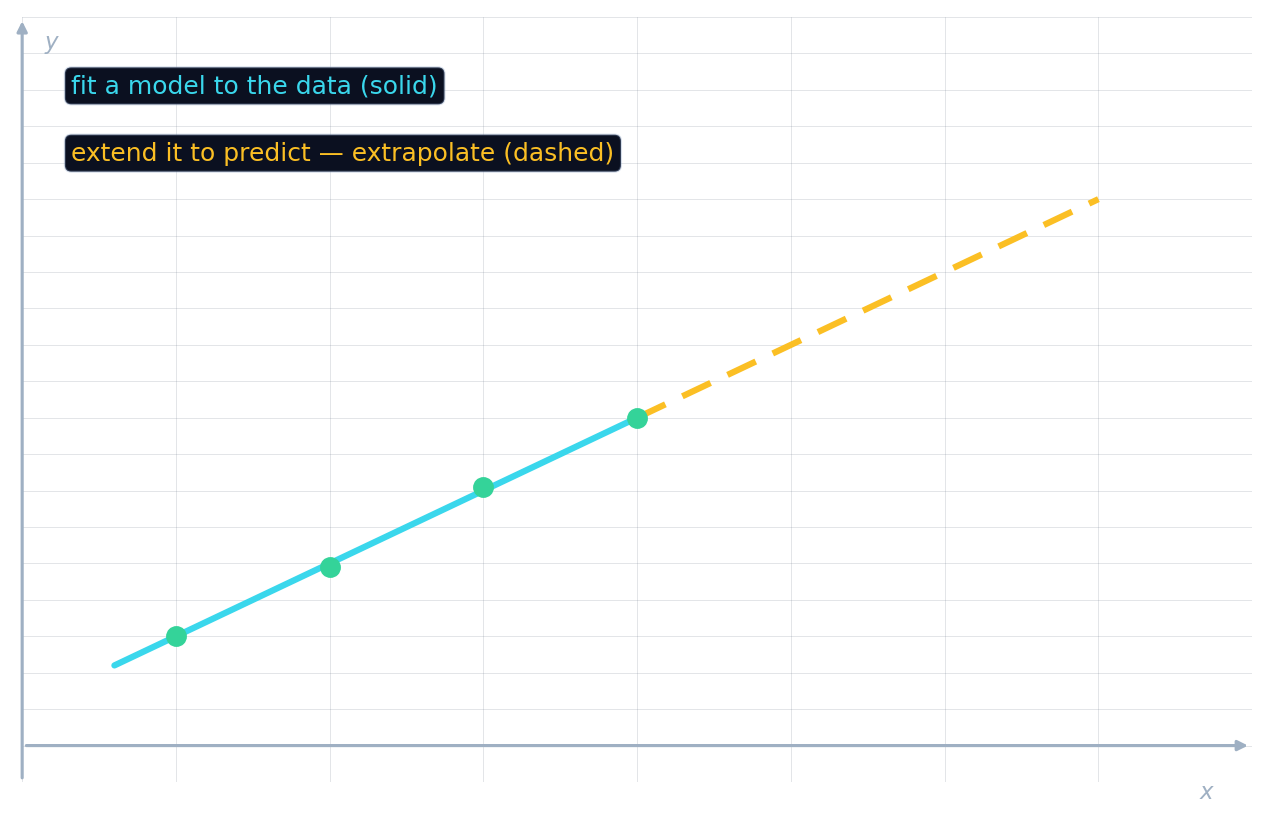
- Interpolation 内插 predicts between known data points — usually safe.
- Extrapolation 外推 predicts beyond the data — riskier the further you go.
- A model with no data to lean on can drift far from reality.
- Trust interpolation more than extrapolation, and say which one you used.
预测已知数据点之间的值,叫做____。
难度 1/5 · 今日首次完成可获 100 金币及少量额外奖励
内插留在数据范围之内,所以通常是可靠的。
预测数据范围之外很远处(外推)通常是……
难度 1/5 · 今日首次完成可获 100 金币及少量额外奖励
在远离数据处,模型没有证据可依靠,所以外推是风险最大的预测。
Interpret the parameters
- The parameters 参数 (the numbers in the rule) carry real-world meaning.
- In $C = 5 + 2n$, the $5$ is the fixed start-up cost and the $2$ is the cost per item.
- Reading parameters in context turns a formula back into a story about the situation.
- A good answer always says what each number means, with its units.
一个模型给出 成本 $= 2x + 1$(单位:千)。预测 $x = 10$ 时的成本。
难度 2/5 · 今日首次完成可获 140 金币及少量额外奖励
代入:$2(10) + 1 = 21$ 千。把一个输入代入模型,就是应用它的方式。
模型的参数(比如斜率)可以用真实情境来解释。
难度 1/5 · 今日首次完成可获 100 金币及少量额外奖励
在 成本 $= 2x + 1$ 中,$2$ 是每单位的成本,$1$ 是固定的启动成本——都有真实含义。
把使用一个模型的步骤按顺序排列。
难度 3/5 · 今日首次完成可获 200 金币及少量额外奖励
数据 → 拟合 → 预测 → 检查。最后的检查能发现偏离现实的模型。
Extrapolating too far is a classic trap. A linear sales model may predict billions of sales in twenty years — clearly nonsense. Always sanity-check a prediction against the real situation before trusting it.
A phone battery drops from $100\%$ by about $8\%$ per hour.
- Model: $B = 100 - 8h$, a linear function model.
- Interpolate at $h = 3$: $B = 100 - 24 = 76\%$ — inside the data, reliable.
- Extrapolate at $h = 20$: $B = -60\%$ — impossible, so the model has broken down.
Build a function model from words, a table, or a graph, using regression for the best fit. Use it to interpolate (safe, inside the data) or extrapolate (risky, beyond it), interpret its parameters in context, and always check the prediction makes real-world sense.
Write from the data: find the cost
- Cost in thousands is 3x plus 4.
- Predict the cost when x equals 6.
某模型给出的成本等于3x加4(单位:千)。当x等于6时,它预测的结果是多少?
18 加 4 等于 22。
该模型预测的成本是多少?
难度 1/5 · 今日首次完成可获 100 金币及少量额外奖励
3乘以6加上4等于22。其他选项——21(课程预测);6(输入值)。