| English | 释义 | 拼音 |
|---|---|---|
| input/ˈɪnpʊt/ | 输入 | shū rù |
| output/ˈaʊtpʊt/ | 输出 | shū chū |
| increasing/ɪnˈkriːsɪŋ/ | 递增 | dì zēng |
| decreasing/ˈdiːkriːsɪŋ/ | 递减 | dì jiǎn |
| constant/ˈkɒnstənt/ | 常数 | cháng shù |
| interval/ˈɪntəvl/ | 区间 | qū jiān |
| concavity/kənˈkævɪti/ | 凹凸性 | āo tū xìng |
| rate of change/reɪt ɒv tʃeɪndʒ/ | 变化率 | biàn huà lǜ |
| concave up/kɒnˈkeɪv ʌp/ | 凹 | āo |
| concave down/kɒnˈkeɪv daʊn/ | 凸 | tū |
| turning point/ˈtɜːnɪŋ pɔɪnt/ | 转折点 | zhuǎn zhé diǎn |
| local maximum/ˈləʊkl ˈmæksɪməm/ | 极大值 | jí dà zhí |
| local minimum/ˈləʊkl ˈmɪnɪməm/ | 极小值 | jí xiǎo zhí |
Watch the water climb
- Pour water into a glass at a steady rate and watch the level rise.
- In a straight glass the level climbs steadily; in a curvy vase it speeds up and slows down.
- Two quantities — the water poured and the height — change together, in tandem.
- Precalculus starts by describing exactly how one quantity changes as another one does.
A function links an input to an output
- A function takes an input 输入 (a value of $x$) and returns exactly one output 输出 (written $f(x)$).
- As the input changes, the output changes with it — that is change in tandem.
- We write $f(2)$ to mean "the output when the input is $2$".
- So the whole story of a function is one question: as $x$ moves, where does $f(x)$ go?
Increasing, decreasing, or constant
- Pick an interval 区间 — a stretch of the input axis — and follow the output from left to right.
- The function is increasing 递增 where the output rises as the input moves right.
- It is decreasing 递减 where the output falls as the input moves right.
- It is constant 常数 where the output stays level.
- You can read this straight off a graph: uphill is increasing, downhill is decreasing.
一个函数在某区间上递增,是指……
难度 1/5 · 今日首次完成可获 100 金币及少量额外奖励
递增讲的是方向,不是大小:沿输入向右移动,输出随之上升。即使输出仍是负数,函数也可以是递增的。
如果图像在某区间上是完全水平的,那么函数在那里是恒定的。
难度 1/5 · 今日首次完成可获 100 金币及少量额外奖励
水平的图像意味着输出不随输入改变——这正是恒定的含义。
Concavity: is the change speeding up or slowing down?
- Even while a curve keeps increasing, its rate of change 变化率 (how fast the output moves) can itself change.
- Concavity 凹凸性 describes which way the curve bends.
- Concave up 凹 — the curve bends upward like a cup, so the rate of change is increasing.
- Concave down 凸 — the curve bends downward like a dome, so the rate of change is decreasing.
- The curvy vase again: where it narrows, the height climbs faster and faster (concave up).
说一条曲线是凹的,告诉你的是……
难度 1/5 · 今日首次完成可获 100 金币及少量额外奖励
凹的形状像一个杯子:变化率本身在上升。曲线在下降时也可以是凹的——想象滑梯在底部逐渐变平。
Turning points: local maxima and minima
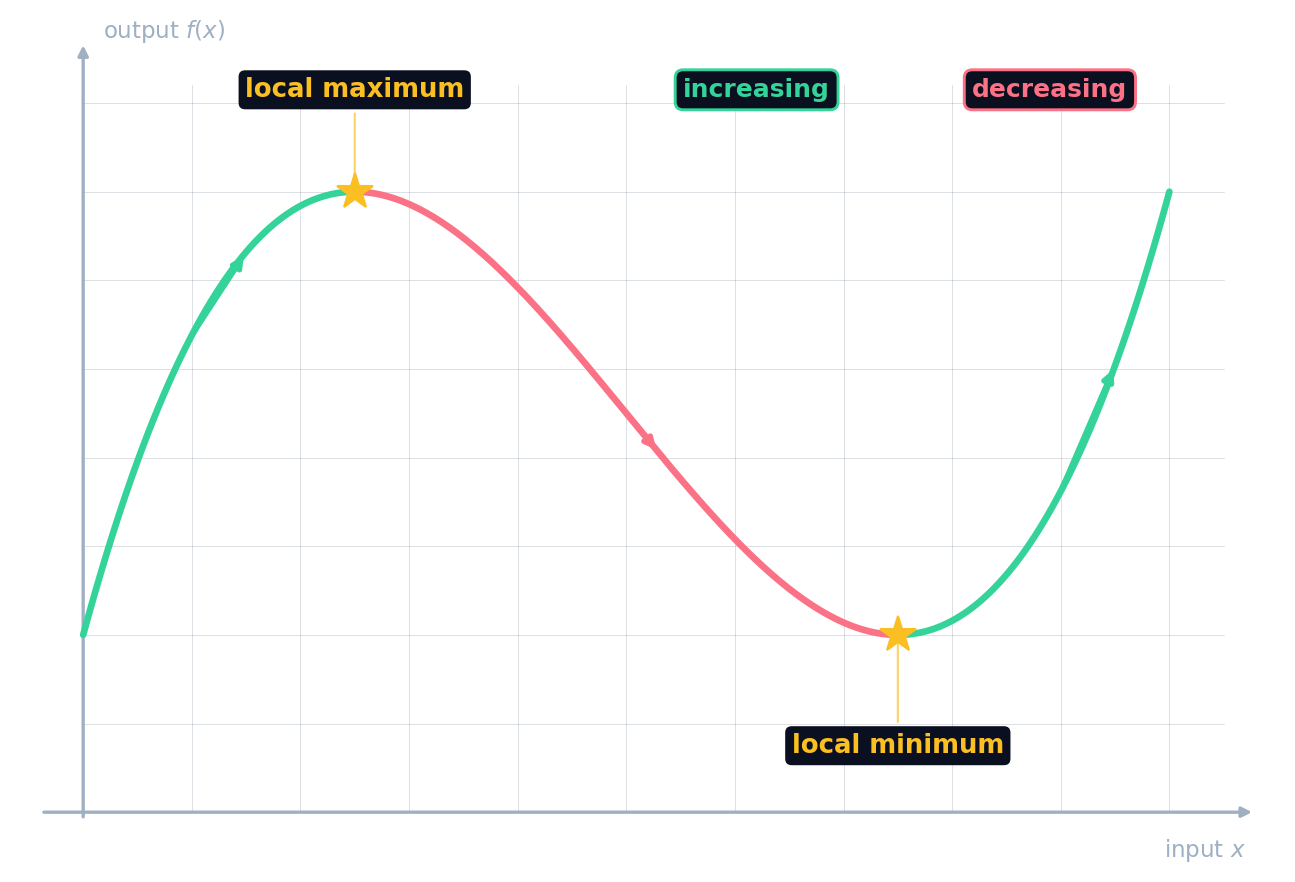
- Where a curve stops increasing and starts decreasing, it reaches a local maximum 极大值 — a peak.
- Where it stops decreasing and starts increasing, it reaches a local minimum 极小值 — a valley.
- Each such peak or valley is a turning point 转折点.
- "Local" means highest or lowest nearby — not necessarily over the whole graph.
切线的斜率就是变化率
f(x) = x³ − 3x
拖动这个点,读出切线的斜率——曲线上升处为正,下降处为负,在转折点处为零。
图像从递增转为递减的那个点,是一个局部____。
难度 1/5 · 今日首次完成可获 100 金币及少量额外奖励
在极大值处,曲线从上坡转为下坡——一个与附近各点相比最高的山峰。
看图中的曲线。选出所有正确的说法。
难度 2/5 · 今日首次完成可获 140 金币及少量额外奖励
曲线先上升,在山峰处转弯,下降到谷底,然后再次上升。它并非处处都凹——在山峰附近向下弯,在谷底附近向上弯。
"Increasing" and "concave up" are different ideas. Increasing is about the output going up; concave up is about the rate of change going up. A curve can be decreasing and concave up at the same time — falling, but flattening out as it falls.
Comparing two outputs
- To compare a function at two inputs $a$ and $b$, compare their outputs $f(a)$ and $f(b)$.
- If $b > a$ and $f(b) > f(a)$, the output grew as the input grew.
- The net change in output from $a$ to $b$ is simply $f(b) - f(a)$.
- If the function returns to the same value, the net change is zero — even if it rose and fell along the way.
某函数满足 $f(2) = 5$ 且 $f(6) = 5$。从 $x = 2$ 到 $x = 6$,输出的净变化是多少?
难度 2/5 · 今日首次完成可获 140 金币及少量额外奖励
净变化 $= f(6) - f(2) = 5 - 5 = 0$。输出回到了起点——尽管中间可能有升有降。
将每个术语与其描述的内容匹配。
难度 2/5 · 今日首次完成可获 140 金币及少量额外奖励
递增/递减描述输出的方向;凹凸性描述变化率本身如何变化;极大值是方向翻转的地方。
A cup of tea cools from 90°C to room temperature.
- Temperature (output) is decreasing the whole time — it never goes back up.
- But it falls fast at first, then slowly: the curve is concave up.
- There is no local maximum or minimum in between — the direction never flips.
A function's behaviour is read from its graph: it is increasing or decreasing on intervals, its concavity tells you whether the rate of change is speeding up or slowing down, and its turning points are the local maxima and minima where the direction flips.
Write from the data: find the change
- f of 1 is 4 and f of 5 is 12.
- Find the change in output.
一个函数满足 f(1) = 4 且 f(5) = 12。输出量的变化是多少?
12 减去 4 等于 8。
输出量的变化是多少?
难度 1/5 · 今日首次完成可获 100 金币及少量额外奖励
输出量相差 8。其他选项 — 0(课程中的变化);2(变化量除以输入量间隔)。